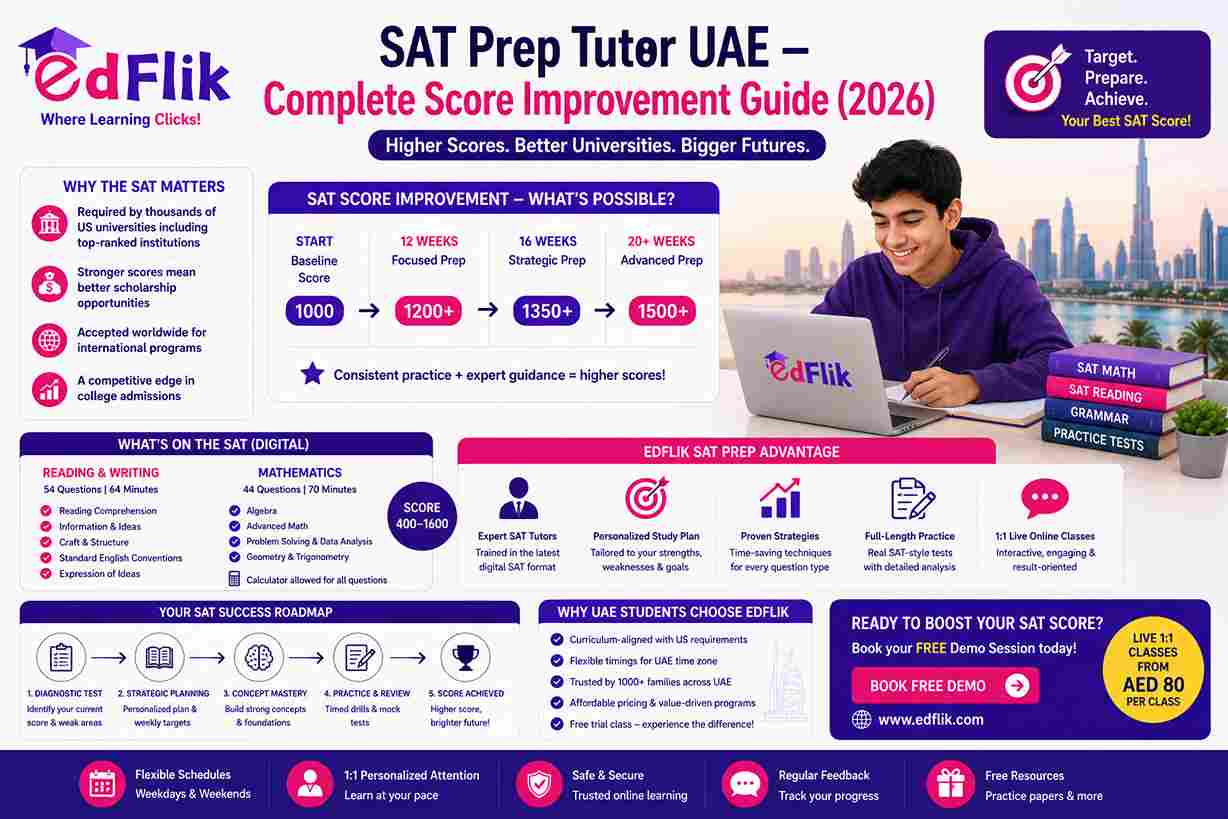
Digital SAT UAE 2026 — Complete Adaptive Format and Prep Guide
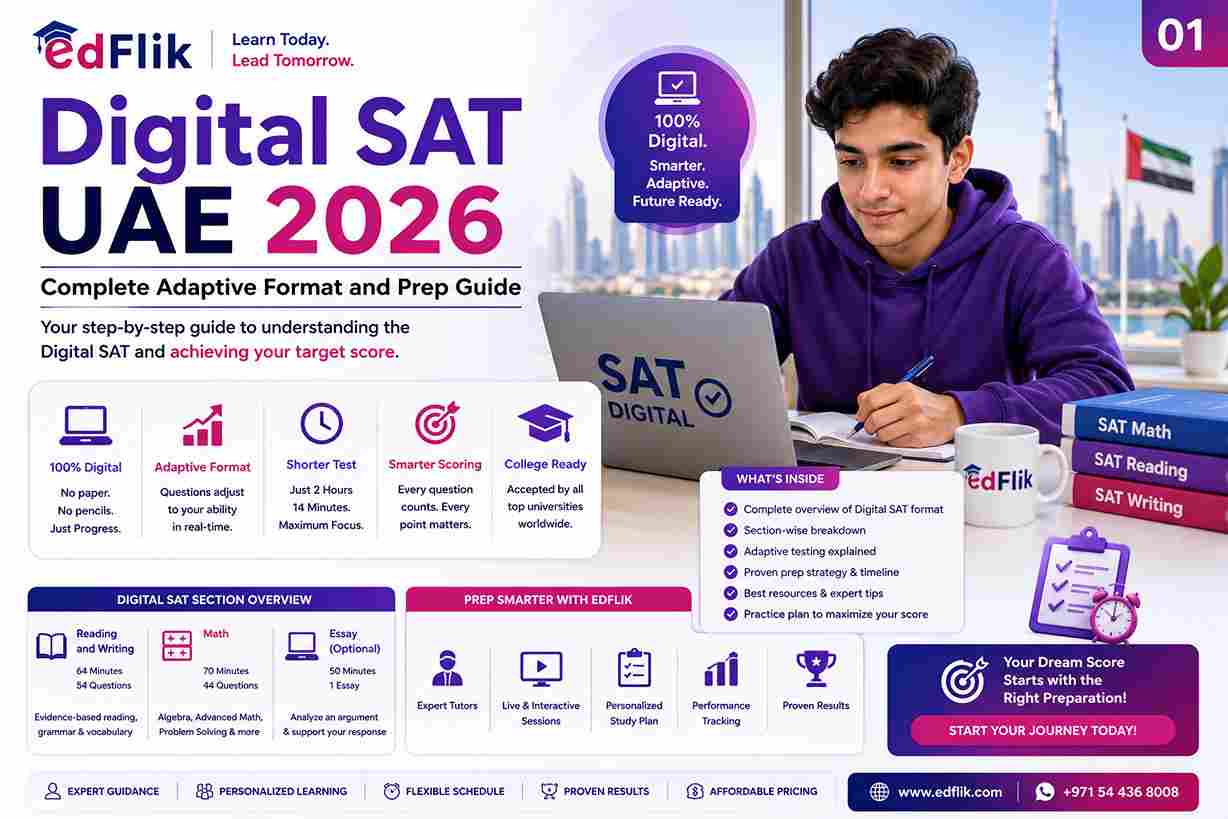
Digital SAT UAE 2026 — Complete Format, Score Structure and Preparation Guide
The Digital SAT launched globally in March 2024 and replaced the paper SAT entirely for international students. UAE students who prepare using old SAT resources — particularly old Reading and Writing content featuring long 10-question passage sets — are preparing for the wrong test. This guide covers what the Digital SAT actually involves, how the adaptive design works, what score targets UAE students need, and how to use the 12-16 weeks before a test date most effectively.
Digital SAT vs Old SAT — What Actually Changed
|
Feature |
Old Paper SAT
(pre-2024) |
Digital SAT
(2024 onwards) |
|
Format |
Paper-based,
fixed difficulty |
Adaptive
digital — Module 2 adjusts based on Module 1 performance |
|
Total time |
About 3 hours |
2 hours 14
minutes |
|
Sections |
Reading,
Writing & Language, Math (no calc), Math (calc) |
Reading and
Writing (54Q); Math (44Q) — only 2 sections |
|
Reading
passages |
Long passages,
10-11 questions each |
Short
passages, 1 question each |
|
Calculator |
Not permitted
for Math Section 1 |
Calculator
permitted for all Math — Desmos built in |
|
Essay |
Optional
(discontinued 2021) |
Not offered |
|
Adaptive
difficulty |
No — every
student same paper |
Yes — Module 2
adapts based on Module 1 score |
|
Score range |
400-1600 (no
change) |
400-1600 (no
change) |
How the Adaptive Design Works — The Module System
The Digital SAT has two sections: Reading and Writing, and Math. Each section has two modules:
• Module 1 (same for all students): Medium difficulty. Your performance on Module 1 determines which Module 2 you receive.
• Module 2 (adaptive): If you performed well on Module 1, you receive a harder Module 2 — which allows you to access scores above approximately 650 per section. If you performed poorly, you receive an easier Module 2 — you can still score up to about 650 per section but cannot reach 700+.
|
The most
critical strategic insight: getting into the harder Module 2 is essential for
scoring above 1300 total. UAE students targeting 1400+ must treat Module 1 as
the most important module of the test. A poor Module 1 performance locks you
into the easier Module 2 and caps your score, regardless of how well you do
on Module 2. |
Digital SAT Score Targets for UAE Students by University Destination
|
University
Tier |
SAT Score
Target |
Notes |
|
Ivy League +
MIT + Stanford |
1520-1580+ |
Most
competitive applicants from UAE present 1500+ for serious consideration |
|
Top 10-20 US
universities |
1470-1540 |
Duke,
Georgetown, Vanderbilt, UChicago — strong UAE applications present 1450+ |
|
Strong US
universities (Top 20-50) |
1350-1470 |
UC Berkeley,
Michigan, Virginia, Emory — achievable for well-prepared UAE students |
|
Australian Go8
universities |
1200-1350 |
University of
Melbourne, Sydney, ANU — SAT accepted; lower thresholds than US elite |
|
UAE
universities (AUS, Khalifa) |
SAT often
optional |
EmSAT is
primary UAE university test; SAT supplementary |
|
UK
universities |
SAT often
optional or supplementary |
IGCSE/A-Level
is primary; SAT can supplement for US-facing universities |
The Four Reading and Writing Question Types — UAE Student Notes
1. Vocabulary in Context (Craft and Structure domain)
"The most logical and precise word or phrase to complete the text is..." — the correct answer is the word whose specific connotation and register fit the passage context exactly. UAE students frequently lose marks by selecting a synonym that is semantically close but registers slightly wrong (e.g. selecting "extensive" when "comprehensive" better captures the precise meaning in context). Do not look for the most impressive or rare word — look for the most precise one.
2. Rhetorical Synthesis (Expression of Ideas domain)
A student taking notes presents 3-4 bullet points from a research source. The question asks: "which choice most effectively uses relevant information from the notes to accomplish this goal?" Students must synthesise the notes rather than simply repeating them, filtering for the information most relevant to the stated goal while maintaining logical coherence.
3. Transitions (Expression of Ideas domain)
Choose the most logical transition word or phrase between two sentences or ideas. The test presents familiar transitions (however, furthermore, therefore, consequently, additionally) and requires understanding the logical relationship between the ideas being connected. This question type rewards understanding of logical structure, not vocabulary breadth.
4. Standard English Conventions (grammar and punctuation)
These questions test specific punctuation and grammar rules. The most consistently tested in the Digital SAT: comma splices (two independent clauses joined by only a comma — incorrect), semicolon usage (correct only between two independent clauses), colon usage (before a list or elaboration), apostrophes in possessives vs plural vs contractions, subject-verb agreement with intervening clauses, and pronoun-antecedent agreement.
Digital SAT Math — What the Desmos Calculator Changes
Desmos graphing calculator is built into the digital testing platform for all Math questions. This changes optimal strategies significantly. Students who know how to use Desmos effectively can: graph equations and read intersection points instead of solving algebraically; use the table function to test specific values; check answers by substituting back into equations graphically. The most time-efficient Digital SAT Math students use Desmos for verification, not as a crutch for primary solution-finding.
|
Math Domain |
% of
Questions |
Highest-Frequency
Topics |
|
Algebra |
~35% |
Solving linear
equations; linear inequalities; systems of two linear equations (substitution
and elimination); interpreting linear functions |
|
Advanced Math |
~35% |
Quadratic
equations (factoring, quadratic formula); vertex form of parabola;
exponential growth/decay functions; function notation and composition |
|
Problem-Solving
& Data Analysis |
~15% |
Ratios, rates,
proportions; percentage calculations; interpreting data from tables and
graphs; mean, median, range; probability from data |
|
Geometry &
Trigonometry |
~15% |
Area and
perimeter; volume of cylinders, cones, spheres; Pythagorean theorem; similar
triangles; basic sine, cosine, tangent in right triangles |
|
EdFlik
provides Digital SAT preparation for UAE students covering both Reading and
Writing (adaptive technique and question types) and Math (Algebra, Advanced
Math, Desmos strategy). Sessions from AED 75. Free diagnostic assessment to
identify which module you are currently accessing. Book at www.edflik.com or
WhatsApp +91 88788 96600. |
Frequently Asked Questions
Q: What changed in the Digital SAT compared to the old paper SAT?
Shorter (2h 14min), fully digital, adaptive design where Module 2 adjusts based on Module 1 performance, short 1-question passages instead of long sets, calculator for all Math, two sections only. Score range unchanged at 400-1600.
Q: What is the Digital SAT score range?
400-1600 total. Reading and Writing: 200-800. Math: 200-800. Adaptive design means performing well on Module 1 is essential to access higher scores (1300+) — poor Module 1 performance caps the maximum achievable score in Module 2.
Q: Can UAE students take the Digital SAT in Dubai?
Yes — approved College Board test centres in Dubai and Abu Dhabi. Register at collegeboard.org. Approximately 7 international test dates per year. Popular dates book out 6-8 weeks in advance.
Q: What reading and writing question types are on the Digital SAT?
Four domains: Information and Ideas (comprehension, evidence, data), Craft and Structure (vocabulary in context, cross-text connections), Expression of Ideas (rhetorical synthesis, transitions), Standard English Conventions (grammar, punctuation).
Q: What maths topics are on the Digital SAT?
Algebra (35%), Advanced Math (35%), Problem-Solving and Data Analysis (15%), Geometry and Trigonometry (15%). Desmos graphing calculator available throughout Math section.