A-Level Chemistry 9701 UAE 2026 — Organic Mechanisms, Electrochemistry and Paper 5 Guide
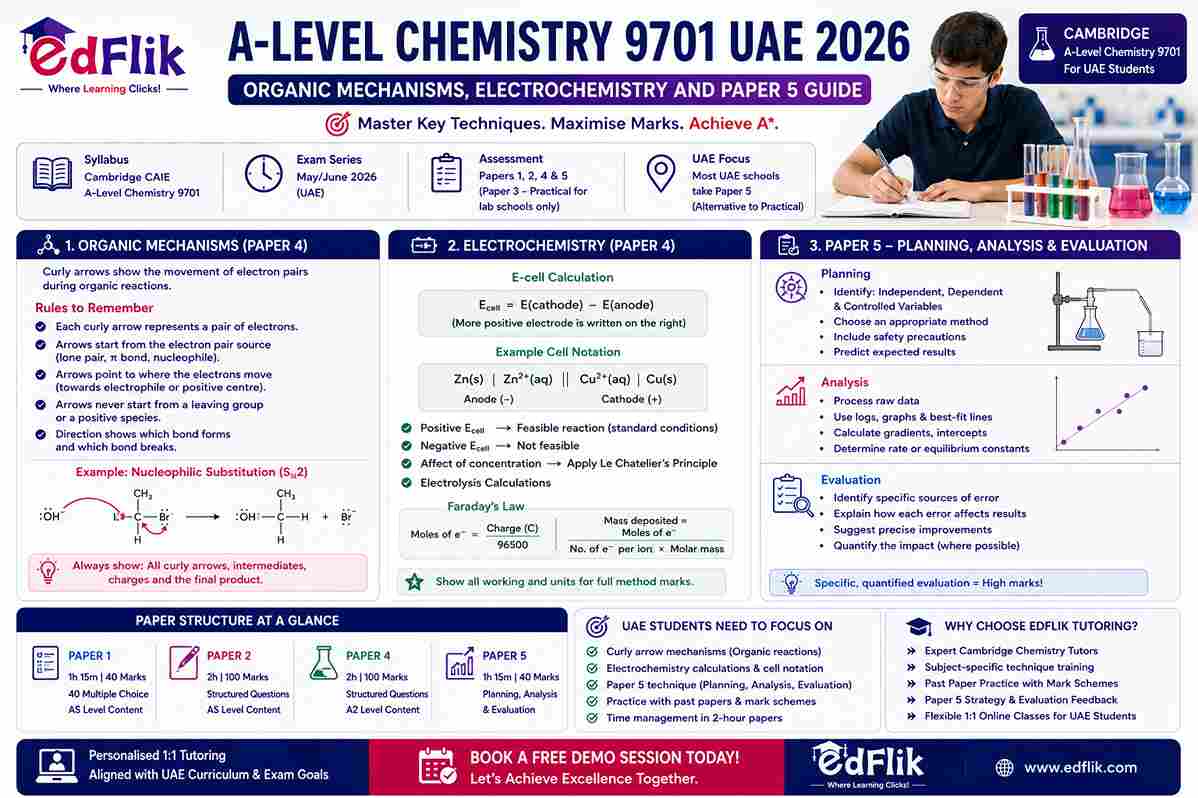
Cambridge A-Level Chemistry 9701 is the second most requested A-Level tutoring subject in UAE — after Mathematics — and the subject required for Medicine at virtually every UK and UAE medical school. At Dubai College, Kings' Al Barsha, JESS, BSAK, and Brighton College, A-Level Chemistry students face two assessment challenges that go significantly beyond IGCSE: organic mechanism drawing with curly arrows (tested specifically at A2 in Paper 4) and Paper 5, the practical skills paper that tests experimental design, data processing, and evaluation without access to a laboratory. This guide addresses both, along with the electrochemistry and equilibrium calculation techniques that consistently produce mark losses on Paper 4.
Cambridge A-Level Chemistry 9701 — Paper Structure
|
Paper |
Duration |
Marks |
Content |
UAE Entry |
|
Paper 1 — MCQ |
1 hr 15 min |
40 |
AS-level full syllabus — 40 multiple choice questions |
Yes |
|
Paper 2 — AS Structured |
2 hours |
100 |
AS-level structured questions: atoms, bonding, energetics,
kinetics, equilibria, organic, group chemistry |
Yes |
|
Paper 4 — A2 Structured |
2 hours |
100 |
A2-level: further organic (mechanisms), transition metals,
electrochemistry, further equilibria, spectroscopy (IR, NMR, mass spec) |
Yes |
|
Paper 5 — Planning, Analysis, Evaluation |
1 hr 15 min |
40 |
Practical skills — no laboratory: planning experiments,
processing data, evaluating methodology |
Yes — most UAE schools |
|
Paper 3 — Practical (laboratory) |
2 hours |
40 |
Actual laboratory practical |
Only at schools running lab practicals |
Curly Arrow Mechanisms — The Complete A-Level 9701 Framework
The Rules Every UAE A-Level Chemistry Student Must Follow
Curly arrow mechanisms are awarded marks in two categories in Cambridge 9701: the curly arrows themselves (direction, origin, termination) and the resulting intermediate species and products. Every mark requires both elements.
|
Rule |
What It Means |
Most Common
UAE Error |
|
Arrows start from electron source |
Curly arrows must originate from: a lone pair on a nucleophile, a
pi (double) bond, or a negative charge. Never from a C–H bond or a leaving
group. |
Drawing arrows starting from the leaving group or from a bond
that is not the electron source |
|
Arrows point toward electron destination |
Curly arrows point to where the electrons move: toward an
electrophilic carbon, toward a positively charged species, or toward the bond
being broken |
Drawing arrows in the wrong direction — backwards arrows earn
zero even if the mechanism type is correct |
|
Full arrows for electron pairs |
One full curly arrow represents movement of one pair of electrons
— not a single electron (which uses a half-headed fishhook arrow in radical
mechanisms) |
Using half-headed arrows in ionic mechanisms; using full arrows
in radical mechanisms |
|
Intermediate species must be drawn |
All carbocation, carbanion, and other intermediate structures
must be drawn explicitly with charges shown |
Skipping the intermediate and drawing only the product — loses
marks for every intermediate not shown |
|
Products must be correct and complete |
The final product must show: correct connectivity, all bonds
correct, correct removal of leaving group, correct functional group
transformation |
Product drawn with the leaving group still attached, or with
incorrect stereochemistry where stereochemistry is specified |
The Four Most Tested Mechanisms in Cambridge 9701 Paper 4
|
Mechanism |
Reaction Type |
Key Arrows
Required |
UAE Student
Error |
|
Nucleophilic substitution (SN2) |
Halogenoalkane + nucleophile (e.g. OH⁻, CN⁻, NH₃) |
Arrow 1: from nucleophile lone pair to carbon bearing leaving
group (backside attack). Arrow 2: from C–X bond to X (leaving group). |
Drawing only one arrow; not showing backside attack geometry; not
showing the leaving group departing with the electron pair |
|
Electrophilic addition to alkene |
Alkene + electrophile (e.g. HBr, Br₂) |
Arrow 1: from pi bond to incoming H⁺ or Br⁺. Intermediate:
carbocation formed. Arrow 2: from nucleophile lone pair (Br⁻) to carbocation. |
Not showing the carbocation intermediate; drawing both steps as
one concerted step (incorrect for ionic addition) |
|
Nucleophilic addition to carbonyl |
Aldehyde/ketone + nucleophile (e.g. CN⁻) |
Arrow 1: from C=O pi bond to O (forming C–O⁻ and free C). Arrow
2: from CN⁻ lone pair to C. Then protonation step. |
Missing the protonation step; not showing the oxygen becoming
negatively charged in the intermediate |
|
Elimination to form alkene |
Halogenoalkane + hot concentrated KOH in ethanol |
Arrow 1: from OH⁻ to H on beta carbon. Arrow 2: from C–H bond to
form C=C pi bond. Arrow 3: from C–X bond to X. |
Missing the beta-hydrogen clarification; not showing all three
arrows; using wrong base (aqueous KOH gives substitution, not elimination) |
Electrochemistry — E-Cell Calculations and Feasibility
E-Cell Calculation — The Step-by-Step Method
Electrochemistry questions appear in Paper 4 and typically award 6 to 12 marks. The calculation method:
1. Write the two half-equations from the given data or from memory, with their standard electrode potentials (E° values).
2. Identify which half-equation runs forward (reduction — occurs at the cathode, more positive E°) and which runs backwards (oxidation — occurs at the anode, less positive E°).
3. Calculate E-cell: E-cell = E°(reduction, right) − E°(oxidation, left). Alternatively: E-cell = E°(cathode) − E°(anode).
4. Write the full cell notation: anode (left) | solution || solution | cathode (right).
5. State feasibility: if E-cell is positive under standard conditions, the reaction is feasible. If negative, it is not feasible under standard conditions.
Critical rule: standard electrode potentials are measured relative to the standard hydrogen electrode (SHE) under standard conditions (25°C, 1 mol/dm³, 100 kPa). Changing concentration changes the electrode potential — a qualitative application of Le Chatelier's principle to the electrode equilibrium.
Paper 5 — Planning, Analysis, and Evaluation
Planning Questions — What Cambridge Requires
Planning questions on Paper 5 ask UAE students to design an experiment to investigate a given hypothesis. The five elements Cambridge awards marks for:
6. Identification of the independent variable (what you change) with specific measurable values stated.
7. Identification of the dependent variable (what you measure) with the measurement method specified.
8. Control variables — state at least two, with the specific method used to control each one. 'Temperature kept constant' earns 0 marks. 'Temperature maintained at 25°C using a thermostatically controlled water bath' earns the mark.
9. Method — apparatus named precisely, procedure described in logical sequence, quantity and concentration of reagents specified where relevant.
10. Safety precaution relevant to the specific experiment — 'care with chemicals' earns 0; 'ethanol is flammable — keep away from Bunsen burner; use an electric heating mantle instead' earns the mark.
Evaluation Questions — The Specific Error Method
Evaluation questions on Paper 5 require identification of specific sources of error and specific improvements. The marking principle: vague errors earn zero; named, specific errors with the direction of their effect earn marks; specific improvements with quantitative justification earn full marks.
|
Vague (Earns
Zero) |
Specific
(Earns Marks) |
|
'Human error in timing' |
'Starting the timer 1 to 2 seconds late due to reaction speed
causes an underestimate of initial rate — use a light sensor and data logger
for automated timing' |
|
'Some of the solution was lost' |
'Transfer from the flask to the cuvette causes loss of volatile
organic compound, reducing the measured concentration by approximately 5% and
causing an overestimate of the rate constant' |
|
'The experiment had errors in measurement' |
'The burette is calibrated to ±0.05 cm³ per reading; with two
readings per titration, the uncertainty in each titration volume is ±0.10
cm³, giving a percentage uncertainty of ±0.10/24.0 × 100 = ±0.4%' |
Frequently Asked Questions — A-Level Chemistry 9701 UAE
Q: What is the paper structure of Cambridge A-Level Chemistry 9701?
A: Full A-Level: Paper 1 (MCQ, AS-level, 1 hr 15 min, 40 marks); Paper 2 (AS structured, 2 hrs, 100 marks); Paper 4 (A2 structured including mechanisms, 2 hrs, 100 marks); Paper 5 (Planning, Analysis, Evaluation — no lab, 1 hr 15 min, 40 marks). Most UAE schools enter Paper 5 rather than Paper 3 (laboratory practical).
Q: What is the curly arrow mechanism technique for A-Level Chemistry?
A: Curly arrows show electron pair movement. Rules: arrows start from electron source (lone pair, pi bond, or negative charge — never from leaving group); arrows point to electron destination; full arrows for electron pairs; all intermediates drawn with charges; products correct and complete. The four most tested mechanisms: SN2 nucleophilic substitution, electrophilic addition to alkene, nucleophilic addition to carbonyl, and elimination.
Q: How do UAE students approach Cambridge A-Level Chemistry Paper 5?
A: Planning: identify independent variable (with specific values), dependent variable (with measurement method), control variables (named with specific method), method with apparatus, safety precaution specific to the experiment. Evaluation: name specific errors (not vague 'human error'), state the direction of effect, propose specific improvements with quantitative justification. Vague comments earn zero.
Q: What electrochemistry calculations must UAE students know?
A: E-cell = E°(cathode) − E°(anode). Positive E-cell = feasible under standard conditions. Cell notation: anode (left) | solution || solution | cathode (right). Electrolysis: moles of electrons = charge ÷ 96500; mass deposited = (moles electrons ÷ electrons per ion) × molar mass. Show all working with units.
How EdFlik Supports A-Level Chemistry 9701 Students Across UAE
EdFlik A-Level Chemistry tutors are 9701-specific — organic mechanism sessions use curly arrow technique from the first lesson. Paper 5 planning and evaluation structured practice built into every A2 session. From AED 75. Free demo. www.edflik.com.