
A-Level Chemistry Tutor: How to Master Organic Chemistry and Mechanisms (2026 Guide)
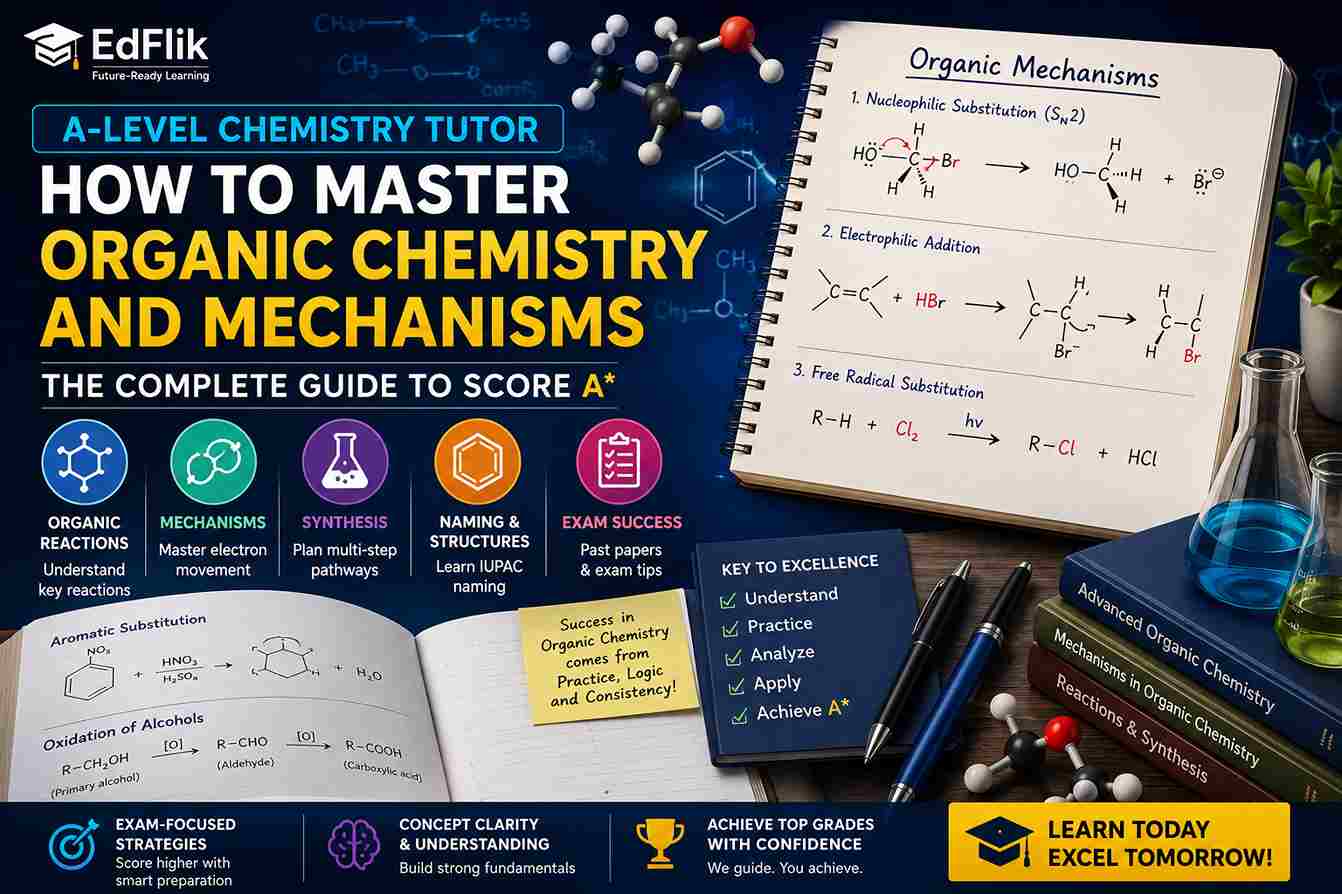
Organic Chemistry is one of the most challenging parts of A-Level Chemistry—but also one of the most scoring when studied correctly.
Students studying under boards like AQA, OCR, and Pearson Edexcel often struggle with:
👉 Reaction mechanisms
👉 Organic synthesis pathways
👉 Naming compounds
👉 Remembering reactions and conditions
This guide will show you exactly how to master Organic Chemistry and mechanisms to score top grades in 2026.
🎯 Why Organic Chemistry Feels Difficult
Organic Chemistry requires students to:
- Understand reaction patterns
- Apply mechanisms logically
- Memorize reactions systematically
👉 It’s not just memory—it’s pattern recognition.
🧪 What Are Organic Mechanisms?
Mechanisms explain:
👉 How chemical reactions happen step-by-step.
They show:
- Movement of electrons
- Bond breaking and formation
- Intermediate structures
🔁 The Most Important Mechanisms to Master
⚡ 1. Free Radical Substitution
Occurs in:
- Alkanes
Key feature:
- UV light initiation
Example reaction:
CH4+Cl2→CH3Cl+HClCH_4 + Cl_2 \rightarrow CH_3Cl + HClCH4+Cl2→CH3Cl+HCl
👉 Learn:
- Initiation
- Propagation
- Termination
⚛️ 2. Electrophilic Addition
Occurs in:
- Alkenes
Example:
CH2=CH2+Br2→CH2BrCH2BrCH_2=CH_2 + Br_2 \rightarrow CH_2BrCH_2BrCH2=CH2+Br2→CH2BrCH2Br
👉 Focus on:
- Breaking double bonds
- Positive intermediates
🧩 3. Nucleophilic Substitution
Occurs in:
- Haloalkanes
Important concepts:
- Partial charges
- Lone pair attack
🔄 4. Elimination Reactions
Forms:
- Alkenes
Students often confuse:
👉 Substitution vs elimination.
🧠 5. Electrophilic Substitution
Occurs in:
- Benzene reactions
This is commonly tested in advanced exams.
📚 How to Memorize Organic Reactions Easily
✅ 1. Learn by Reaction Patterns
Instead of memorizing individually:
👉 Group reactions together.
Example:
- Alkenes → Addition reactions
- Alcohols → Oxidation reactions
✅ 2. Use Reaction Maps
Create:
- Flowcharts
- Organic synthesis pathways
👉 Visual memory works better.
✅ 3. Practice Mechanism Drawing Daily
Even 15–20 minutes helps.
✅ 4. Learn Conditions Carefully
Examiners frequently ask:
- Catalysts
- Temperature
- Reagents
✍️ How to Score High in Mechanism Questions
🔍 1. Draw Curly Arrows Correctly
Curly arrows show:
👉 Electron movement.
Incorrect arrows = lost marks.
🧪 2. Include All Intermediates
Students lose marks by:
- Skipping charges
- Missing intermediates
📖 3. Learn Examiner Language
Use terms like:
- Electrophile
- Nucleophile
- Heterolytic fission
👉 Scientific vocabulary matters.
❌ Common Organic Chemistry Mistakes
- Memorizing without understanding
- Forgetting conditions
- Incorrect curly arrows
- Mixing mechanisms
🚀 Pro Tips to Score A*
✅ Practice Past Papers
Mechanism questions repeat patterns.
✅ Build Organic Reaction Maps
Connect reactions visually.
✅ Focus on Weak Areas
Track common mistakes.
✅ Revise Little and Often
Organic Chemistry requires repetition.
📅 4-Week Study Plan
Week 1:
- Learn core reactions and naming
Week 2:
- Focus on mechanisms
Week 3:
- Practice synthesis pathways
Week 4:
- Solve past papers + revision
❓ FAQs (Search Optimized)
How to master Organic Chemistry for A-Levels?
Focus on reaction patterns, mechanisms, and regular practice.
Are mechanisms difficult in A-Level Chemistry?
They become easier once you understand electron movement and reaction logic.
How to memorize Organic Chemistry reactions?
Use flowcharts, reaction maps, and repeated practice.
What is the hardest topic in Organic Chemistry?
Many students find mechanisms and synthesis pathways the most challenging.
🎓 Final Thoughts
To master A-Level Organic Chemistry:
👉 Understand mechanisms logically
👉 Practice reaction pathways
👉 Draw mechanisms carefully
👉 Revise consistently
Master these skills, and top grades become achievable.
📞 Need Help with A-Level Chemistry?
Get expert guidance from EdFlik
🌐 Website:-www.edflik.com
📞 Contact Number:-+91 8878896600
📧 Email:-support@edflik.com
You May Also Like To Read:-