A-Level Chemistry Tutor UAE 2026 — Cambridge 9701 Organic Mechanisms, Thermodynamics and Paper 5 Guide
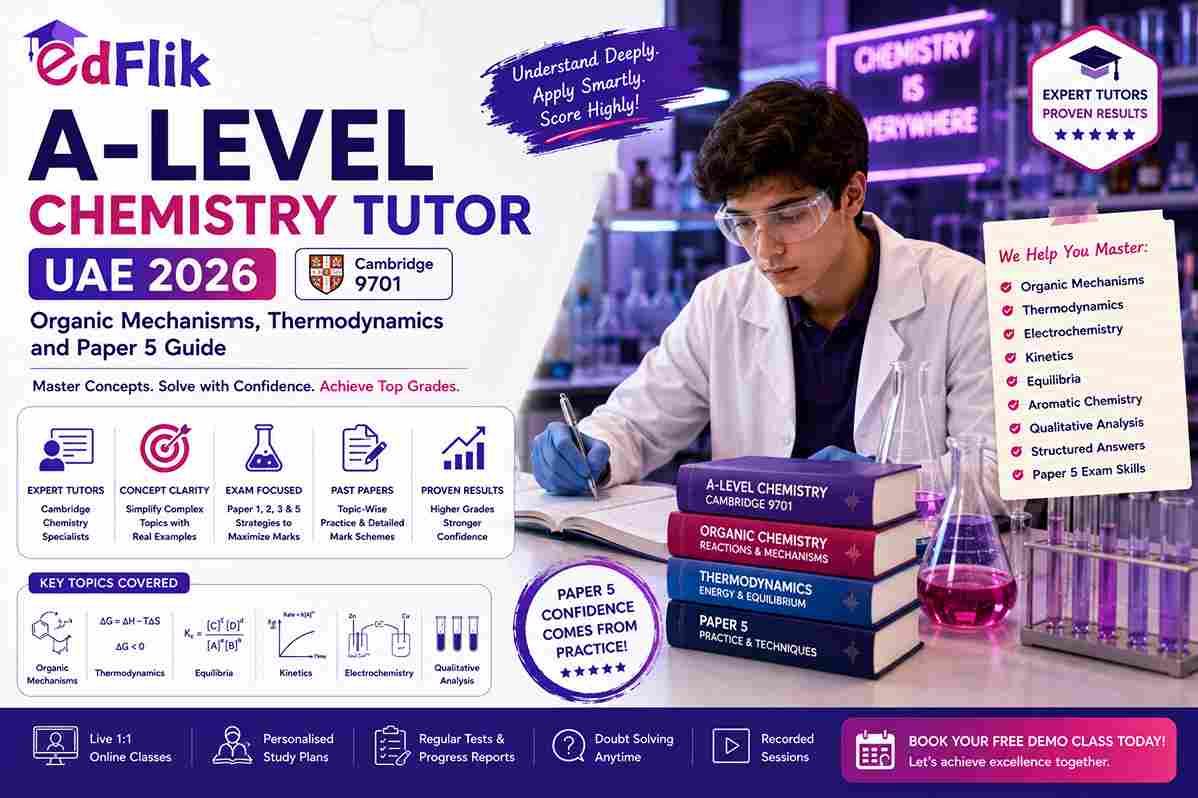
A-Level Chemistry (Cambridge 9701) is the most consistently requested science tutoring subject at UAE British curriculum Sixth Forms — and for good reason. The difficulty jump from IGCSE Chemistry to A-Level is among the steepest of any subject. Organic mechanisms alone (curly arrow notation for electrophilic addition, nucleophilic substitution, free radical substitution, and acylation) represent entirely new content that IGCSE Chemistry barely introduces. This guide covers the A-Level Chemistry structure, the highest-difficulty topics, and what Paper 5 specifically requires.
Cambridge A-Level Chemistry (9701) — Paper Structure
|
Paper |
Year |
Content
Coverage |
Duration |
Marks |
Key Skill |
|
Paper 1 — MCQ |
Year 12 (AS)
or Year 13 (A2) |
40
multiple-choice questions covering AS or A2 content |
1h 15min |
40 marks |
Rapid recall
of factual chemistry and quick calculation; process of elimination on tricky
questions |
|
Paper 2 —
Structured |
Year 12 (AS)
or Year 13 (A2) |
Structured
questions requiring written calculations, explanations, and short essays |
1h 15min (AS)
/ 2h (A2) |
60 marks (AS)
/ 100 marks (A2) |
Calculation
method marks; mechanism notation; accurate written explanations using correct
chemical terminology |
|
Paper 3 —
Planning/Eval |
Year 13 (A2
only) |
Questions
requiring experimental design, data analysis, and evaluation |
2h |
40 marks |
Experimental
planning; error identification; statistical analysis of data |
|
Paper 5 —
Practical |
Year 12 or 13
(depending on school) |
Practical-based
questions without conducting actual experiments — planning, data processing,
graph work, evaluation |
1h 15min |
30 marks |
Experimental
reasoning without practical equipment; graph interpretation; significant
figures; error analysis |
Organic Mechanisms — The Most Distinctive A-Level Chemistry Skill
A-Level Chemistry requires drawing reaction mechanisms using curly arrow notation — arrows that show the movement of electron pairs from electron-rich to electron-poor atoms or bonds. The five main mechanism types required at A-Level:
• Electrophilic addition (alkenes + Br₂, HBr, H₂O): Curly arrows show the pi bond of the alkene attacking the electrophile (Br₂); intermediate carbocation forms; second step — nucleophile attacks the carbocation. Markovnikov's rule determines which carbon the electrophile adds to for unsymmetrical alkenes.
• Nucleophilic substitution — SN1 and SN2: SN2 (one step — backside attack; stereochemical inversion); SN1 (two steps — carbocation intermediate; racemisation). Halogenoalkanes react with OH⁻, CN⁻, or NH₃ as nucleophiles.
• Electrophilic substitution (benzene): The Friedel-Crafts alkylation and acylation mechanisms; nitration of benzene using curly arrows for the formation of the nitronium ion and its reaction with the benzene ring.
• Free radical substitution (alkanes + Cl₂/Br₂ in UV light): Initiation (Cl₂ → 2Cl•), propagation (chain reaction), termination (two radicals combine). The most common exam question: show the mechanism for the monochlorination of methane.
• Nucleophilic addition (carbonyl compounds + CN⁻, NaBH₄, LiAlH₄): The carbonyl C=O is attacked by the nucleophile; the π electrons move onto oxygen; protonation gives the product.
Thermodynamics — The A2 Year 13 Extension
Year 13 A-Level Chemistry extends thermodynamics significantly beyond Year 12 enthalpy cycles. The three key Year 13 thermodynamics topics:
• Entropy (ΔS): Entropy is a measure of disorder. Reactions that increase disorder (more moles of gas produced; dissolving solids) have positive ΔS. Reactions that decrease disorder have negative ΔS. Knowing the sign of ΔS for common reaction types is required for Paper 2 questions.
• Gibbs Free Energy (ΔG = ΔH - TΔS): A reaction is spontaneous when ΔG is negative. ΔG calculation: substitute ΔH (in kJ mol⁻¹), T (in Kelvin), and ΔS (in J mol⁻¹ K⁻¹ — note units mismatch from ΔH) and check the sign.
• Born-Haber cycles: For calculating lattice energy of ionic compounds using energy cycle data. The six standard cycle steps (atomisation, ionisation, electron affinity, formation, and lattice energy) must be recalled and applied in the correct direction.
Paper 5 — The Most Underestimated A-Level Chemistry Paper
Paper 5 (Planning, Analysis and Evaluation) is taken without laboratory equipment — all questions are based on experimental scenarios, data sets, and methodological scenarios. UAE A-Level Chemistry students consistently underperform on Paper 5 because school preparation often focuses on content papers rather than experimental reasoning. Effective Paper 5 preparation:
• Practise identifying independent, dependent, and controlled variables for given experimental scenarios
• Practise drawing calibration graphs with appropriate axes (independent on x-axis, dependent on y-axis) and determining gradients and intercepts
• Learn to identify significant figures in experimental data and propagate errors through calculations
• Practise evaluating experimental methods — which aspect of a method introduces the greatest uncertainty? what specific change would reduce that uncertainty?
|
EdFlik
A-Level Chemistry tutors are Cambridge 9701 specialists — separate from IGCSE
and IB Chemistry expertise. Sessions cover organic mechanism notation,
thermodynamics calculations, Paper 5 experimental reasoning, and Year 12-13
content progression. From AED 70 per session (Year 12), AED 75 per session
(Year 13). Free diagnostic. Book at www.edflik.com or WhatsApp +91 88788
96600. |
Frequently Asked Questions
Q: What does Cambridge A-Level Chemistry (9701) cover?
Four papers: Paper 1 (MCQ), Paper 2 (structured responses), Paper 3 (planning and evaluation), Paper 5 (practical reasoning). AS: atomic structure, bonding, energetics, kinetics, equilibrium, basic organic. A2: thermodynamics (entropy, Gibbs free energy), transition metal chemistry, advanced organic (NMR, aromatic chemistry), buffers.
Q: What are the hardest A-Level Chemistry topics for UAE students?
Organic reaction mechanisms (curly arrow notation — electrophilic addition, SN1/SN2, free radical substitution), thermodynamics (Born-Haber cycles, Gibbs free energy), buffers and acid-base equilibria, and transition metal chemistry (complex ion naming, d-block colour theory).
Q: What is Cambridge A-Level Chemistry Paper 5?
1h 15min practical reasoning paper — experimental planning, data processing (significant figures, error propagation), graph interpretation, and methodology evaluation — without conducting actual experiments. Consistently underperformed by UAE students when preparation focuses only on content papers.
Q: How is A-Level Chemistry different from IGCSE Chemistry?
A-Level adds: organic mechanisms with curly arrow notation, thermodynamics (entropy, Gibbs free energy, Born-Haber cycles), transition metal chemistry (entirely new), and NMR + IR spectroscopy interpretation. Significantly deeper mathematical treatment of all topics covered in IGCSE.
Q: Which UAE schools offer A-Level Chemistry?
All UAE British curriculum Sixth Forms — Repton Dubai, Brighton College Dubai, Kings, Nord Anglia, GEMS WASO, Cranleigh Abu Dhabi, Brighton College Abu Dhabi, BSAK, and Repton Abu Dhabi. A-Level Chemistry is essentially required for Medicine, Pharmacy, and Chemical Engineering applications.