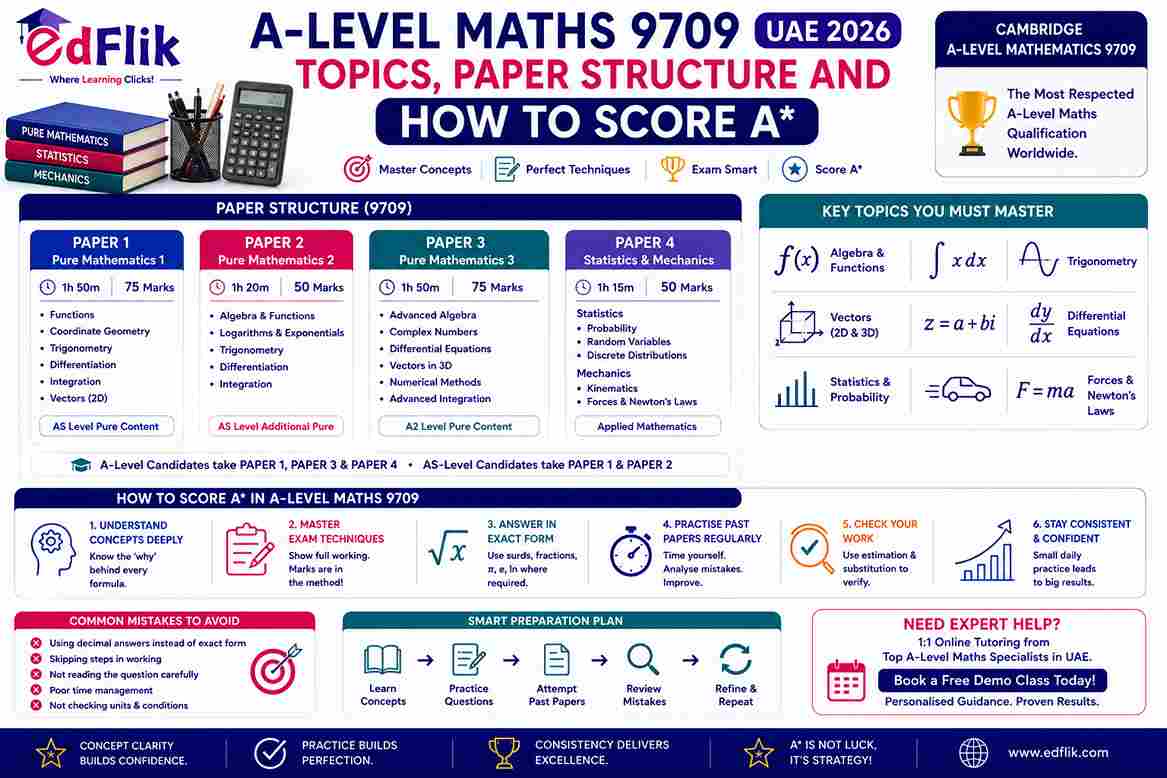
A-Level Maths 9709 UAE 2026 — Topics, Paper Structure and How to Score A*
Cambridge International A-Level Mathematics 9709 is the most requested A-Level subject from UAE families at British-curriculum sixth form schools — and the subject where the gap between IGCSE preparation and A-Level demand is most sharply felt. Students who achieved A* in IGCSE Maths 0580 regularly find the step up to 9709 unexpected: not because the underlying maths is incomprehensible, but because A-Level demands a precision of algebraic manipulation, a comfort with formal proof, and an awareness of the exact-answer requirement that IGCSE never fully established. This guide covers the complete 9709 paper structure, the most demanding topics for UAE students, and the specific technique rules that separate A from A* performance.
Cambridge A-Level Maths 9709 — Paper Structure
|
Paper |
Duration |
Marks |
Content |
UAE Entry
(full A-Level) |
|
Paper 1 — Pure Mathematics 1 |
1 hr 50 min |
75 |
Functions, coordinate geometry, trigonometry, sequences and
series, differentiation, integration (AS-level pure) |
Yes — all full A-Level candidates |
|
Paper 3 — Pure Mathematics 3 |
1 hr 50 min |
75 |
Algebra and functions, complex numbers, differential equations,
vectors in 3D, numerical methods, advanced integration (A2-level pure) |
Yes — all full A-Level candidates |
|
Paper 4 — Statistics and Mechanics |
1 hr 15 min |
50 |
Probability, discrete random variables, normal distribution,
kinematics, forces and Newton's laws (applied maths) |
Yes — all full A-Level candidates |
|
Paper 2 — Pure Mathematics 2 (AS only) |
1 hr 20 min |
50 |
AS-level additional pure mathematics — logarithms, integration,
trigonometry |
AS-Level candidates only — not required for full A-Level |
Full Cambridge A-Level Mathematics: Papers 1, 3, and 4. AS-Level only: Papers 1 and 2. Most UAE sixth form school students sit the full A-Level (Papers 1, 3, and 4) at the end of Year 13.
The Exact-Answer Rule — The Most Important Technique Change from IGCSE to A-Level
This is the technique difference that most consistently costs UAE A-Level Maths students marks in their first year of 9709, and the one that tutors must address in the first session. Cambridge 9709 requires exact answers unless the question explicitly says otherwise.
|
Question Type |
Required
Answer Form |
What UAE
Students Often Write (Wrong) |
|
√18 simplified |
3√2 (exact surd form) |
4.243 or 4.24 (decimal approximation) |
|
7 divided by 12 as exact value |
7/12 (exact fraction) |
0.583 (rounded decimal) |
|
Area under a curve involving π |
3π cm² (exact) |
9.42 cm² (decimal approximation) |
|
Logarithm answer |
ln 3 (exact) or log₂ 8 = 3 (exact) |
1.099 (decimal for ln 3) |
|
Exponential value |
2e³ (exact) |
40.2 (decimal) |
|
Trigonometric value |
sin⁻¹(√3/2) = π/3 (exact, in radians) |
1.047 (decimal approximation of π/3) |
|
Integration constant |
+ c (always include for indefinite integrals) |
Missing the + c — loses the accuracy mark on every indefinite
integral |
The rule: if the question does not contain the phrases 'correct to n decimal places', 'correct to n significant figures', or 'give a decimal approximation', the answer must be in exact form. Cambridge 9709 examiner reports identify decimal approximations in place of exact answers as one of the most consistent causes of accuracy mark loss.
Paper 1 Topics — The Pure Foundation
Paper 1 (Pure Mathematics 1) covers the AS-level pure content. All full A-Level students sit Paper 1. Topics and their typical mark allocations:
|
Topic |
Typical Mark
Allocation |
Key Technique
Rule |
|
Functions — domain, range, composite, inverse |
8–12 marks |
State the domain before finding the inverse; check the range of f
to determine the domain of f⁻¹; fg(x) means apply g first |
|
Coordinate geometry — lines, circles, gradients |
8–12 marks |
Perpendicular gradient = –1/m; circle equation: (x–a)²+(y–b)²=r²;
always complete the square to find centre and radius |
|
Trigonometry — identities, equations, graphs |
10–15 marks |
Know sin²θ + cos²θ = 1 and its derived identities; for equations
in range, find ALL solutions; radians are standard |
|
Sequences and series — AP, GP, binomial |
10–15 marks |
Binomial expansion: (1+x)ⁿ for any n including fractions and
negatives; state the validity condition for convergence |
|
Differentiation — chain, product, quotient rules |
10–15 marks |
Show the chain/product/quotient rule step explicitly; for
stationary points, justify using second derivative or sign change |
|
Integration — definite, indefinite, area under curve |
10–15 marks |
Include + c for ALL indefinite integrals; area between curve and
x-axis using definite integral; area between two curves: integrate (top curve
– bottom curve) |
|
Vectors — in 2D (Paper 1) |
5–8 marks |
Magnitude = √(a²+b²); unit vector = vector divided by magnitude;
perpendicular vectors have dot product = 0 |
Paper 3 Topics — Where A* is Won or Lost
Paper 3 (Pure Mathematics 3) is the most challenging component and the one that most differentiates A from A* performance at UAE sixth form schools. The topics that most consistently produce mark losses:
Complex Numbers
Complex numbers appear in every Paper 3 sitting and are typically worth 10 to 15 marks. UAE students must be fluent in all three forms: Cartesian (a + bi), modulus-argument (r(cosθ + isinθ)), and Euler/exponential (re^(iθ)). De Moivre's theorem applies: (cosθ + isinθ)ⁿ = cos(nθ) + isin(nθ). Applications: finding nth roots of complex numbers (divide the argument by n and consider all n roots spaced equally around the Argand diagram); proving trigonometric identities using de Moivre; finding loci on the Argand diagram (half-lines, circles, perpendicular bisectors). The most common UAE student error: not considering all roots when finding the nth roots of a complex number.
Differential Equations
Differential equations appear in most Paper 3 sittings (10 to 12 marks). Two main types: first-order separable (separate variables, integrate both sides, apply initial conditions to find the constant); and first-order linear (using integrating factor — multiply through by the integrating factor e^(∫P dx), then integrate the product on the left as d/dx[y × integrating factor]). Key rule: always include the constant of integration and always apply the initial or boundary condition given in the question to find its value.
Partial Fractions and Advanced Integration
Partial fractions and their application in integration appear in most Paper 3 sittings. UAE students must be comfortable decomposing rational expressions into partial fractions for three denominator types: linear factors (A/(ax+b) + B/(cx+d)); repeated linear factors (A/(ax+b) + B/(ax+b)²); and quadratic factors (A/(ax+b) + (Bx+C)/(cx²+dx+e)). These partial fraction expansions are then integrated using logarithm integrals or the standard tan⁻¹ integral.
Grade Boundaries — Cambridge A-Level Maths 9709
|
Grade |
Approximate
Mark (out of 200 total) |
Approximate % |
UAE School
Context |
|
A* |
~175–190 |
87.5–95% |
Requires near-perfect Paper 3 performance alongside strong Papers
1 and 4 |
|
A |
~145–174 |
72.5–87% |
Strong across all papers; some Paper 3 topic gaps acceptable |
|
B |
~115–144 |
57.5–72% |
Good Paper 1 and 4; significant Paper 3 losses likely |
|
C |
~85–114 |
42.5–57% |
Adequate Paper 1; substantial Paper 3 and integration
difficulties |
Frequently Asked Questions — A-Level Maths 9709 UAE
Q: What is the paper structure of Cambridge A-Level Maths 9709?
A: Full A-Level: Paper 1 (Pure Maths 1, 1 hr 50 min, 75 marks), Paper 3 (Pure Maths 3, 1 hr 50 min, 75 marks), Paper 4 (Statistics and Mechanics, 1 hr 15 min, 50 marks). All three sat at end of Year 13. Paper 2 is AS-Level only. Total 200 marks for full A-Level.
Q: What is the most important technique rule for Cambridge A-Level Maths 9709?
A: Exact answers. Cambridge 9709 requires exact forms (surds, fractions, ln, π, e) unless the question explicitly says 'give to n decimal places' or 'to n significant figures'. Decimal approximations in place of exact answers lose accuracy marks on every question. This is the most common mark-loser for UAE Year 12 students in their first 9709 papers.
Q: What are the hardest Paper 3 topics for UAE students?
A: Complex numbers (all three forms — Cartesian, modulus-argument, Euler; de Moivre's theorem and nth roots); differential equations (separable and integrating factor); partial fractions and their use in integration; vectors in 3D (lines, planes, intersections, distances). These appear in most Paper 3 sittings and collectively account for the majority of Paper 3 marks.
Q: Which UAE schools offer Cambridge A-Level Maths 9709?
A: Most UAE British-curriculum sixth form schools: Dubai College (typically requires IGCSE Maths A*), Kings' Al Barsha (A or A*), JESS (A or B), Brighton College Dubai (A), BSAK Abu Dhabi (A or B), Repton Dubai (B or above). Confirm current entry requirements directly with each school.
How EdFlik Supports A-Level Maths 9709 Students Across UAE
EdFlik A-Level Maths tutors are 9709-specific — not IGCSE tutors who extend into A-Level. The exact-answer rule and Paper 3 content depth are established from the first session. From AED 75 per class. Free demo. www.edflik.com.