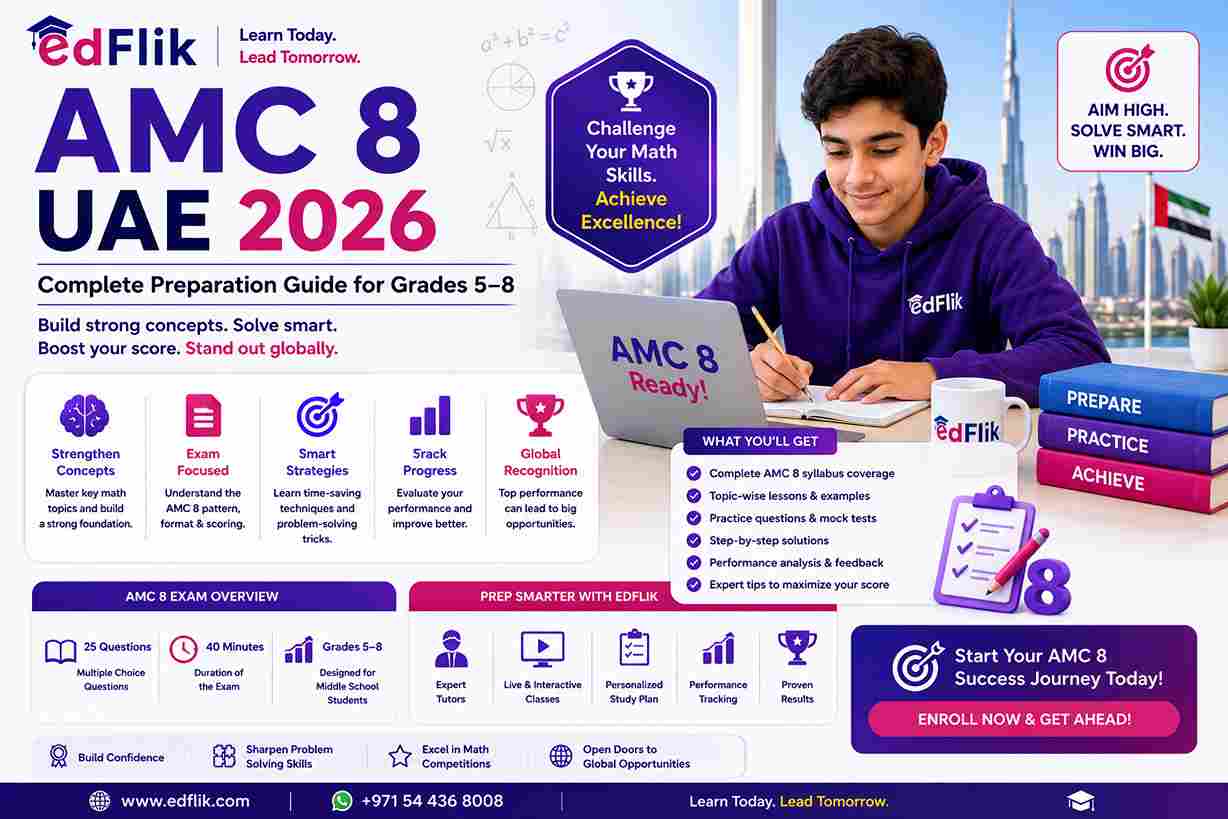
AMC 8 UAE 2026 — Complete Preparation Guide for Grades 5 to 8
AMC 8 is the Mathematical Association of America's entry-level maths competition — accessible to students in Grade 8 and below, but genuinely challenging in a way that school maths rarely is. For UAE students at American curriculum and some British curriculum schools, AMC 8 is the first step in a competition mathematics pathway that leads to AMC 10, AMC 12, AIME, and for the very best students, the USA(J)MO. This guide covers the full AMC 8 structure, the five problem types, score benchmarks, and the most effective preparation approach.
AMC 8 at a Glance
|
Item |
Detail |
|
Full name |
American
Mathematics Competition 8 |
|
Administered
by |
Mathematical
Association of America (MAA) |
|
Eligibility |
Grade 8 and
below; must be under 14.5 years old on competition day |
|
Format |
25
multiple-choice questions (5 options each) |
|
Time |
40 minutes |
|
Scoring |
1 point per
correct answer; no penalty for incorrect answers (since 2000) |
|
Maximum score |
25 points |
|
When
administered |
November each
year (typically third week of November) |
|
UAE access |
Through
registered schools or MAA-registered exam centres |
|
Cost |
Approximately
USD 10-15 per student (registered through school) |
AMC 8 Score Benchmarks
|
Score Range |
Recognition |
What It Means |
|
19-25 |
Distinguished
Honor Roll (top ~1% globally) |
Exceptional —
signals strong potential for AMC 10/12 preparation |
|
15-18 |
Honor Roll
(top ~25% globally) |
Strong
performance — well above median; ready for AMC 10 preparation |
|
10-14 |
Above global
median |
Solid
performance — consistent problem-solving across easier questions |
|
Below 10 |
At or below
median |
Foundation
work needed on non-routine problem types before next attempt |
The Five AMC 8 Problem Types — With Examples
1. Arithmetic and Number Theory (approximately 6-8 questions)
These problems involve prime factorisation, divisibility, remainders, GCD, LCM, and properties of digits. Example: "What is the units digit of 7^2026?" — requires identifying the pattern in powers of 7 (7, 49, 343, 2401 — units digits cycle: 7, 9, 3, 1, 7, 9, 3, 1...) and computing 2026 mod 4. Answer: 2026 = 4×506 + 2, so units digit is 9. This type of pattern-recognition in number theory is the most characteristic AMC 8 skill that school maths does not develop.
2. Algebra and Patterns (approximately 5-7 questions)
Simple equations, sequences with non-obvious rules, and problems where setting up an equation is the key step. Example: "A store sells 3 items. If item A costs twice as much as item B, and item C costs AED 5 less than item A, and the total cost is AED 55, what does item B cost?" — straightforward algebraic setup but presented in a worded problem format that requires translating context into algebra.
3. Geometry (approximately 5-7 questions)
Area, perimeter, circles, angles, Pythagorean theorem, and visual spatial problems. AMC 8 geometry frequently involves dividing a figure into parts, finding shaded areas, or working with composite shapes. Drawing a careful diagram is always the correct first step for AMC 8 geometry problems.
4. Combinatorics and Probability (approximately 4-6 questions)
Counting problems (how many ways can X be arranged), probability from equally likely outcomes, and Venn diagram problems. AMC 8 combinatorics does not use formal permutation or combination formulae — it uses systematic listing and the multiplication principle. Example: "How many 3-digit numbers have digits that sum to 7?" — systematic case analysis (starting with highest-possible first digit) is the expected approach.
5. Logic and Puzzle Problems (approximately 2-4 questions)
Problems involving visual patterns, deductive reasoning, or multi-step logical chains. These are the hardest to prepare for because they are the most non-routine. The best preparation is practising similar problems until the general approach to spatial or logical pattern identification becomes intuitive.
Preparation Strategy — From First Attempt to Honor Roll
• Phase 1 (Weeks 1-4): Solve AMC 8 problems from 2020-2022 with unlimited time. Build familiarity with non-routine format. Target: understand every solution, not just answer correctly.
• Phase 2 (Weeks 5-8): Solve under timed conditions (40 minutes). Aim for Questions 1-15 consistently. Identify which problem types generate the most errors.
• Phase 3 (Weeks 9-12): Targeted practice on the highest-error problem types. Begin attempting Questions 16-25 — these require creative approaches.
• Week before the competition: Full timed practice tests. Review any remaining systematic errors. Confirm registration and logistics.
|
EdFlik
provides AMC 8, AMC 10, and AMC 12 preparation for UAE students. Sessions
develop non-routine problem-solving across all five AMC 8 question types.
From AED 70 per session. Free diagnostic. Book at www.edflik.com or WhatsApp
+91 88788 96600. |
Frequently Asked Questions
Q: What is AMC 8 and who can take it in UAE?
AMC 8 is a 25-question, 40-minute MAA maths competition for Grade 8 and below (under age 14.5). UAE students participate through registered schools or MAA exam centres. Several UAE American and British schools register students annually.
Q: What topics does AMC 8 cover?
Arithmetic and number theory, algebra and patterns, geometry, combinatorics and probability, and logic/puzzle problems — all presented in non-routine creative formats requiring mathematical reasoning, not procedure recall.
Q: What is a good AMC 8 score?
19/25+ = Distinguished Honor Roll (top ~1%). 15/25+ = Honor Roll (top ~25%). Median score is typically 10-12. For UAE students, 15+ is a strong benchmark; 19+ is exceptional.
Q: How are AMC 8 problems different from school maths?
Non-routine — creative application of mathematical principles to unfamiliar situations. School maths rewards applying known procedures; AMC 8 rewards discovering patterns, systematic counting, and mathematical reasoning in new contexts.
Q: How should UAE students prepare for AMC 8?
Work through last 5-10 years of AMC 8 problems (free at MAA website). Understand solutions thoroughly. Classify problems by type. Target questions 1-15 for reliable scoring first. Then tackle 16-25 for Honor Roll range.