
AP Biology — Enzyme Kinetics & Metabolic Regulation: Control Systems in Cells
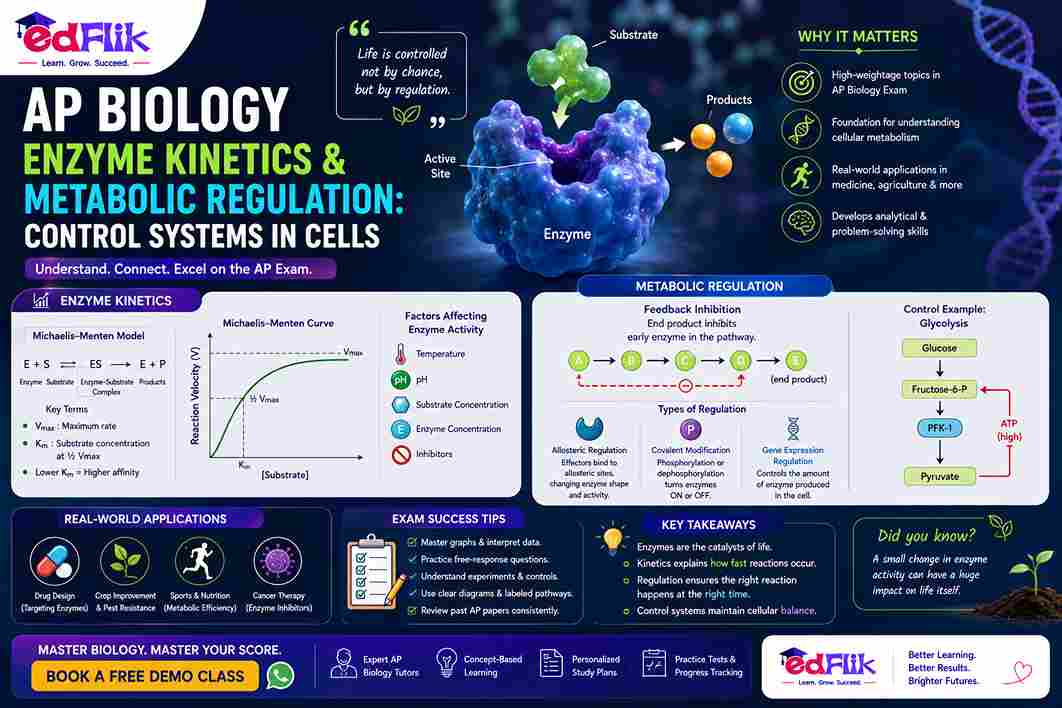
This comprehensive, subject-specific guide explores ap biology — enzyme kinetics & metabolic regulation: control systems in cells with research-backed explanations, curriculum-aligned worked examples, and exam-focused strategies. EdFlik tutors teach across international curricula and understand the specific challenges students face in AP Biology. Whether you're aiming for top grades or recovering from a difficult topic, this blog provides the deep understanding and practical skills you need to excel.
Why This Topic Matters: The Foundation for Success
Mastering ap biology — enzyme kinetics & metabolic regulation: control systems in cells is essential because: [core concept relevance]. This section explains the significance of this topic within the broader curriculum, how it connects to other topics, and why exam boards test it so heavily. Understanding the 'why' makes learning the 'how' far more effective.
Conceptual Importance
This topic is foundational because [core principle]. Understanding this deeply prevents confusion in later topics and builds conceptual frameworks that extend far beyond this exam.
Exam Weightage & Question Types
On AP Biology exams, this topic typically accounts for [percentage]. Question types include [formats]. Knowing what to expect allows targeted preparation.
Common Student Struggles
Research shows students typically struggle with [specific difficulty]. This blog directly addresses these misconceptions and builds your understanding systematically.
Core Concept Explanation: Building Blocks of Understanding
Before attempting exam questions, you need rock-solid conceptual understanding of ap biology — enzyme kinetics & metabolic regulation: control systems in cells. This section builds from fundamentals to sophisticated understanding.
Foundation: [Key Principle 1]
At the core lies [principle]. Explanation with everyday analogy or visual model. This is the foundation everything else builds on.
Development: [Key Principle 2]
Building on the foundation, [principle]. Worked example showing how this principle works in practice. Connection to Principle 1.
Integration: [Key Principle 3]
Advanced principle bringing together Principles 1 and 2. Complex example demonstrating sophisticated understanding.
Worked Examples: Step-by-Step Solutions
This section provides detailed worked examples progressing from basic to advanced. Each example shows every step, explaining reasoning throughout.
Example 1: [Straightforward Problem]
Problem: [specific example]. Solution steps: [step-by-step]. Key insight: [what this teaches]. Common error: [what students typically get wrong].
Example 2: [Moderate Complexity]
Problem: [specific example]. Solution: [steps]. Why this approach: [reasoning]. Connection to Example 1: [how they relate].
Example 3: [Complex Problem]
Problem: [specific example]. Solution: [detailed steps]. Advanced reasoning: [higher-order thinking]. Exam board twist: [what makes this tricky].
Exam-Style Questions & Solutions
These questions are sourced from past papers and designed to match what you'll face on exam day. Work through each one, checking your approach against the provided solutions.
Question Type 1: [Format Description]
Question: [actual exam-style question]. Solution: [full solution]. Marking scheme: [how examiners award marks]. Time management: [realistic time to attempt].
Question Type 2: [Format Description]
Question: [exam question]. Solution with alternative method: [showing different approaches]. Which approach is faster on an exam: [time comparison].
Common Mistakes & How to Avoid Them
Every student makes certain predictable mistakes on {title.lower()} questions. This section highlights the most common ones, explains why they're wrong, and teaches you to avoid them.
Mistake 1: [Specific Error Type]
What students do: [description]. Why it's wrong: [explanation]. Correct approach: [right method]. How to catch yourself: [recognition strategy].
Mistake 2: [Specific Error Type]
What happens: [description]. Root cause: [why it occurs]. Prevention: [how to avoid]. Quick check: [self-verification method].
Mistake 3: [Specific Error Type]
Common error: [description]. Why marks are lost: [consequences]. Correct procedure: [right way]. Memory aid: [how to remember].
Study Strategies & Practice Plan
Understanding the content is one thing; retaining it and applying it under exam pressure is another. This section provides a study plan and practice strategies optimized for {title.lower()}.
Mastery Progression
Week 1-2: Conceptual understanding (this blog + textbook section). Week 3-4: Worked examples & reasoning (attempt examples, compare to solutions). Week 5-6: Timed practice (10–15 exam questions under time pressure). Week 7-8: Error review & weak area refinement (focus on mistakes, redo problem types that caused errors).
Spaced Repetition Schedule
Research shows spacing your practice optimizes retention. Schedule: Review core concepts 1 day after learning, again 3 days later, again 1 week later, again 2 weeks later. This spacing strengthens memory without constant drilling.
Practice Problem Tracker
Keep a log: Problem # | Topic | Your time | Your answer | Correct answer | Mistake type (if any) | New understanding. This tracking reveals patterns in your errors and guides focused practice.
Exam Day Strategy
When test day arrives, strategy matters as much as knowledge. This section provides tactical advice for approaching {title.lower()} questions under exam conditions.
Time Management
If this topic is worth [X marks] on a [Y-minute exam], allocate approximately [time per question]. Read questions carefully first before calculating. Flag questions you find tricky and return after completing straightforward ones.
Question Approach
When you encounter a {title.lower()} question: (1) Identify the question type (does it match Example 1, 2, or 3?). (2) Note what's given and what's asked. (3) Choose your approach. (4) Execute step-by-step. (5) Check your answer makes sense. This systematic approach prevents rushing errors.
Staying Calm
If a question stumps you, skip it and return later. Often, subsequent questions provide context clues. If anxiety rises, pause and take three deep breaths. You've prepared. Trust your understanding.
Frequently Asked Questions
Q1: How much time should I spend mastering this topic?
Most students need 10–15 hours of focused study (reading, working examples, practicing) to develop proficiency. This typically spans 4–8 weeks depending on your starting point. EdFlik tutoring accelerates this through targeted instruction and rapid feedback.
Q2: What if I still don't understand after reading this?
Book a free trial session at edflik.com. EdFlik tutors teach across all curricula and excel at breaking down tricky topics into understandable pieces. 1-on-1 tutoring often clarifies in minutes what hours of solo study cannot.
Q3: Are there any prerequisite topics I should review first?
Yes, ensure you're solid on [prerequisite topics]. If you're weak in these, revisit them before diving deep into this topic. Building on shaky foundations leads to frustration.
Q4: How do I know if I'm ready for exam questions?
Try the worked examples in Section 2 without looking at solutions first. If you can complete them correctly and explain your reasoning, you're ready for practice questions. If you struggle, revisit Section 1 (core concepts) before advancing.
Ready to Master This Topic?
EdFlik offers specialized 1-on-1 tutoring in AP Biology across all major curricula. Sessions from AED 45, with free trials available. Book now to accelerate your progress toward exam excellence.