AP Computer Science A Tutor UAE 2026 — Java, OOP, Arrays and Algorithm Design for Dubai Students
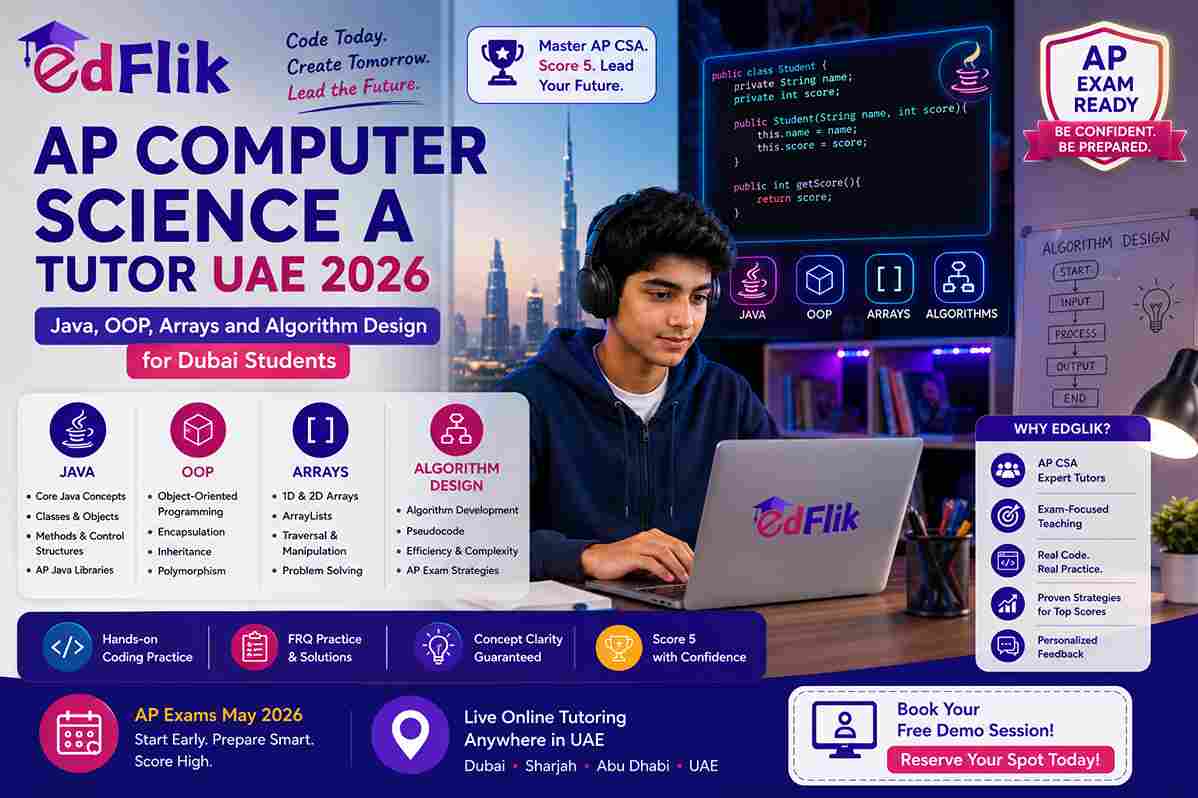
AP Computer Science A is the most rigorous programming AP — it teaches Java in depth and earns the most university CS credit of any AP offering. UAE demand is growing rapidly as the UAE government's AI education mandate drives families toward computing education. This guide covers the full Java curriculum, the four FRQ types that appear every year, and how prior coding experience in Python or IGCSE pseudocode translates to AP CS A preparation.
AP Computer Science A — Full Exam Structure
|
Section |
Format |
Time |
% of Score |
|
Section I |
40 MCQ — Java
code analysis, output prediction, error identification |
90 minutes |
50% |
|
Section II |
4 FRQ —
Methods and Control Structures, Class, Array/ArrayList, 2D Array |
90 minutes |
50% |
Java Concepts Tested in AP CS A — By Frequency
|
Concept |
AP CS A Usage |
Python/Pseudocode
Equivalent |
|
Variable
declaration |
int x = 5;
double d = 3.14; String s = "hello"; |
x = 5 (Python
— no type declaration) |
|
Method
definition |
public int
addTwo(int a) { return a + 2; } |
def addTwo(a):
return a + 2 |
|
For loop |
for (int i =
0; i < 10; i++) { ... } |
for i in
range(10): ... |
|
While loop |
while (x >
0) { x--; } |
while x >
0: x -= 1 |
|
Array creation |
int[] arr =
new int[5]; or int[] arr = {1,2,3}; |
arr = [0]*5 or
arr = [1,2,3] |
|
ArrayList |
ArrayList<String>
list = new ArrayList<>(); |
list = []
(Python list) |
|
Class
definition |
public class
Dog { private String name; } |
class Dog:
(Python) |
|
Constructor |
public
Dog(String n) { name = n; } |
def
__init__(self, n): self.name = n |
|
Inheritance |
public class
Poodle extends Dog { } |
class
Poodle(Dog): |
|
String methods |
s.length(),
s.substring(0,3), s.equals("abc") |
len(s),
s[0:3], s == "abc" |
The 4 AP CS A FRQ Types — What Each Requires
FRQ Type 1: Methods and Control Structures
Write one or two methods that use loops, conditionals, string operations, or arithmetic. This is the most accessible FRQ type. Key technique: write the method signature exactly as specified (correct return type, parameter types, method name), then implement the logic step by step. Partial credit is awarded for correct logic even if Java syntax is not perfect.
FRQ Type 2: Class
Design a class from a specification — or complete an incomplete class. Requires: private instance variables with correct types, a constructor that initializes them, and methods that use and modify them. UAE students who learned OOP in Python sometimes forget Java requires explicit type declarations on every variable and parameter.
FRQ Type 3: Array/ArrayList
Traverse a 1D array or ArrayList to find, count, modify, or remove elements. Common operations: finding a maximum or minimum, counting occurrences, removing elements that meet a condition (requires careful index management during ArrayList traversal).
Critical Java detail for ArrayList removal: when removing elements during traversal with a for loop, use a reverse iterator or decrement the index after removal. Failing to do so causes elements to be skipped. AP CS A examiners award marks for correct removal logic — even if the syntax is slightly off.
FRQ Type 4: 2D Array
Traverse and process a 2D array (a grid or matrix). Common patterns: computing row sums, column averages, diagonal traversal, searching for a value. 2D array access in Java: arr[row][col], where row is the outer index and col is the inner index.
|
2D Array
Pattern |
Java Code
Structure |
Common Error |
|
Traverse all
elements |
for (int r=0;
r<arr.length; r++) { for (int c=0; c<arr[r].length; c++) { ... } } |
Confusing
arr.length (rows) with arr[0].length (columns) |
|
Row sum |
for each row
r: sum=0; for each col c: sum += arr[r][c] |
Forgetting to
reset sum for each new row |
|
Column sum |
for each col
c: sum=0; for each row r: sum += arr[r][c] |
Outer loop on
column, inner on row — opposite of row traversal |
|
Find maximum |
track max
variable, update when arr[r][c] > max |
Initializing
max to 0 instead of arr[0][0] (fails for all-negative arrays) |
Prior Coding Experience and AP CS A
|
Prior
Experience |
AP CS A
Preparation Needed |
Estimated
Timeline |
|
No coding
experience |
Full Java from
scratch: syntax, OOP, all data structures |
4–5 months,
Sept–Jan |
|
Python
experience |
Java syntax
translation, type declarations, OOP differences |
3 months,
Oct–Jan |
|
IGCSE CS
(pseudocode) |
Java syntax
mapping, OOP concepts, ArrayList vs array |
3–4 months,
Oct–Feb |
|
Scratch/block
coding |
Text-based
syntax, Java OOP from scratch, data structures |
4 months,
Sept–Jan |
|
C++ experience |
Syntax
differences minimal; Java-specific (ArrayList, String methods) |
2 months,
Nov–Jan |
|
EdFlik AP
Computer Science A tutors teach Java from the AP CS A curriculum — not
generic Java. Every session uses AP-style FRQ questions. Prior Python or
IGCSE pseudocode experience is a useful foundation. Sessions from AED 75.
Free trial. Book at www.edflik.com or WhatsApp +91 88788 96600. |
Frequently Asked Questions
Q: What programming language is used in AP Computer Science A?
Java exclusively. All MCQ and FRQ use Java syntax. Python experience is helpful background but Java-specific preparation (type declarations, class structure, ArrayList) is required.
Q: What is the difference between AP CS A and AP CS Principles?
CS A is rigorous Java programming — OOP, arrays, recursion, algorithm analysis. CSP is a broader, less technical computing concepts course using any language. CS A is more valuable for CS degree applicants.
Q: How hard is AP Computer Science A?
Rated 6/10 difficulty, 5-score rate ~25–30%. Students with prior programming experience manage with 2–3 months of targeted Java preparation; no prior experience requires 4–5 months.
Q: What are the AP CS A FRQ types?
Four FRQs: (1) Methods and Control Structures, (2) Class design, (3) Array/ArrayList traversal, (4) 2D Array processing. All four appear on every exam.
Q: Do I need prior coding experience for AP Computer Science A?
Not required, but strongly beneficial. Python or IGCSE CS experience reduces preparation time by 1–2 months. Students with zero coding experience need 4–5 months starting September.