AP Statistics: The Complete Tutoring Guide for Dubai Students
The Challenge: Why AP Statistics Overwhelms Students Who Aren't Strong in Probability
AP Statistics combines data analysis, probability theory, and inferential statistics in ways that challenge even mathematically strong students.
The trouble? Many students haven't built solid probability fundamentals. They don't intuitively understand distributions or hypothesis testing. Then AP Statistics arrives and asks them to design experiments, analyze data, and make statistical inferences — skills built on probability they never mastered.
Most tutors teach AP Statistics as "here are the formulas, plug numbers in." They skip the conceptual foundation.
EdFlik's AP Statistics tutors teach the *understanding* first, then the calculations.
What Makes an Effective AP Statistics Tutor
1. Probability Foundations Expertise
Many AP Statistics students have gaps in probability. A tutor must build this foundation:
· **Basic probability** — sample spaces, events, probability rules (addition, multiplication, complement)
· **Conditional probability** — P(A|B), independence, Bayes' Theorem
· **Random variables** — discrete vs. continuous, expected value, variance
· **Distributions** — binomial, normal, t-distributions, chi-square
A student who understands these *intuitively* rather than memorizing formulas will excel in AP Statistics.
2. Data Analysis and Exploratory Techniques
AP Statistics starts with exploratory data analysis (EDA) — looking at data visually and numerically before running tests.
A good tutor teaches:
· **Visualization** — choosing the right plot (histogram, boxplot, scatter plot) for the data type
· **Summary statistics** — mean, median, standard deviation and what they tell us
· **Normal distribution** — z-scores, standardization, understanding area under the curve
· **Regression** — correlation vs. causation, least-squares regression, residual analysis
By exam day, your child can look at a dataset and immediately know what analyses to perform.
3. Hypothesis Testing Conceptual Clarity
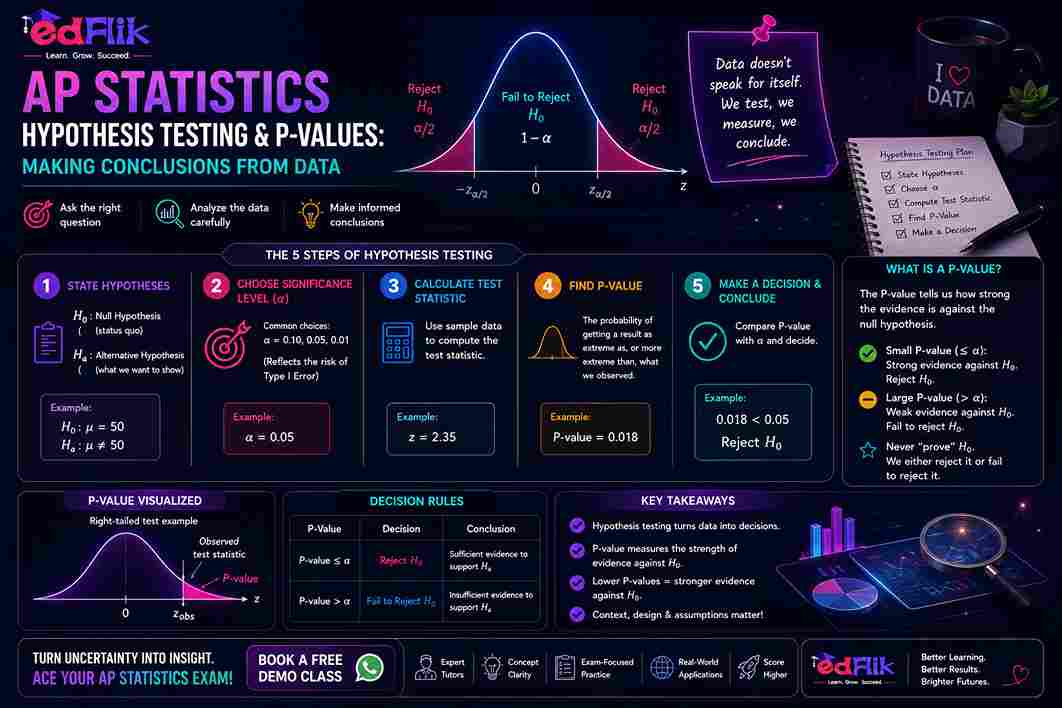
Hypothesis testing is a major AP Statistics topic and a major source of confusion. Students memorize the steps (state hypotheses, calculate test statistic, find p-value, conclude) but don't understand *why*.
A good tutor explains:
· **What a p-value actually means** — NOT "the probability the null hypothesis is true" (common misconception), but "the probability of observing data this extreme (or more) if the null hypothesis is true"
· **Type I and Type II errors** — when do false positives and false negatives occur?
· **Choosing the right test** — when to use z-test vs. t-test vs. chi-square vs. ANOVA
· **Interpreting conclusions** — how to state a conclusion that matches the p-value and context
By exam day, your child understands hypothesis testing conceptually, not just mechanically.
Book Your Free Trial Now
Master AP Statistics.
Book a free trial class with an AP Statistics specialist. WhatsApp **+91 88788 96600** or www.edflik.com
Most students see confidence improve within 4–6 weeks.
5 Tutoring Mistakes Dubai Parents Make (And How to Avoid Them)
Mistake 1: Skipping Probability Practice
Some students assume AP Statistics is just "plugging numbers into formulas." Then probability questions arrive on the exam and they're lost. A good tutor spends time on probability fundamentals.
Mistake 2: Not Understanding the Conceptual Meaning
Students memorize "to find the p-value, calculate the test statistic and find the tail probability." They don't understand *why* they're doing this or *what it means*. Tutors who skip conceptual understanding cost your child.
Mistake 3: Ignoring Calculator Technique
AP Statistics allows (and requires) graphing calculators. Students who don't know their calculator's stats functions waste time. Tutors should teach calculator shortcuts.
Mistake 4: Not Practicing FRQs Early
FRQs are 50% of the exam. Leaving FRQ practice until March means only a few attempts before the exam. Start FRQ practice in January.
Mistake 5: Treating Each Test Type in Isolation
Students learn "t-tests," "chi-square tests," "ANOVA" separately. Then exam questions ask "which test would you use?" and they're confused. A tutor should teach when to use each test *comparatively*.
Why EdFlik AP Statistics Tutors Get Results
AP-Experienced Teachers
Our tutors have taught AP Statistics for 5+ years. They know which topics appear repeatedly on exams. They understand common student misconceptions and how to address them.
Probability Foundations
We build solid probability understanding:
· Rules of probability (addition, multiplication, complement)
· Conditional probability and independence
· Random variables and distributions
· Normal distribution and standardization
By the end, probability feels intuitive, not mysterious.
Hypothesis Testing Clarity
We teach hypothesis testing using a conceptual framework:
1. State null and alternative hypotheses (what are we assuming? what are we testing?)
2. Choose appropriate test (what type of data? how many groups?)
3. Calculate test statistic (standardize the sample result)
4. Find p-value (what's the probability of this result if null is true?)
5. Make conclusion (reject null? or fail to reject?)
By exam day, students understand *why* each step matters.
Calculator Mastery
We teach students to use their graphing calculators efficiently:
· Generating random data
· Creating histograms and boxplots
· Calculating regressions
· Finding normal probabilities
· Running hypothesis tests
By exam day, students don't waste time hunting through calculator menus.
FRQ Strategy & Practice
We teach FRQ structure and practice extensively. Students write 15–20 FRQs before the exam and feel confident with the format.
Monthly Progress Tracking
Every month you'll know:
· Units covered
· Conceptual understanding (probability, tests, distributions)
· Mock exam scores
· Weak areas for next focus
AP Statistics Curriculum
8 Units (All Covered):
1. Exploring one-variable data (distributions, summary statistics, outliers)
2. Exploring two-variable data (correlation, regression, residuals)
3. Collecting data (sampling methods, experimental design, bias)
4. Probability (rules, conditional probability, independence, random variables)
5. Probability distributions (binomial, geometric, normal, sampling distributions)
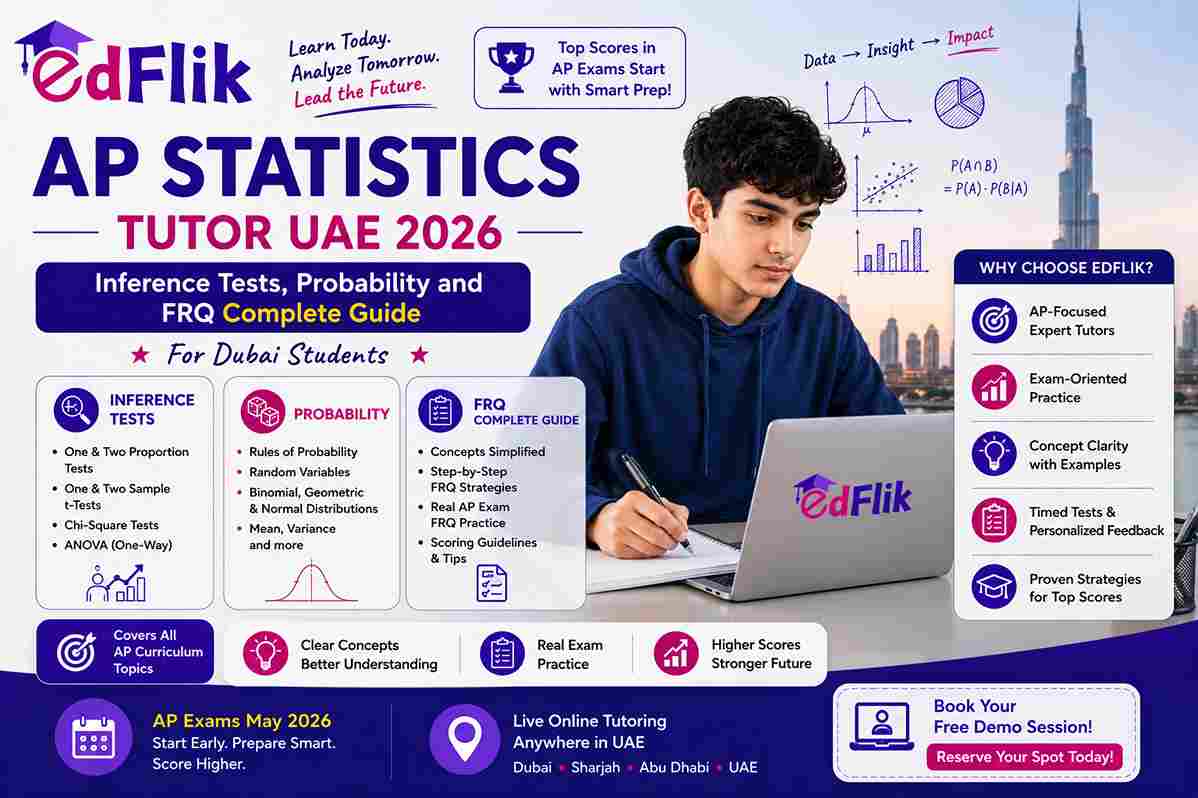
6. Inference for categorical data (confidence intervals, hypothesis tests, chi-square)
7. Inference for quantitative data (t-tests, paired t-tests, ANOVA)
8. Inference for linear regression
Exam Structure:
· Multiple choice: 40 questions, 90 minutes
· Free response: 6 questions, 90 minutes
How It Works: 6 Steps to Statistics Mastery
Step 1: Contact EdFlik
WhatsApp +91 88788 96600 or www.edflik.com. Tell us you're taking AP Statistics and your weak areas.
Step 2: Tutor Matching
Within 24 hours, we match an AP Statistics specialist.
Step 3: Free Trial
Your child attends 1–2 free classes to judge the tutor's teaching approach.
Step 4: Systematic Unit Coverage
2–3 sessions per week (2–3 hours total). We cover units systematically with practice problems and quizzes for each.
Step 5: Practice Exam Focus (January–March)
By January, we transition to full-length practice exams (multiple choice + FRQs). Monthly practice exams track progress.
Step 6: Final Review & Exam Readiness
April–May focuses on weak units and last-minute FRQ refinement.
What Students Say
*"Hypothesis testing was confusing until my tutor explained that a p-value isn't the probability the null is true — it's the probability of the data *given* the null is true. That changed everything."*
— Aisha Al-Kaabi, Dubai
*"My tutor showed me when to use which test (t-test vs. chi-square vs. ANOVA). Suddenly they weren't random — they had logic."*
— Hassan Al-Mazrouei, Sharjah
*"FRQs seemed impossible until I'd written 10+ of them. My tutor's systematic approach made them manageable."*
— Priya Patel, Ajman
FAQs:-
Q: Is AP Statistics as hard as AP Calculus?
A: Different challenges. Calculus requires algebraic fluency. Statistics requires probability intuition and conceptual understanding. Neither is "harder" — just different.
Q: How much tutoring is needed?
A: 2–3 sessions per week (2–3 hours total) is standard.
Q: When should tutoring start?
A: September of your AP year is ideal. This allows 8 months for systematic coverage and practice exams.
Q: What if my child is weak in probability?
A: We can do foundation sessions on probability before moving into AP Statistics content. Most students need 4–6 weeks of probability work.
Q: What's the cost?
A: Starting at 50 AED per hour. Most families invest 200–300 AED per week.
Q: Can my child score a 5 on the exam?
A: With consistent tutoring starting in September and strong effort, a 5 is achievable. Grades depend on starting point and dedication.
Q: Do I need to know Calculus to do AP Statistics?
A: Not really. AP Statistics and AP Calculus are independent. A student can excel at Statistics even if they struggle with Calculus (and vice versa).