Applying Gauss's Law to Spherical and Cylindrical Charge Distributions in AP Physics C: E&M
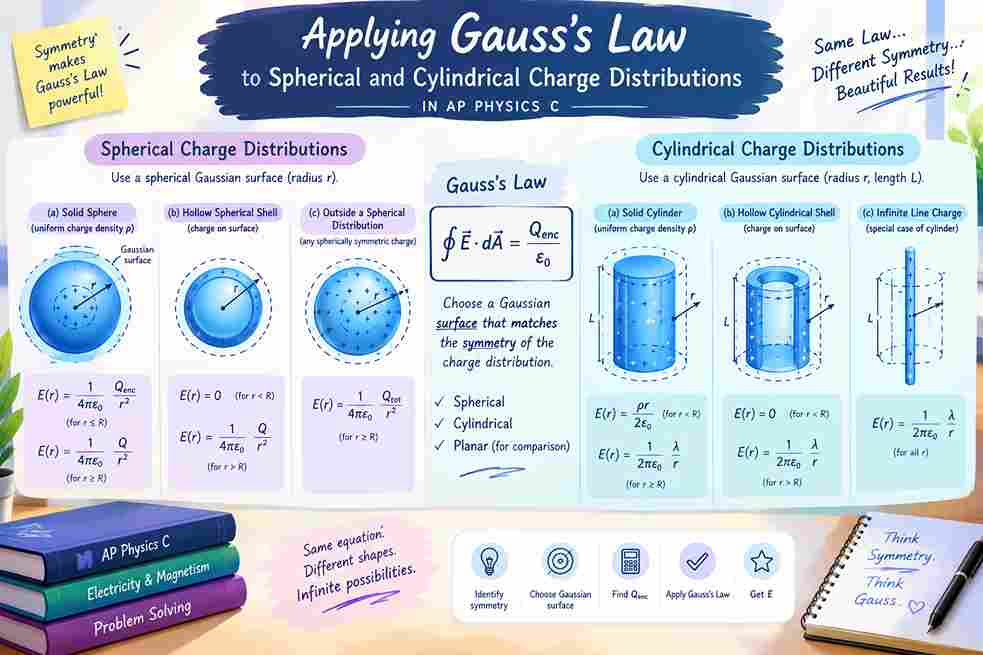
If you are preparing for AP Physics C: Electricity and Magnetism, Gauss's Law is a topic you will meet again and again. It is a shortcut that finds the electric field around a charged object without messy calculations, as long as the charge is arranged in a symmetric way. Spheres and cylinders are the favourite shapes in exam questions, and once you see the pattern, these problems become some of the most satisfying in the course.
In this post, we will build the idea step by step, work through two examples, point out the mistakes students make most often, and share exam tips. Parents, you are welcome to read along too. You do not need to be a physicist to follow it.
What Is Electric Flux?
Electric flux measures how much electric field passes through a surface. Picture holding a hoop in a steady breeze. The more air flows through the hoop, the greater the flux. For electric fields, the surface is imaginary, and we call it a Gaussian surface.
Gauss's Law says:
Φ = ∮ E · dA = Q_enc / ε₀
In plain words, the total electric flux out of a closed surface equals the net charge inside that surface, divided by ε₀ (the permittivity of free space, about 8.85 × 10⁻¹² C²/(N·m²)). The symbol ∮ means we add up contributions over the whole closed surface, and dA is a tiny patch of area pointing outward. Only the charge inside the surface, written Q_enc, counts.
Symmetry Is the Secret
Gauss's Law is always true, but it gives you E easily only when symmetry lets you pull E outside the integral. You need two things:
- The field has the same magnitude everywhere on the Gaussian surface.
- The field is either parallel or perpendicular to the surface, so E · dA becomes simply E dA or zero.
Spheres: A point or spherically symmetric charge produces a field pointing straight out from the centre, with equal strength everywhere at the same distance. Choose a concentric sphere as your Gaussian surface. Its area is 4πr².
Cylinders: A long charged rod or cylinder produces a field pointing radially away from its axis. Choose a coaxial cylinder of radius r and length L. The flat end caps have zero flux because the field runs parallel to them, so only the curved side, with area 2πrL, contributes.
Your job is to pick a surface that matches the symmetry and passes through the point where you want the field.
Worked Example 1: Uniformly Charged Solid Sphere
A solid sphere of radius R carries total charge Q spread evenly through its volume. Find E inside (r < R) and outside (r > R).
Step 1: Choose the Gaussian surface. A concentric sphere of radius r.
Step 2: Find the flux. The field is radial and constant over the surface, so Φ = E × 4πr².
Step 3: Find the enclosed charge.
- Inside (r < R): The charge density is ρ = Q / ((4/3)πR³). The enclosed charge is Q_enc = ρ × (4/3)πr³, which simplifies to Q_enc = Q r³ / R³.
- Outside (r > R): The whole sphere is enclosed, so Q_enc = Q.
Step 4: Apply Gauss's Law.
- Inside: E × 4πr² = (Q r³ / R³) / ε₀, so E = Q r / (4π ε₀ R³)
- Outside: E × 4πr² = Q / ε₀, so E = Q / (4π ε₀ r²)
Check: At r = R, both answers give Q / (4π ε₀ R²). The field matches smoothly at the surface, which is a great habit to check on every problem.
The thin shell: For a thin spherical shell of charge Q, a Gaussian sphere drawn inside the shell encloses no charge. So E = 0 inside the shell. Outside, the field is Q / (4π ε₀ r²), exactly like a point charge at the centre.
Worked Example 2: Long Charged Cylinder
Now take an infinitely long solid cylinder of radius R with uniform charge density ρ (charge per unit volume). "Infinitely long" means we ignore the ends, so the field points radially outward.
Step 1: Choose the Gaussian surface. A coaxial cylinder of radius r and length L.
Step 2: Find the flux. Only the curved side contributes, so Φ = E × 2πrL.
Step 3: Find the enclosed charge.
- Inside (r < R): Q_enc = ρ × πr²L
- Outside (r > R): Q_enc = ρ × πR²L
Step 4: Apply Gauss's Law.
- Inside: E × 2πrL = ρπr²L / ε₀, so E = ρr / (2ε₀)
- Outside: E × 2πrL = ρπR²L / ε₀, so E = ρR² / (2ε₀r)
Check: At r = R, both give ρR / (2ε₀). The answers agree at the boundary.
A line of charge: For an infinitely long line with charge per unit length λ, the enclosed charge in a length L is λL. Gauss's Law gives E × 2πrL = λL / ε₀, so E = λ / (2πε₀r).
Common Mistakes to Avoid
- Choosing the wrong surface. A cube does nothing for a sphere. Match the surface to the symmetry.
- Using total charge instead of enclosed charge. Inside a uniform sphere or cylinder, only the charge within radius r counts.
- Using the wrong area. A sphere uses 4πr². A cylinder uses only the curved side, 2πrL, because the end caps contribute no flux.
- Mixing up ε₀ with k or μ₀. Coulomb's law uses k = 1/(4πε₀). Gauss's Law uses ε₀ directly. Mixing them is a common source of factors of 4π.
- Ignoring direction. A positive charge's field points outward, and a negative charge's field points inward. State the direction in your final answer.
- Skipping the boundary check. Confirming that your inside and outside answers match at r = R catches many algebra slips.
Exam Tips for AP Physics C: E&M
Multiple choice
- Identify the symmetry in a few seconds before doing any algebra.
- Remember the quick proportionalities. Inside a uniform sphere, E grows with r. Outside, E falls off as 1/r². Inside a uniform cylinder, E grows with r. Outside, E falls off as 1/r. These often eliminate wrong options immediately.
- Know that E = 0 inside a shell.
Free response
- Write the Gaussian surface in words, then the flux, then the enclosed charge, then Gauss's Law, before substituting numbers. Graders award points for a correct setup even if the arithmetic slips.
- Check your units. Electric field is in N/C or V/m.
- State the direction of the field.
- Check your boundary at r = R.
How EdFlik Can Help
Some physics topics click quickly, and others need patient practice. At EdFlik, every class is live and one-to-one with a certified teacher who works at your child's pace. If Gauss's Law still feels like a puzzle, we can work through practice problems together, build confidence step by step, and share monthly progress reports with parents.
Start with a free trial class to see how it fits. Visit www.edflik.com or email support@edflik.com.
Frequently Asked Questions
Do I need calculus for Gauss's Law?
AP Physics C: E&M does use calculus, and Gauss's Law is written with an integral. For symmetric charges, though, the integral becomes simple multiplication, so most problems rely on algebra plus a clear understanding of symmetry.
Why can't I use Gauss's Law for every charge distribution?
Gauss's Law is always true, but it only gives the field easily when symmetry lets you take E outside the integral. For irregular charge shapes with no symmetry, other methods, such as adding up contributions with Coulomb's law, are needed.
What is a Gaussian surface?
It is an imaginary closed surface you choose to calculate flux. It does not physically exist. The best choice matches the symmetry of the charge: a sphere for a spherical charge, or a coaxial cylinder for a long rod or line.
Why is the field zero inside a conducting shell?
Any Gaussian surface drawn inside the hollow region encloses no charge, so Gauss's Law gives E = 0 there. Charge on a conductor spreads over its outer surface, which leaves the inside empty of field.
How is this different from AP Physics 2?
AP Physics 2 introduces electric fields and Gauss's Law in a mostly conceptual, algebra-based way. AP Physics C: E&M expects you to set up and solve the full integral for symmetric charges and to use the result confidently in multi-step, calculus-based problems.