
Arabic Tutor UAE 2026 — MOE, IGCSE & A-Level Arabic for Native and Non-Native Speakers
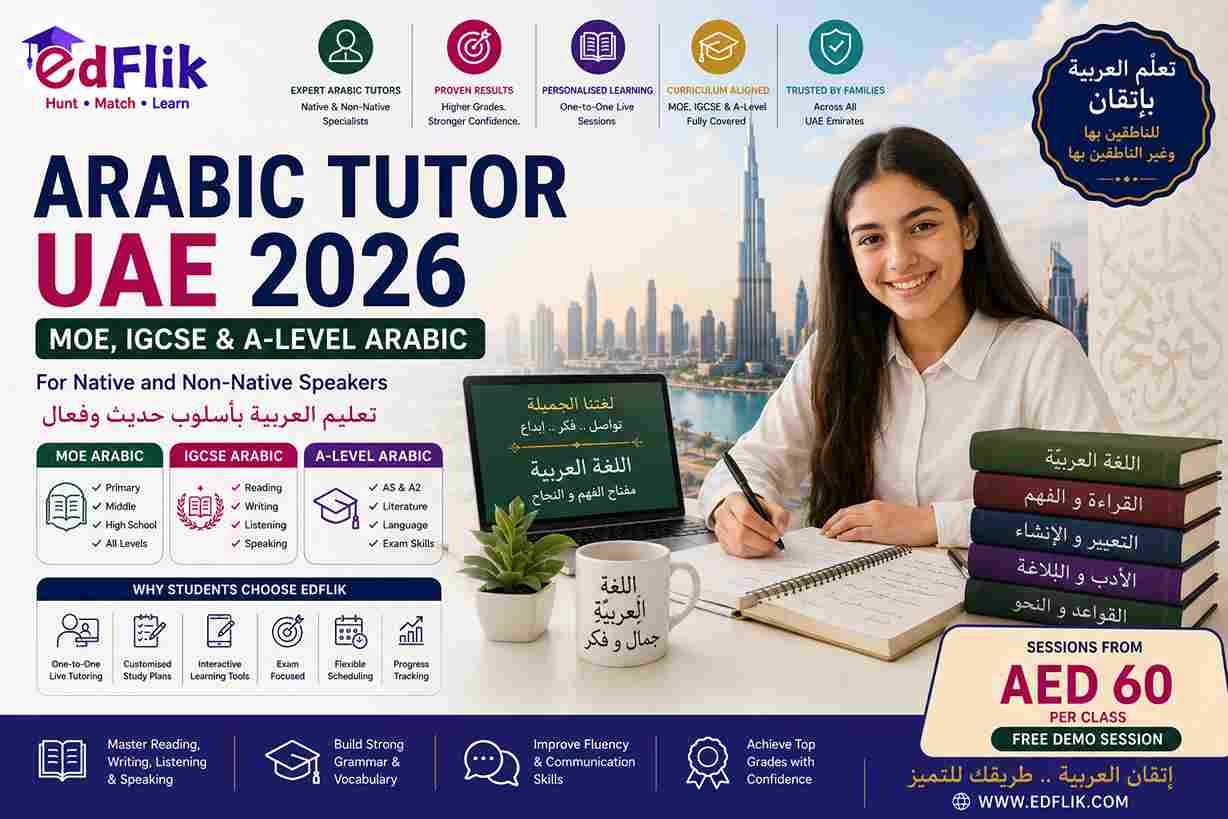
Arabic holds a unique position in UAE education: it is the only subject that is compulsory for every student at every private school in the country, regardless of nationality, curriculum board, or fee bracket. From a student at GEMS Wellington in Dubai studying IB, to a student at Indian High School Dubai studying CBSE, to a student at BSAK Abu Dhabi studying A-Level — every student in UAE schools studies Arabic. Yet Arabic is also the subject with the most fragmented and least curriculum-specific tutoring support available in the UAE market.
This guide covers the Arabic language learning landscape across UAE school types, the specific differences between MOE Arabic, IGCSE Arabic, A-Level Arabic, and EmSAT Arabic preparation, and how EdFlik provides curriculum-matched Arabic support for both native Arabic speakers and non-Arab expatriate students.
Arabic in UAE Schools — The Legal Requirement
KHDA (Dubai) and ADEK (Abu Dhabi) both mandate Arabic instruction as follows:
• All Dubai private schools: Arabic is compulsory from Grade 1 (Year 2) through at least Grade 9 (Year 10). From 2025–26, Arabic is also mandated for children aged 4 to 6 at all Dubai private schools and early childhood centres.
• All Abu Dhabi private schools: Arabic instruction at ADEK-required contact hours per week, aligned with MOE Arabic standards for the relevant grade level.
• Sharjah and other emirates: Ministry of Education Arabic requirements apply to all private schools.
• Non-Arab students: study Arabic B (as an additional language/second language) with a minimum of 4 lessons per week. Native Arabic speakers study Arabic A (first language) with higher instructional time requirements.
The Four Types of Arabic Tutoring UAE Students Need
|
Arabic Type |
Who Needs It |
Assessment |
Tutoring
Focus |
|
UAE MOE Arabic (Arabic A) |
Native Arabic speakers in MOE and private schools |
Internal school assessments; MOE-aligned tests |
Classical and Modern Standard Arabic grammar; composition;
literature |
|
UAE MOE Arabic (Arabic B) |
Non-Arab expatriates in all UAE private schools |
Internal school assessments; school Arabic B curriculum |
Vocabulary building; reading comprehension; functional writing;
pronunciation |
|
Cambridge IGCSE Arabic First Language (0508) |
Native-speaker IGCSE students in British-curriculum schools |
Two written papers: comprehension + composition |
Literary analysis; formal composition; directed writing; summary
paraphrase |
|
Cambridge IGCSE Arabic Foreign Language (0544) |
Non-native-speaker IGCSE students |
Listening, Reading, Speaking, Writing components |
Functional proficiency; examination skill development |
|
EmSAT Arabic |
Grade 12 students applying to UAE universities |
Computer-based adaptive test, score 600–1500 |
I'rab (case endings), complex comprehension, formal composition,
literary devices |
|
IB Arabic A (Language & Literature) |
Native speakers in IB schools |
Individual Oral, Papers 1 and 2, HL Essay |
IB command terms applied to Arabic texts; Individual Oral
preparation |
|
IB Arabic B |
Non-native speakers in IB schools |
Interactive oral, written assignment, Paper 1 and 2 |
Functional use of Arabic; grammar and communication for IB B
level |
|
A-Level Arabic |
Cambridge A-Level students |
Papers covering translation, reading, writing, literature |
Advanced formal Arabic; translation technique; literary
commentary |
Arabic for Non-Arab Expatriate Students — The Specific Challenge
The most underserved Arabic tutoring community in the UAE is non-Arab expatriate students. These students — the majority of students at most Dubai and Abu Dhabi international schools — are required to study Arabic B from Year 2 or Grade 1 onwards, but typically have no Arabic home language exposure and limited opportunity to practise outside of school. By Year 10 or Grade 9, when Arabic assessments become more demanding, many non-Arab students are struggling with a language they have studied for 8 to 10 years but never had the opportunity to immerse in.
Effective Arabic B tutoring for non-Arab students focuses on: vocabulary acquisition through contextualised reading rather than rote memorisation; grammatical patterns (verb conjugation, gender agreement, plural formation) practised in communicative contexts; reading comprehension strategies that leverage the student's other language learning skills; and exam-specific writing techniques for the descriptive and formal writing tasks assessed in UAE school Arabic B curricula.
EmSAT Arabic — What UAE Grade 12 Students Need to Know
The EmSAT Arabic exam is required for all UAE high school graduates applying to UAE universities. It assesses Modern Standard Arabic (Fusha) — formal written and literary Arabic — not spoken dialect. The five key skill areas tested:
1. Reading comprehension: complex formal Arabic texts with vocabulary and inference questions.
2. Grammatical analysis (I'rab): identifying and explaining the grammatical function and case ending of words in formal sentences — a skill requiring specific systematic preparation.
3. Literary device identification: recognising and explaining metaphor, simile, repetition, and other rhetorical devices in literary Arabic extracts.
4. Vocabulary in context: understanding the precise meaning of formal Arabic vocabulary within a passage.
5. Formal composition: writing structured formal Arabic paragraphs in response to a prompt — requiring standard Arabic essay structure, grammatical accuracy, and appropriate formal register.
EmSAT Arabic scores range from 600 to 1500. Most UAE universities require a minimum of 900 to 1100 for standard programmes. Score targets: Khalifa University requires 1100 for Engineering; NYU Abu Dhabi requires competitive Arabic proficiency; UAEU typically requires 900 for most programmes. Emirates students (UAE nationals) typically require higher EmSAT Arabic scores for federal scholarship eligibility.
IGCSE Arabic First Language (0508) — Exam Technique for Native Speakers
Cambridge IGCSE Arabic First Language (0508) is taken by native Arabic speakers at British-curriculum schools across the UAE. It is assessed through two written papers:
• Paper 1 (Reading and Directed Writing, 2 hours): comprehension questions on formal Arabic texts, requiring precise textual evidence and formal Arabic written responses; a directed writing task (letter, article, report, speech) in a specific register and audience.
• Paper 2 (Composition and Summary, 1 hour 45 minutes): a formal Arabic composition (descriptive, narrative, argumentative, or discursive) and a summary of a provided text in the student's own Arabic.
The most common technique issues among UAE IGCSE Arabic 0508 students: formal Arabic composition lacks structural variety in sentence patterns (over-reliance on simple subject-verb-object constructions); summary responses contain copied phrases from the original text rather than genuine paraphrase in the student's own Arabic; directed writing does not sufficiently adapt register for the specified audience.
Frequently Asked Questions — Arabic Tutor UAE
Q: Is Arabic compulsory in UAE schools?
A: Yes — at all Dubai, Abu Dhabi, and Sharjah private schools. Arabic B (non-native speakers) is required from Grade 1 or Year 2 through at least Grade 9 for all expatriate students regardless of nationality. Arabic A (native speakers) is required for Arab students. From 2025–26, KHDA mandates Arabic for children aged 4–6 at all Dubai private schools.
Q: What is the difference between Arabic A and Arabic B?
A: Arabic A: native speakers — first language curriculum, classical and Modern Standard Arabic, literature, formal grammar. Arabic B: non-native speakers — second language curriculum, functional communication, vocabulary, basic grammar. Both designations are present in UAE private schools and require different teaching approaches.
Q: What is IGCSE Arabic and how is it assessed?
A: Cambridge IGCSE Arabic First Language (0508) for native speakers: two written papers covering comprehension, directed writing, composition, and summary. Cambridge IGCSE Arabic Foreign Language (0544) for non-native speakers: listening, reading, speaking, and writing components. EdFlik provides tutoring for both, matched to the student's designation.
Q: What is EmSAT Arabic and who needs it?
A: The EmSAT Arabic exam is required for UAE high school graduates applying to UAE universities. It assesses Modern Standard Arabic (Fusha) — reading comprehension, I'rab (grammatical case analysis), literary devices, vocabulary in context, and formal composition. Scores range from 600–1500. Most universities require 900–1100 minimum. Targeted specialist preparation is essential.
Q: How much does an Arabic tutor cost in UAE in 2026?
A: EdFlik: from AED 55/class for MOE Arabic B; AED 60 for IGCSE Arabic (0508 or 0544); AED 65 for EmSAT Arabic and A-Level Arabic. Free demo session. No lock-in. www.edflik.com. In-home private tutors: AED 80–200/hr.
Q: Does EdFlik provide Arabic tutoring for non-Arab expatriate students?
A: Yes. EdFlik provides Arabic B tutoring specifically designed for non-Arab students at UAE private schools — a distinct teaching approach from Arabic A. Tutors experienced in building Arabic as a second language, aligned to the specific school's Arabic B curriculum. Sessions from AED 55 free demo.
How EdFlik Provides Arabic Tutoring Across UAE
EdFlik Arabic tutors are matched to the specific Arabic type: MOE Arabic A or B, Cambridge IGCSE 0508 or 0544, EmSAT Arabic, IB Arabic A or B, or A-Level Arabic. Native Arabic speakers and non-Arab expatriate students are both served by specialists in the relevant curriculum and assessment level. Sessions from AED 55 per class. Free demo session. Book at www.edflik.com.