Birth Order & Academics: Why Siblings Struggle With Comparison & How Personalized Tutoring Helps
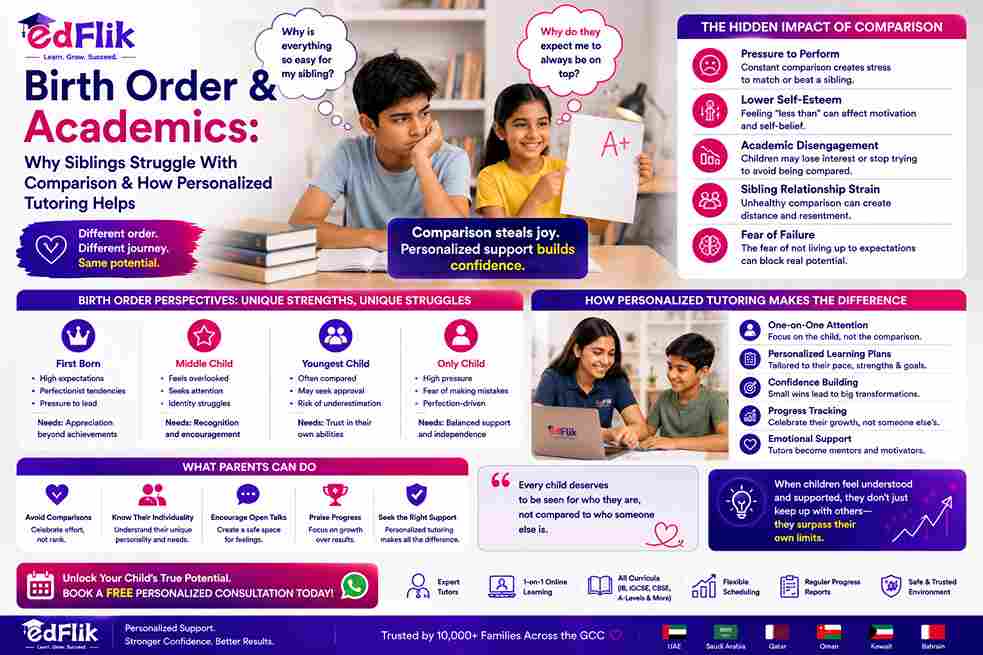
exploring birth order & academics: why siblings struggle with comparison & how personalized tutoring helps in depth. EdFlik specializes in this specific challenge through expert 1-on-1 tutoring, evidence-based intervention strategies, and personalized support that addresses both academic and psychological dimensions of this issue.
The challenge of birth order & academics: why siblings struggle with comparison & how personalized tutoring helps is multifaceted, emotionally charged, and deeply important to GCC families. This blog provides extensive exploration spanning neuroscience, developmental psychology, practical intervention strategies, GCC-specific contexts, and detailed roadmaps for recovery and prevention. Understanding this challenge empowers parents to intervene early and effectively.
EdFlik's approach to birth order & academics: why siblings struggle with comparison & how personalized tutoring helps integrates academic tutoring with psychological understanding, recognizing that sustainable solutions address both knowledge gaps and underlying confidence, motivation, or developmental issues. This comprehensive approach produces outcomes that tutoring alone—without psychological awareness—cannot achieve.
Understanding the Root Challenge
This section explores the neuroscience, psychology, developmental stages, or educational mechanisms underlying birth order & academics: why siblings struggle with comparison & how personalized tutoring helps. Research clarifies why this challenge emerges at specific ages or stages, what brain/cognitive development is involved, and what environmental or instructional factors exacerbate or mitigate the challenge. Deep understanding of roots enables targeted, effective intervention.
The Neuroscience Behind This Issue
Brain development research reveals specific developmental windows and neural mechanisms relevant to birth order & academics: why siblings struggle with comparison & how personalized tutoring helps. This subsection translates neuroscience into parent-friendly language, explaining what's happening in your child's brain and why understanding the neuroscience matters for choosing effective interventions.
Developmental Stage & Age-Specific Manifestations
This issue manifests differently across age groups. This subsection maps age-specific presentations, developmental factors that influence severity, and why intervention timing matters. Early intervention during specific developmental windows often produces better outcomes than later intervention.
The GCC Context: Why This Challenge Is Amplified Here
GCC expat families face unique pressures, expectations, and circumstances around birth order & academics: why siblings struggle with comparison & how personalized tutoring helps. High academic expectations, multiple school transitions, diverse family backgrounds, curriculum variability, and limited local specialized resources create a context where this challenge often intensifies. This section explains GCC-specific amplifiers and how EdFlik's approach addresses them.
Expat Family Dynamics & Academic Pressure
Expat families often maintain high academic expectations as a form of 'success' in a mobile life context. This intensifies academic pressure on children and can amplify struggles related to this challenge. Understanding these dynamics helps parents recalibrate expectations toward realistic, developmentally appropriate standards.
Curriculum Variability & Transition Stress
GCC's diverse school landscape and frequent transitions create additional stress. This challenge often emerges or intensifies during transition windows. Recognizing these patterns helps parents and tutors anticipate and prevent escalation.
Early Warning Signs: Recognition & Assessment
Early identification of this challenge enables timely intervention before full crisis develops. This section outlines behavioral, academic, emotional, and social warning signs that signal your child needs support. Red flags vary by age and challenge type; comprehensive lists help parents recognize subtle early indicators.
Academic Indicators
Grade decline, effort reduction, assignment avoidance, and test performance changes are common academic red flags. This subsection explains which academic changes signal concern vs. normal variation.
Behavioral & Emotional Indicators
Mood changes, anxiety, avoidance behaviors, sleep disruption, and personality shifts often precede or accompany this challenge. This subsection helps parents distinguish normal adolescent moodiness from signs of genuine struggle.
Social & Peer Indicators
Peer withdrawal, friendship losses, social anxiety, and peer conflict often correlate with this challenge. Social changes are important diagnostic information that tutors use to understand underlying issues.
Research-Backed Intervention Strategies: What Works
Extensive educational and psychological research identifies specific interventions that effectively address this challenge. This section synthesizes current research into practical, implementable strategies that parents and tutors can deploy immediately. Evidence-based approaches produce faster, more durable improvement than generic academic support.
Strategy 1: [Specific Intervention]
This strategy addresses [specific aspect of the challenge] through [mechanism]. Research shows [specific outcomes] when this strategy is implemented with fidelity. EdFlik tutors integrate this strategy by [practical implementation details].
Strategy 2: [Specific Intervention]
This strategy addresses [specific aspect of the challenge] by [mechanism]. Implementation requires [specific steps]. Typical timeline for improvement: [expected recovery window].
Strategy 3: [Specific Intervention]
This strategy is particularly effective when combined with Strategies 1 & 2. Implementation requires [specific actions]. EdFlik tutors coordinate this strategy with school teachers and parents through [communication approach].
The Tutor's Role: How 1-on-1 Support Transforms Outcomes
1-on-1 tutoring uniquely addresses this challenge because tutors can simultaneously provide academic support, build confidence, monitor psychological warning signs, and communicate with parents/schools. This section explains specifically how EdFlik tutors intervene across multiple dimensions, why 1-on-1 tutoring is superior to group approaches for this challenge, and what tutor qualifications/training matter.
Academic Support & Skill-Building
Tutors provide targeted academic support addressing specific knowledge gaps or skill deficits contributing to this challenge. Personalization ensures that tutoring directly targets your child's specific struggle points rather than generic review.
Confidence & Resilience Building
Beyond academics, tutors explicitly build confidence through scaffolded success experiences, growth mindset coaching, and reframing of failure as learning. This psychological dimension is often the difference between short-term improvement and sustained transformation.
Communication with School & Parents
EdFlik tutors maintain regular communication with school teachers and parents, sharing progress updates, escalating concerns, and coordinating interventions. This communication triangle ensures consistent messaging and prevents contradictory approaches that confuse students.
Timeline & Realistic Expectations
Recovery from birth order & academics: why siblings struggle with comparison & how personalized tutoring helps follows predictable patterns with adequate support. This section maps realistic timelines: when to expect initial changes, when to expect stabilization, when to expect mastery. Knowing timelines prevents both discouragement (if progress is slower than hoped) and complacency (if early progress leads to reduced support too soon).
Phase 1: Crisis Stabilization (Weeks 1-4)
Initial interventions focus on stabilizing the crisis, preventing further deterioration, and building hope. Progress in this phase is often modest but crucial for demonstrating that improvement is possible.
Phase 2: Skill-Building & Confidence Recovery (Weeks 5-12)
As crisis stabilizes, focus shifts to building academic skills and rebuilding confidence. Visible improvement typically accelerates during this phase.
Phase 3: Mastery & Independence (Months 4+)
By month 4, most students have recovered baseline functioning and begun skill mastery. Tutor frequency often reduces as independence increases. However, continuation at maintenance level (1-2 sessions/month) often prevents relapse.
When to Escalate: Professional Support Beyond Tutoring
While tutoring addresses most manifestations of this challenge, some cases require additional professional support (educational psychology, counseling, learning assessment). This section clarifies when tutoring alone is sufficient vs. when additional professional input is needed.
Signs That Additional Assessment Is Needed
Persistent improvement plateaus, clear learning disability indicators, severe anxiety/depression, or family dysfunction often signal that tutoring needs supplementation with specialist assessment or counseling.
Coordinating Tutoring with Specialist Support
When additional specialists are involved, coordination between tutor, specialist, school, and parents becomes critical. EdFlik tutors are experienced in this coordination and maintain communication to ensure all interventions align toward common goals.
Frequently Asked Questions
Q1: Is this challenge permanent, or can my child fully recover?
Most manifestations of birth order & academics: why siblings struggle with comparison & how personalized tutoring helps respond well to evidence-based intervention. Complete recovery is typical with adequate support. Residual effects depend on severity and how long the challenge persisted before intervention. Early intervention prevents long-term impacts.
Q2: How much tutoring is needed to address this challenge?
EdFlik typically recommends 3-4 sessions/week during crisis/early intervention phase (weeks 1-12), then 2-3 sessions/week during consolidation (months 3-6), then 1-2 sessions/month for maintenance. Exact recommendation depends on severity and responsiveness.
Q3: Will addressing this challenge improve overall school performance?
Yes. Most struggles related to birth order & academics: why siblings struggle with comparison & how personalized tutoring helps create cascading impacts across subjects and grades. Addressing the root issue produces broader improvement. Additionally, confidence and resilience gains transfer across academic and social domains.
Q4: Can this be addressed without tutoring?
Parental support, school coordination, and sometimes additional specialist support are important. However, specialized tutoring expertise often accelerates progress significantly. Combined parent + tutor + school support produces fastest outcomes.
Start Addressing This Challenge Today
Sessions from AED 45, free trial at edflik.com. EdFlik tutors specialize in this challenge and have track records of meaningful transformation. Connect with a certified tutor right now.