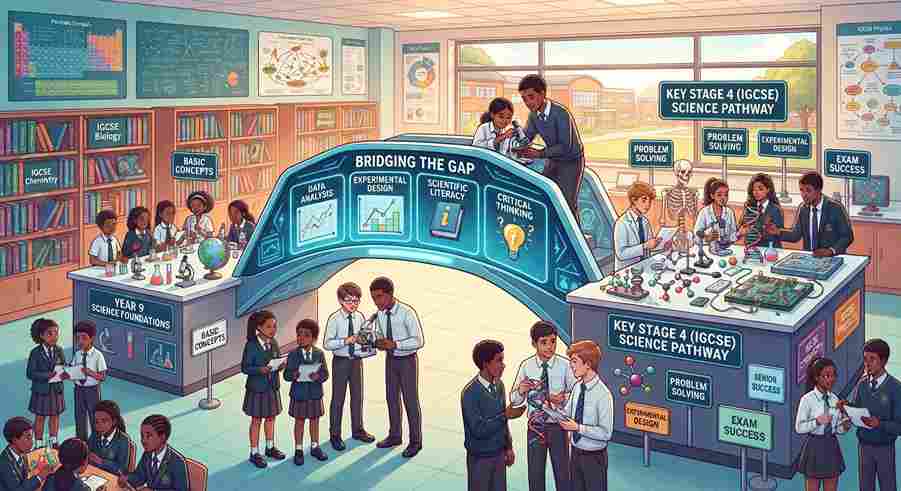
Bridging the Gap: Preparing for Key Stage 4 (IGCSE) Science from Year 9
Last Updated: September 2026 | By EdFlik Education Team
For students transitioning from Year 9 (Lower Secondary) into Year 10—the official start of Key Stage 4 and IGCSE coursework—the academic landscape shifts dramatically. Whether your child is studying in the UAE, the UK, or international schools across the globe, the leap from general Key Stage 3 science to specialized IGCSE Biology, Chemistry, and Physics can feel like scaling a steep cliff.
In Year 9, science is often broad, exploratory, and conceptual. In Key Stage 4, it becomes rigorous, mathematical, precise, and heavily dependent on specific exam board terminology and past paper technique.
If you want to ensure your teenager avoids the common "Year 10 shock" and steps into their IGCSE years with absolute confidence, here is a complete, expert guide on how to bridge the gap successfully.
What Changes Between Key Stage 3 and Key Stage 4?
Understanding the shift helps parents and students prepare mentally and academically:
- Depth Over Breadth: Instead of touching briefly upon topics like "space" or "ecosystems," students dive deep into cellular respiration, organic chemistry reaction mechanisms, and electromagnetic induction.
- The Math Connection: Science in IGCSE is no longer just qualitative. Students must master calculations—such as moles in chemistry, rearranging physics kinematic formulas, and analyzing biological data through statistical ratios.
- Exam Board Strictness: Exam boards like Cambridge (CAIE) and Pearson Edexcel use rigid mark schemes. Knowing a scientific concept is no longer enough; students must write answers using exact scientific keywords to secure marks.
Step 1: Solidify Foundational Misconceptions Early
Many students enter Year 10 carrying unresolved misunderstandings from Key Stage 3. If a student has a shaky grasp of basic atomic structure, trying to learn chemical bonding in Year 10 is like trying to build a roof without walls.
- Actionable Tip: Spend the summer or early term reviewing foundational pillars: the particle theory of matter, plant and animal cell structures, energy stores and transfers, and basic algebraic rearrangement (solving equations for $x$).
Step 2: Master Scientific Terminology
Examiners do not award marks for vague phrasing. If a student writes "the particles move faster because they are heated" instead of "thermal energy is transferred to kinetic energy, increasing particle velocity and collision frequency," they will lose points.
- Actionable Tip: Have your child start a dedicated scientific glossary notebook. Every time a new key term is introduced in class (e.g., isotope, osmosis, or terminal velocity), they should write down the formal definition and a concrete example.
Step 3: Embrace the Language of Mathematics in Science
A significant percentage of marks in IGCSE Physics and Chemistry papers come from mathematical calculations.
- Physics: Students must comfortably memorize and rearrange formulas (e.g., $v = u + at$, $E_k = \frac{1}{2}mv^2$, and $P = IV$).
- Chemistry: Balancing chemical equations and calculating relative formula masses ($M_r$) must become second nature.
- Actionable Tip: Practice multi-step calculation questions early. Encourage your child to always write down the formula, substitute values with units, and show every line of working out.
Step 4: Develop Scientific Inquiry and Graph Skills
IGCSE science papers feature extensive data-analysis questions where students must interpret unfamiliar tables, charts, and graphs.
- Actionable Tip: Practice drawing lines of best fit, calculating gradients (slopes) from experimental graphs, and identifying independent, dependent, and control variables in an investigation. Understanding why a control variable matters is a guaranteed exam question type.
Step 5: Build a Consistent Revision Habit
The biggest mistake Year 10 students make is waiting until the end-of-year exams to open their textbooks.
- Spaced Repetition: Use active recall methods—such as flashcards and mind maps—to review weekly topics rather than cramming before exams.
- Past Paper Introduction: Even in Year 10, looking at past paper style questions helps students understand how examiners test knowledge, shifting their mindset from passive reading to active problem-solving.
Worried about your child making the transition to IGCSE Science? EdFlik offers expert, 1-to-1 online tutoring customized for IGCSE Biology, Chemistry, and Physics, helping students bridge learning gaps and build lifelong academic confidence.Book a Free Demo Class Today!
Frequently Asked Questions (FAQs)
Q1: Is Combined Science harder than Triple Science (Separate Sciences) in IGCSE?
Ans: Combined Science covers all three sciences (Biology, Chemistry, Physics) but awards two GCSE grades based on a balanced syllabus, whereas Triple Science awards three separate GCSE grades with deeper content (such as organic chemistry extensions and astrophysics). Triple Science is more rigorous and is recommended for students planning to pursue A-Level or IB sciences.
Q2: When should students start preparing for IGCSE exams?
Ans: Preparation starts on day one of Year 10. While intensive past-paper revision usually ramps up 3 to 4 months before the final exams in Year 11, building strong study habits, note-taking skills, and conceptual clarity in Year 10 is essential.
Q3: Why do students struggle most when transitioning to IGCSE Science?
Ans: The primary hurdle is the jump in academic rigor and the strict requirement for precise keyword usage in exam mark schemes. Memorizing general facts is no longer enough; students must apply concepts to unfamiliar real-world scenarios.
Q4: How can EdFlik help my child transition smoothly into IGCSE Science?
Ans: EdFlik connects students with experienced, certified 1-to-1 online tutors who specialize in IGCSE Biology, Chemistry, and Physics. Our tutors break down complex theories, strengthen mathematical problem-solving skills, and guide students through targeted exam practice.