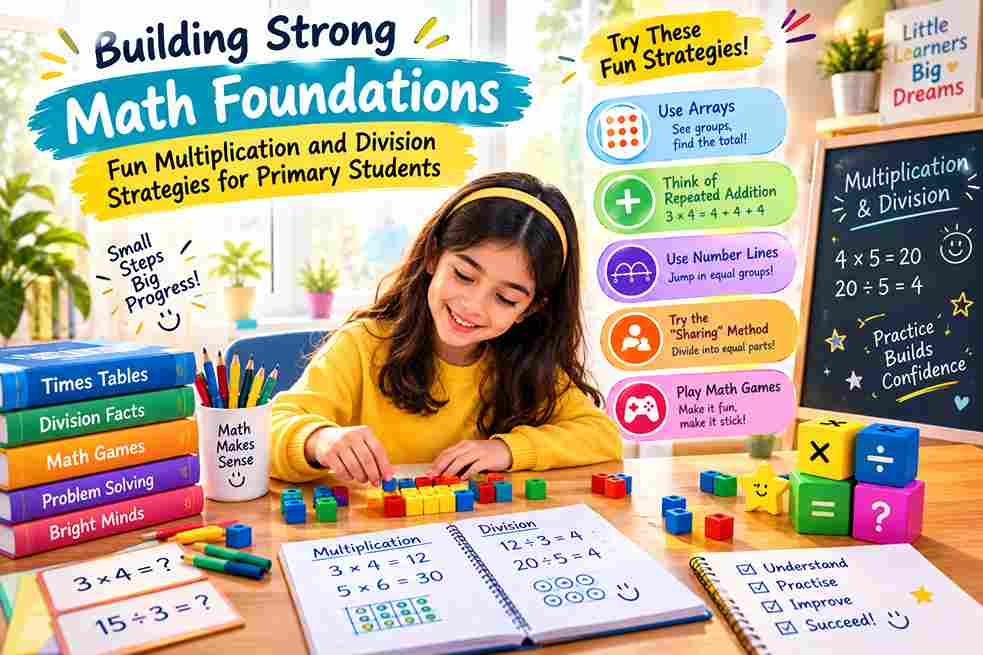
Building Strong Math Foundations: Fun Multiplication and Division Strategies for Primary Students
Last Updated: September 2026 | By EdFlik Education Team
For primary school students—whether navigating British Key Stage 2, the IB Primary Years Programme (PYP), or American Elementary school math—multiplication and division represent a massive developmental milestone. Moving beyond basic addition and subtraction into multiplicative thinking is where many children first encounter abstract mathematical reasoning.
Unfortunately, traditional rote memorization and endless timed drills often spark math anxiety rather than mathematical curiosity. When children view multiplication tables as chores rather than patterns to explore, they build mental roadblocks that can hinder their math confidence for years to come.
In this comprehensive, engaging guide, our expert primary mathematics educators break down how children learn multiplicative structures, share playful, hands-on strategies to make learning fun, and explain how to build rock-solid foundational math skills.
Part 1: Moving Beyond Rote Memorization (The Why Behind Multiplication)
Multiplication is fundamentally repeated addition and scaling, while division is sharing and grouping. Before asking children to memorize times tables up to $12 \times 12$, they must visualize what these numbers actually represent in the physical world.
1. The Power of Arrays
An array is an orderly arrangement of objects in rows and columns.
- Visualizing Math: Instead of just saying $3 \times 4 = 12$, have students arrange 12 counters, toy blocks, or buttons into 3 rows of 4 columns.
- The Commutative Property: By simply rotating the array 90 degrees, students instantly see that 3 rows of 4 ($3 \times 4$) equals 4 rows of 3 ($4 \times 3$). This visual discovery demystifies algebraic properties long before formal algebra begins.
2. Equal Groups and Repeated Addition
Use everyday household items to model multiplication naturally:
- "If each spider has 8 legs, how many legs do 3 spiders have?" ($\text{8} + \text{8} + \text{8} = \text{24}$, or $3 \times 8 = 24$).
Part 2: Fun, Hands-On Strategies for Multiplication Success
Transforming multiplication practice from a boring worksheet drill into an interactive game builds positive associations with mathematics:
1. Skip-Counting Rhythm and Music
Long before formal multiplication, children should master skip-counting ($2, 4, 6, 8, 10\dots$ or $5, 10, 15, 20\dots$).
- Clap and Count: Turn skip-counting into a rhythmic clapping game or sing along to upbeat multiplication chants. Rhythm helps encode numerical sequences into long-term memory.
2. Array Treasure Hunts Around the House
Send students on a "math safari" around their home or classroom to spot arrays in everyday life:
- A a carton of eggs ($2 \times 6$)
- A bar of chocolate ($4 \times 4$)
- Window panes, floor tiles, or muffin tins.
- Have them photograph or sketch these arrays and write the matching multiplication sentence.
3. Card and Dice Games
- Dice Product War: Roll two standard six-sided dice, multiply the numbers together, and whoever calls out the correct product first wins both dice. Add multi-sided dice as children grow more confident.
Part 3: Unlocking Division Through Inverse Operations
Many students view division as intimidating because it feels entirely disconnected from multiplication. The secret to mastering division is teaching it as the inverse (opposite) of multiplication.
1. The Fact Family Triangle
Use triangular flashcards to connect multiplication and division simultaneously:
- Put the product (e.g., $24$) at the top vertex, and the two factors ($4$ and $6$) at the bottom vertices.
- From this single triangle, students instantly see four related math facts:
- $4 \times 6 = 24$
- $6 \times 4 = 24$
- $24 \div 4 = 6$
- $24 \div 6 = 4$
2. Sharing and Grouping Manipulatives
- Division as Sharing (Fair Share): Give a student 12 counters and 3 paper plates. Ask them to share the counters equally across the plates. How many on each plate? ($12 \div 3 = 4$).
- Division as Grouping (Measurement): Give them 12 counters and ask, "Put these into groups of 3. How many groups did you make?" ($12 \div 3 = 4$ groups). Both methods yield the same mathematical result but build flexible mental models.
Part 4: Top 4 Tips for Parents to Support Math Confidence at Home
- Keep Practice Short and Sweet: Ten minutes of focused, playful math games every day is infinitely more effective than a grueling one-hour weekend study session that ends in tears.
- Praise Effort, Not Speed: Avoid rewarding children solely for answering quickly. Praise them for working through a difficult problem, trying a new strategy, or catching their own mistakes.
- Incorporate Math into Cooking and Shopping: Baking is a goldmine for fractions, multiplication, and measurement. Doubling a recipe ($1.5 \text{ cups} \times 2$) turns multiplication into delicious real-world practice.
- Embrace Mistakes as Learning Moments: When a child miscalculates a times table, frame it calmly: "Interesting! Let's check our array again together." A growth mindset prevents math anxiety from taking root.
Looking for engaging, supportive 1-to-1 online tutoring to help your primary school child build confidence in math, multiplication, and foundational numeracy? EdFlik connects international school students globally with expert tutors who make learning interactive, effective, and fun.Book a Free Demo Class Today!
Frequently Asked Questions (FAQs)
Q1: At what age should children start learning multiplication tables?
Ans: Children typically begin exploring repeated addition and arrays in Year 2 / Grade 1 (ages 6–7), moving into formal multiplication table recall and division facts throughout Year 3 and Year 4 (ages 7–9).
Q2: My child understands multiplication but struggles with division. How can I help?
Ans: Emphasize the connection to multiplication by framing division as a "missing factor" puzzle. Instead of asking "What is $20 \div 4$?", ask "4 times what number equals 20?" This bridges their existing multiplication knowledge directly into division.
Q3: Are timed math tests helpful for primary students?
Ans: Timed tests often provoke severe math anxiety and encourage rushed guessing over conceptual understanding. Untimed, game-based practice is far more effective for building deep fluency and confidence.
Q4: How does EdFlik support primary math students?
Ans: EdFlik connects young learners worldwide with vetted, patient, 1-to-1 online tutors specializing in primary mathematics. Our lessons use interactive digital tools, games, and visual models to make foundational math enjoyable and stress-free.