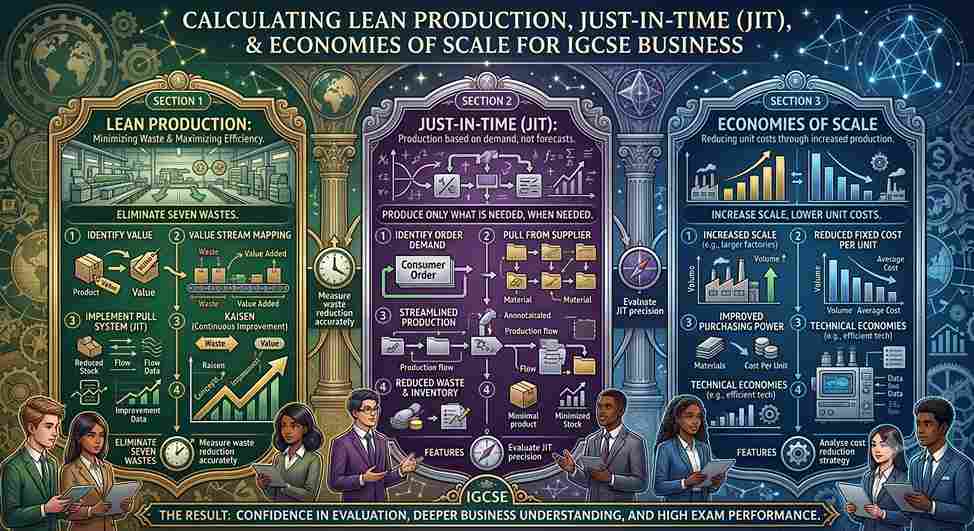
Calculating Lean Production, Just-in-Time (JIT), and Economies of Scale for IGCSE Business
Last Updated: October 2026 | By EdFlik Education Team
For high school students completing the Cambridge IGCSE Business Studies (0450) or Pearson Edexcel IGCSE Business (4BS1) qualifications, operations management forms a central pillar of the syllabus. Featured prominently in Paper 1 (Short Answer and Structured Questions) and Paper 2 (Case Study Analysis), concepts relating to production efficiency, cost reduction, inventory control, and business scale frequently account for high-mark calculation and evaluation tasks.
Whether a manufacturing firm is evaluating how expanding its factory output lowers average unit costs, assessing whether to implement Japanese-style Just-in-Time (JIT) inventory management, or calculating unit costs under lean production techniques, mastering these operations concepts is essential for securing an $A^*$ grade.
In this comprehensive, exam-focused masterclass guide, our expert IGCSE business educators break down the core formulas, explore internal and external economies of scale, demystify lean manufacturing, expose common examiner traps, and provide structured problem-solving frameworks to help you excel.
Part 1: Economies of Scale and Diseconomies of Scale
As a business grows larger and increases its scale of production, its cost structure changes dramatically. Understanding why costs fall—and eventually rise—is a staple of IGCSE business exams.
                        BUSINESS SCALE DYNAMICS
                                   |
      +----------------------------+----------------------------+
      |                                                         |
ECONOMIES OF SCALE (EoS)                                 DISECONOMIES OF SCALE (DDoS)
• Long-run average costs FALL as                         • Long-run average costs RISE as
  scale of production increases.                           the business becomes excessively large.
1. Internal Economies of Scale (The 6 Main Types)
Internal economies of scale occur when a single business grows larger and benefits from cost savings specific to its own operations. Memorize the PRITM-R acronym for IGCSE structured questions:
- P — Purchasing (Bulk-buying) Economies: Large firms buy raw materials and components in massive quantities. Suppliers often offer generous trade discounts, reducing the cost per unit.
- R — Risk-bearing Economies: Large diversified conglomerates producing multiple products across various global markets can absorb the failure of one product line much better than a single-product firm.
- I — Indivisible (Technical) Economies: Certain pieces of specialized capital equipment (e.g., automated robotic assembly lines or massive printing presses) are too expensive for small firms. Large firms can spread the high fixed cost of this machinery over a massive output volume, reducing average fixed cost per unit.
- T — Technical Economies: Advanced production techniques, specialized assembly lines, and computer-aided design (CAD) systems boost operational efficiency.
- M — Managerial Economies: Large firms can afford to hire specialist functional managers (e.g., a dedicated Marketing Director, a Chartered Accountant, and a Human Resources Specialist) rather than relying on a single owner-manager juggling all roles.
- R — Research and Development (R&D) Economies: Large profitable enterprises can reinvest surplus funds into innovative product design and technological research.
2. External Economies of Scale
External economies of scale occur when the entire industry grows or clusters in a specific geographic region, benefiting all firms within that sector (e.g., Silicon Valley for tech startups or Dubai Media City for digital publishing).
- Skilled Labor Pool: Local universities and schools train workers specifically for that industry, reducing recruitment and training costs.
- Ancillary and Support Services: Specialized suppliers, transport links, and maintenance providers cluster nearby, driving down operational costs for all local firms.
3. Diseconomies of Scale (When a Firm Gets Too Big)
If a business expands beyond its optimal scale of production, managerial inefficiency sets in, causing long-run average costs to rise:
- Poor Communication: Information gets distorted as it travels through complex corporate hierarchies and multiple layers of management.
- Lack of Coordination and Control: Senior managers struggle to monitor workforce productivity across geographically dispersed branches.
- Low Worker Morale: Employees in massive multinational corporations often feel alienated and like "a small cog in a giant machine," leading to absenteeism and lower productivity.
Part 2: Lean Production and Waste Reduction
Lean production is a philosophy originating from Japanese manufacturing (specifically Toyota) focused on producing goods and services with minimum waste of time, materials, and human effort while maintaining high quality.
1. The 7 Wastes of Lean Production (TIMWOOD)
To eliminate waste, lean businesses target seven operational inefficiencies:
- T — Transportation: Unnecessary movement of materials, parts, or work-in-progress around the factory floor.
- I — Inventory: Holding excess raw materials, components, or finished goods that tie up working capital and incur storage costs.
- M — Motion: Unnecessary physical movement by workers due to poor ergonomic layout on the assembly line.
- W — Waiting: Delays caused by bottlenecked processes, machine breakdowns, or late raw material deliveries.
- O — Overproduction: Producing more goods than customer demand dictates, leading to unsold stock and clearance discounting.
- O — Over-processing: Doing more work on a product than the customer actually requires or values.
- D — Defects: Manufacturing faulty products that require rework, scrap disposal, or customer warranty returns.
2. Key Lean Production Techniques
- Kaizen (Continuous Improvement): A Japanese management philosophy where employees at all levels hold regular meetings to suggest small, incremental improvements to production processes.
- Cell Production: Organizing the factory floor into autonomous "cells" or work teams where each cell is responsible for producing a complete unit or sub-assembly from start to finish, boosting worker motivation and accountability.
- Simultaneous Engineering: Developing new products concurrently across cross-functional teams (design, production, and marketing) rather than sequentially, significantly reducing time-to-market.
Part 3: Just-in-Time (JIT) Inventory Control
Just-in-Time (JIT) is an advanced inventory management strategy where materials and components arrive from suppliers only as they are needed in the production process, and finished goods are dispatched immediately to customers without being stored in warehouses.
                      TRADITIONAL vs. JIT INVENTORY
                                    |
        +---------------------------+---------------------------+
        |                           |                           |
   TRADITIONAL STOCKHOLDING        JUST-IN-TIME (JIT)
   • Holds large buffer stocks     • Holds zero buffer stock
   • High warehouse rental costs   • Requires ultra-reliable suppliers
   • Ties up working capital       • Minimizes holding expenses
1. Advantages of JIT
- Reduction in Holding Costs: Eliminates warehouse rental expenses, security costs, insurance, and losses from obsolescence or spoilage.
- Improved Cash Flow: Working capital is not tied up in rotting or sitting inventory; liquid cash is freed up for core business investments.
- Higher Quality Focus: Because there is no buffer stock of components, any defective raw material delivered by a supplier immediately halts the production line, forcing strict quality control at the source.
2. Disadvantages and Risks of JIT
- Vulnerability to Supply Chain Disruptions: If a delivery truck is delayed by traffic congestion, a port strike, or severe weather, the entire factory production line grinds to a halt.
- Loss of Bulk-Buying Discounts: Because orders are placed in small, frequent batches, the business cannot take advantage of supplier discounts for bulk purchasing.
- High Administrative Burden: Requires sophisticated electronic data interchange (EDI) systems and absolute trust in reliable, local suppliers.
Part 4: Quantitative Calculations in Operations Management
Examiners on Cambridge Paper 1 and Edexcel Paper 1 regularly test numerical calculations regarding production costs and efficiency.
1. Calculating Average Cost (Cost Per Unit)
Average cost measures how much, on average, it costs to produce a single unit of output.
$$\text{Average Cost} = \frac{\text{Total Costs}}{\text{Total Output}}$$
Worked Example: A manufacturing firm has Fixed Costs of $\$50,000$ per month and Variable Costs of $\$20$ per unit. If the firm produces $2,500$ units in a month:$\text{Total Variable Cost} = 2,500 \times \$20 = \$50,000$$\text{Total Cost} = \text{Fixed Costs} + \text{Total Variable Cost} = \$50,000 + \$50,000 = \$100,000$$\text{Average Cost per Unit} = \frac{\$100,000}{2,500} = \$40 \text{ per unit}$
2. Calculating Productivity (Labor Productivity)
Labor productivity measures how efficiently human resources convert inputs into outputs.
$$\text{Labor Productivity} = \frac{\text{Total Output}}{\text{Number of Workers}}$$
Worked Example: If an assembly plant with $40$ workers produces $2,000$ bicycles in a 40-hour work week:$\text{Labor Productivity} = \frac{2,000 \text{ units}}{40 \text{ workers}} = 50 \text{ units per worker}$
Part 5: Top 4 Traps That Cost Students Marks in IGCSE Business
- Confusing Internal and External Economies of Scale: Writing that a firm benefits from a skilled local labor pool because its own size increased. A skilled local labor pool is an external economy of scale resulting from industry clustering, not internal expansion.
- Assuming JIT Eliminates All Inventory Completely: Stating that JIT means a business holds zero stock ever. JIT minimizes buffer inventory, but work-in-progress and transit stock still exist in small quantities.
- Failing to Include Fixed Costs in Average Cost Calculations: Dividing only variable costs by output when calculating total unit cost, forgetting to allocate fixed overhead expenses.
- Treating Lean Production as Just "Cutting Staff": Describing lean production purely as a method of laying off workers to save money. Lean is about eliminating waste in processes, improving quality, and respecting workers through Kaizen and teamwork.
Preparing for Cambridge or Edexcel IGCSE Business exams and aiming for an $A^$ grade? EdFlik connects international school students globally with expert, 1-to-1 online IGCSE tutors, helping you master calculation questions, evaluate operational strategies, structure 6-mark and 8-mark essay responses, and work through past papers. *Book a Free Demo Class Today!
Frequently Asked Questions (FAQs)
Q1: What is the difference between batch production and flow production?
Ans: Batch production involves manufacturing items in groups (batches) where one operation is completed on the whole batch before moving to the next step (e.g., bakery baking a batch of chocolate cookies, then a batch of vanilla cookies). Flow production (mass production) involves continuous, uninterrupted movement of items down an assembly line where each worker or machine performs a specific repetitive task (e.g., bottling soft drinks).
Q2: Can a business experience economies of scale forever?
Ans: No! Beyond a certain threshold of size, managerial diseconomies of scale take over. Communication breaks down, bureaucracy increases, and long-term average costs begin to rise. This point is known as the minimum efficient scale (MES).
Q3: How does lean production improve a company's competitive advantage?
Ans: By eliminating waste, reducing inventory holding costs, and minimizing defect rates, lean production lowers total unit production costs. This allows the business to either lower its selling prices to undercut competitors (cost leadership) or improve profit margins while maintaining competitive pricing.
Q4: How does EdFlik support IGCSE Business students?
Ans: EdFlik connects international school students worldwide with vetted, expert 1-to-1 online tutors specializing in Cambridge (0450) and Edexcel (4BS1) IGCSE Business. Our personalized coaching focuses on clarifying operational concepts, solving calculation problems, structuring case study answers, and building exam confidence.