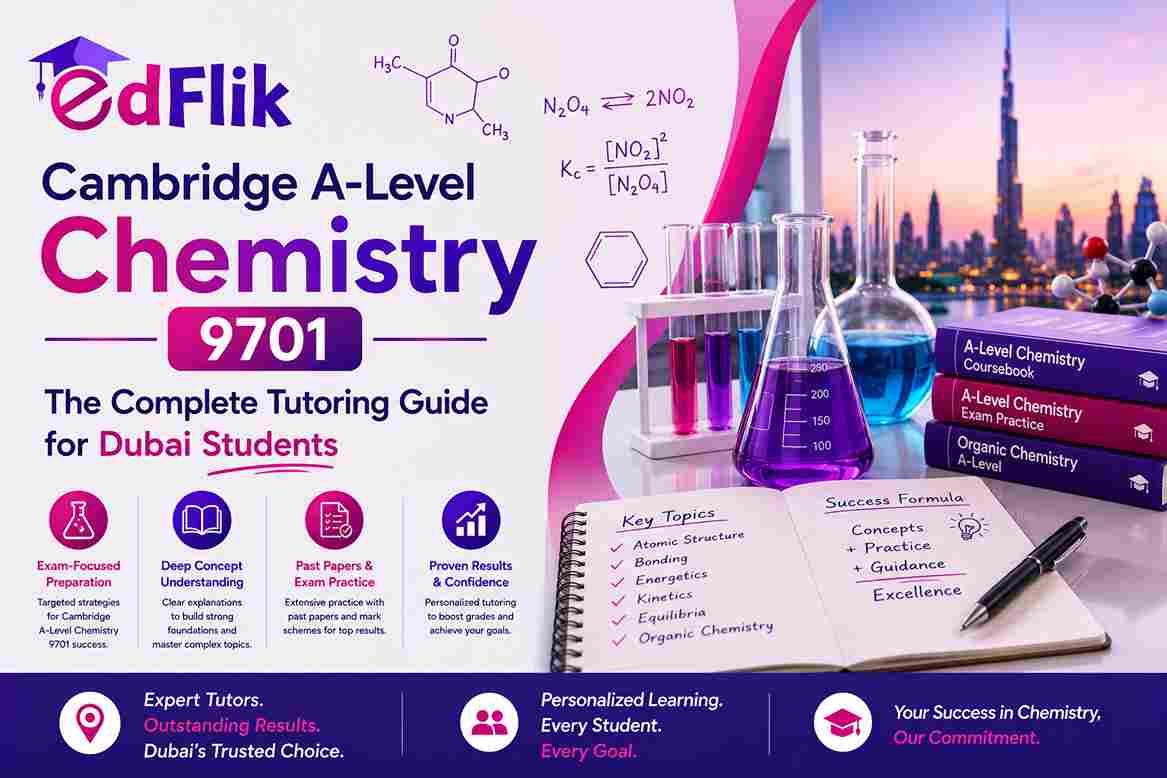
Cambridge A-Level Chemistry 9701: The Complete Tutoring Guide for Dubai Students
The Challenge: Why Cambridge A-Level Chemistry Tests Deeper Understanding
Your child aced IGCSE Chemistry. Then A-Level arrives and the scope expands dramatically.
Organic chemistry now includes multi-step synthesis sequences (alkane → alkene → alcohol → aldehyde, each step requiring a different reagent and conditions). Inorganic chemistry dives into transition metal chemistry, complex ions, and redox titrations. Practical assessments demand not just executing an experiment, but *designing* one from scratch.
Most students who were strong at IGCSE struggle at A-Level because the thinking is fundamentally different. IGCSE asks: "What happens when you add HCl to an alkene?" A-Level asks: "Design a synthetic route to convert compound A to compound B in three steps."
EdFlik's A-Level Chemistry tutors teach the deeper thinking A-Level demands.
What Makes an Effective Cambridge A-Level Chemistry Tutor
1. Organic Chemistry Synthesis Expertise
Organic chemistry is 30–40% of A-Level. It requires understanding reaction mechanisms *and* applying them to multi-step syntheses.
A student must know:
· Alkane reactions (free radical substitution)
· Alkene reactions (electrophilic addition)
· Alkyne chemistry
· Nucleophilic substitution (SN1 vs. SN2)
· Elimination reactions
· Condensation reactions (esterification, amide formation)
· Oxidation & reduction
· How to link these reactions into a synthesis sequence
Many tutors teach "here's how alkenes react" in isolation. A good tutor asks: "How would you make compound X from compound Y?" and guides students through the logical sequence of reactions.
By exam day, your child has solved 30+ synthesis problems and understands the underlying logic.
2. Inorganic Chemistry Depth
A-Level inorganic includes:
· Periodicity & atomic structure (deep understanding)
· Group chemistry (alkali metals, halogens, noble gases)
· Transition metals (complex ions, color, variable oxidation states)
· Complexes and ligands
· Solid-state chemistry
Transition metal chemistry is particularly challenging. A tutor who explains *why* Cu²⁺ is blue (d-d electron transitions) and *why* Cu(NH₃)₄²⁺ is a different shade beats a tutor who just says "it's blue."
3. A-Level Practical Expertise
A-Level practicals aren't just executing an experiment given detailed instructions. Students must:
· Design their own experiment to answer a research question
· Choose appropriate apparatus and techniques
· Collect accurate data
· Analyze and interpret results critically
· Evaluate sources of error
A good tutor guides students through 10–15 practical designs so they enter the practical exam confident.
Book Your Free Trial Now
Master Cambridge A-Level Chemistry.
Book a free trial class with an A-Level Chemistry specialist. WhatsApp **+91 88788 96600** or www.edflik.com
Most students feel significantly more confident within 4–6 weeks.
5 Tutoring Mistakes Dubai Parents Make (And How to Avoid Them)
Mistake 1: Assuming IGCSE Success Translates to A-Level
IGCSE and A-Level are fundamentally different. A student can ace IGCSE through memorisation. A-Level demands application and synthesis. Starting with fresh tutoring is wise.
Mistake 2: Treating Organic Chemistry as Optional
Some students avoid organic initially, thinking it's "just memorisation." Then they realize organic synthesis questions dominate the exam and they're unprepared. Organic chemistry needs tutoring and practice from day one.
Mistake 3: Not Building Reaction Mechanisms
Many tutors show reactions without explaining the mechanism (the step-by-step electron movement). A-Level specifically tests mechanism understanding. A tutor who skips mechanisms is a red flag.
Mistake 4: Ignoring Lab Skills
Some students focus 100% on theory. Then the practical exam arrives and they're underprepared. Practical work should represent ~20% of tutoring time.
Mistake 5: Starting Too Late
A-Level has two years. Waiting until Year 2 to get tutoring leaves no time for remedial work on weak Year 1 topics. Start tutoring from September of Year 1.
Why EdFlik A-Level Chemistry Tutors Get Results
Certified Teachers with 5+ Years A-Level Experience
Our tutors have taught Cambridge A-Level Chemistry for years. They've graded student papers. They know which questions appear repeatedly and which topics examiners emphasize.
Organic Synthesis Coaching
We teach students to map organic synthesis using a logical approach:
1. Identify the starting material and target product
2. Count the carbons (are they the same? rearranged?)
3. Identify functional group changes (what needs to happen?)
4. Work backwards from the target (or forwards from the start) to find the reaction sequence
5. Verify the sequence with actual reagents and conditions
By exam day, your child has solved 30+ synthesis problems using this framework.
Transition Metal Chemistry Clarity
We explain transition metal chemistry conceptually:
· Why do transition metals have variable oxidation states?
· What causes the color of complex ions?
· How does crystal field theory explain complex stability?
· Why is Fe³⁺ colored but Al³⁺ colorless?
This understanding makes exam questions intuitive, not memorized.
Practical Design Mastery
We guide students through designing experiments:
· Research question formulation
· Hypothesis development
· Apparatus selection and justification
· Hazard identification and safety protocols
· Data collection with precision & accuracy
· Results interpretation and error analysis
· Report writing in scientific style
By the practical exam, your child has designed and executed 10+ experiments.
Monthly Progress Reports
Every month you'll know:
· Organic topics covered and mastered
· Inorganic chemistry progress
· Practical skills developed
· Mock exam scores
· Weak areas for next focus
Cambridge A-Level Chemistry 9701 Curriculum
Core Organic Chemistry:
· Alkanes (combustion, free radical substitution)
· Alkenes (electrophilic addition, polymerization)
· Alkynes
· Arenes (benzene, aromatic substitution)
· Alcohols (oxidation, dehydration, esterification)
· Aldehydes & Ketones (formation, reduction, condensation)
· Carboxylic Acids & Esters
· Amines & Amides
· Amino Acids & Proteins
· Polymers (addition & condensation)
Core Inorganic Chemistry:
· Atomic structure & periodicity
· Bonding & structure
· Redox reactions
· Group 2 chemistry (alkaline earth metals)
· Group 17 chemistry (halogens)
· Transition metals & complex ions
· Reactions of inorganic compounds
Physical Chemistry:
· Thermodynamics (enthalpy, entropy, Gibbs free energy)
· Kinetics (rates of reaction, activation energy, catalysis)
· Equilibria
· Electrochemistry (cells, electrolysis, electrode potentials)
Practicals:
· ~15–20 core practicals across chemistry
· Students must design and execute unknown practicals
How It Works: 6 Steps to Chemistry Success
Step 1: Contact EdFlik
WhatsApp +91 88788 96600 or www.edflik.com. Tell us you're doing A-Level Chemistry and your weak areas.
Step 2: Tutor Matching
Within 24 hours, we match a Cambridge A-Level Chemistry specialist.
Step 3: Free Trial
Your child attends 1–2 free classes to ensure the tutor's depth and teaching style match their needs.
Step 4: Structured Year 1 Learning
2–3 sessions per week (2–3 hours total). Balanced coverage of organic, inorganic, and physical chemistry with practical work integrated.
Step 5: Year 2 Exam Preparation
Continued tutoring with increasing emphasis on past papers, synthesis problems, and practical exam readiness.
Step 6: Exam Success
By exam month, your child has solved 30+ organic syntheses, understands transition metal chemistry deeply, and has practical skills ready for assessment.
What Students Say
*"Organic synthesis looked impossible until my tutor taught me the logical approach. Suddenly I could tackle unfamiliar synthesis questions."*
— Aisha Al-Mansoori, Dubai
*"Transition metal chemistry finally made sense when my tutor explained the science behind colors. No more memorising — I understood the "why."*
— Hassan Al-Mazrouei, Sharjah
*"The practical exam scared me, but my tutor had me design and do so many experiments that I felt completely prepared on exam day."*
— Pooja Desai, Ajman
FAQs:-
Q: Is A-Level Chemistry harder than IGCSE?
A: Substantially harder. The depth, breadth, and application level are significantly greater.
Q: How much tutoring is needed?
A: 2–3 sessions per week (2–3 hours total) is standard. Some students do 4 sessions during particularly dense topics.
Q: Should I start in Year 1 or Year 2?
A: Year 1 is ideal. Building a solid foundation in Years 1 makes Year 2 (and exam prep) much easier.
Q: Is organic chemistry really 40% of the grade?
A: Approximately 30–40% of marks come from organic chemistry across the papers. It's a major component.
Q: What if my child struggles with mechanisms?
A: Mechanisms are learnable. It takes 10–15 practice problems for most students to get comfortable. Tutors should spend time here.
Q: Can my child pass with tutoring?
A: With consistent tutoring starting in Year 1, passing is very likely. Most students improve by 1–2 grades within the first year of tutoring.
Q: What's the cost?
A: Starting at 50 AED per hour. Most families invest 200–300 AED per week.