Cambridge IGCSE and A-Level Exam Timetable UAE: How to Plan Revision Around Exam Dates
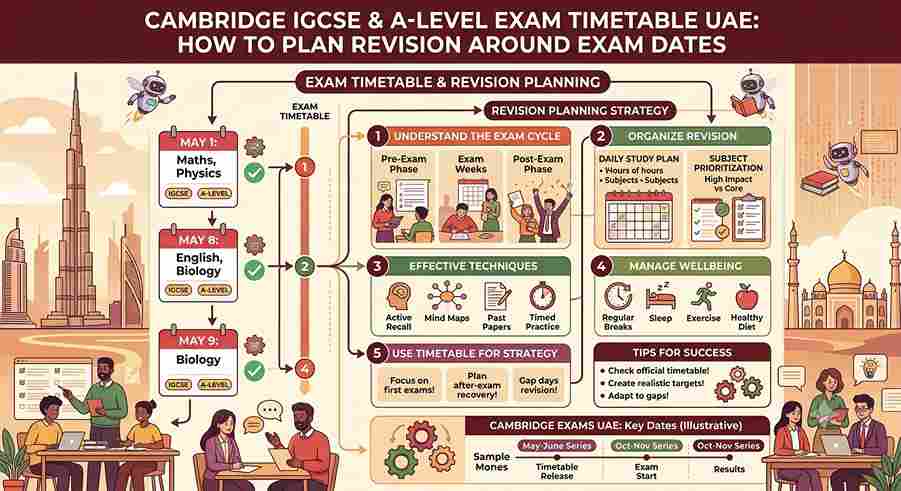
Who this is for: Students in UAE private schools sitting Cambridge Assessment International Education (CAIE) IGCSE, AS, and A-Level exams across administrative Zone 4 (which includes the UAE), as well as parents planning revision schedules around term breaks and Ramadan/Eid academic calendars.
What query it owns: how to plan a revision timetable around Cambridge IGCSE and A-Level exam dates in the UAE.
Why this is safe: this page owns the comprehensive exam planning and timeline strategy angle, while EdFlik’s Cambridge IGCSE & A-Level resource hub owns structured subject notes and the matching past-paper score tracker handles retrieval practice.
Across Dubai, Abu Dhabi, Sharjah, and the Northern Emirates, thousands of students enrolled in British curriculum schools prepare for the Cambridge International Examinations (CAIE) series. Unlike modular domestic qualifications, Cambridge IGCSE and International AS/A-Levels test two years of linear content across multiple written, practical, and oral components in a tightly packed exam window.
Whether you are sitting the primary May/June exam series or the October/November series, simply knowing your subject content is not enough. Success requires backward planning: aligning topic reviews, mock paper sessions, and past-paper drills directly with the published CAIE Zone 4 timetable while managing school schedules, local public holidays, and exam-day Key Times.
This masterclass guide breaks down the Cambridge administrative zone structure for UAE schools, outlines the official exam session calendar, provides a 6-month backward revision planning protocol, exposes top timetable management traps, and supplies a 100% copy-paste JSON-LD schema markup script.
Key Takeaways
- UAE Administrative Zone: The UAE primarily operates under Cambridge Administrative Zone 4. Always verify that your exam timetable PDF matches Zone 4 to ensure correct paper variant codes (e.g., Component 22, 42) and Key Times (AM/PM start times).
- Two Main Exam Series: The primary sitting for UAE full-time candidates is the May/June series (results in August). The October/November series serves as a secondary sitting or resit window (results in January).
- Component Clustering: Science practicals/Alternatives to Practical (e.g., Paper 5/6) and Language oral tests often occur in earlier test windows prior to the core written theory papers.
- Key Time Compliance: CAIE strictly enforces "Key Times" for morning (AM) and afternoon (PM) sessions to maintain global exam security. Students must be under full supervision during these windows.
Part 1: Understanding Cambridge Administrative Zones and UAE Exam Windows
Cambridge divides global exam centers into administrative zones to manage time differences and preserve question paper security.
                 CAMBRIDGE GLOBAL TIMETABLE STRUCTURE
                                   |
  • Administrative Zone: Zone 4 (UAE & South Asia)
  • Primary Component Variants: Variant 2 (e.g., 0580/22, 9709/12, 0620/42)
  • Key Session Times: AM (Morning Session) & PM (Afternoon Session)
The Two Annual Examination Series in the UAE:
                      CAMBRIDGE EXAM SESSIONS IN THE UAE
                                       |
        +------------------------------+------------------------------+
        |                                                             |
1. MAY / JUNE SERIES (PRIMARY SESSION)                        2. OCTOBER / NOVEMBER SERIES (SECONDARY)
• Speaking & Practical Windows: March – April                 • Speaking & Practical Windows: Sept – Oct
• Main Written Exams: Late April – Early June                 • Main Written Exams: Early Oct – Mid Nov
• Results Released: Mid-August                                • Results Released: Mid-January
Part 2: High-Density Exam Clashing and Paper Clustering
A major challenge for IGCSE and A-Level candidates in the UAE is paper clustering—when multiple high-tariff subjects fall on the exact same day or within a 48-hour window (e.g., IGCSE Extended Maths Paper 4 and Chemistry Paper 4 written back-to-back).
                      TYPICAL COMPONENT SEQUENCE FLOW
                                     |
  Phase 1: Practical & Oral Windows  ---> ICT Practical (0417/9626), Language Speaking (0500/0510).
  Phase 2: Core Theory Papers        ---> Pure Maths (9709/12), Physics (0625/42), Chemistry (0620/42).
  Phase 3: MCQ & Planning Papers     ---> A-Level Lab Skills (9702/52), IGCSE Science MCQs (0620/22).
Part 3: The 6-Month Backward Revision Planning Framework
To avoid last-minute cramming, execute this structured 6-month backward planning protocol aligned with your Cambridge Zone 4 timetable:
                  THE 6-MONTH BACKWARD REVISION PROTOCOL
                                    |
  Month 6–5: Curriculum Mastery     ---> Complete 100% syllabus coverage; build concise summary notes.
  Month 4: Timetable Audit          ---> Download official Zone 4 timetable; highlight exam dates & clashes.
  Month 3: Topical Past Papers      ---> Practice classified questions by topic for weak areas.
  Month 2: Full Timed Mocks         ---> Complete full past papers (last 5 years) strictly under timed conditions.
  Month 1: Final Polish & AM/PM Sync---> Replicate exact exam session start times (AM/PM) during practice.
Step-by-Step Execution Plan:
- Obtain Your Official Statement of Entry: Retrieve your Statement of Entry from your school’s exams officer. Verify your candidate name, date of birth, syllabus codes, and component codes.
- Build a Master Exam Calendar: Map out your specific paper codes on a visual wall planner. Highlight days with two papers or back-to-back heavy subjects.
- Plan Around Local School Breaks: Account for UAE school term breaks, national holidays, and Ramadan adjusting hours to ensure consistent study routines without burn-out.
- Simulate Key Times: If your Maths paper is scheduled for an 8:30 AM (AM session) start, perform weekend past-paper drills at 8:30 AM to condition your cognitive focus to match the official exam window.
Part 4: Top 4 Traps That Cost UAE Students Marks on Cambridge Exams
- Studying from the Wrong Zone Timetable: Downloading a Zone 1, 3, or 5 timetable instead of Zone 4. This can cause candidates to prepare for the wrong paper variant or miscalculate exam dates.
- Ignoring Component Weightings: Spending equal revision time on low-tariff components while neglecting high-weighting papers (e.g., spending weeks on IGCSE Science MCQ Paper 2 while ignoring Paper 4 Extended Theory, which carries $50\%$ of the total mark).
- Mismanaging Paper Clashes: Failing to notify your school's exams officer early about timetable clashes (two exams scheduled at the exact same time), which requires formal full-supervision arrangements under Cambridge rules.
- Neglecting Alternative to Practical Papers (Paper 6 / Paper 5): Assuming lab skills do not require written revision. Paper 6 in IGCSE Sciences tests specific experimental design, safety precautions, table drawing, and error analysis.
Looking for expert 1-on-1 tutoring support to master Cambridge IGCSE, AS, and A-Level subjects, navigate past-paper mark schemes, and construct personalized study plans? Book a class on EdFlik.
Frequently Asked Questions (FAQs)
Q1: What is the difference between Cambridge Zone 3 and Zone 4 timetables?
Ans: Cambridge divides administrative centers into geographical zones to maintain exam security globally. The UAE primarily falls under Zone 4. While the syllabus content is identical, Zone 4 receives specific paper variants (usually Variant 2) and designated Key Times for morning and afternoon sessions.
Q2: What happens if a student has two exams scheduled at the exact same time?
Ans: This is known as a timetable clash. The school’s Cambridge exams officer will arrange a formal "clash supervision." The student sits one paper, remains under strict supervision without access to phones or internet during the break, and then sits the second paper immediately afterward.
Q3: When are Cambridge May/June and October/November results released in the UAE?
Ans: Results for the May/June series are released electronically in mid-August. Results for the October/November series are released in mid-January.
More on A-Level
- A-Levels in the UAE: A Complete Guide to Boards, Subjects, Exams and University Entry
- A-Level Revision Timetable: A Planning Guide for the Final Year
- May–June 2027 IGCSE and A-Level Revision Planner for UAE Students
- A-Level Physics Tuition in Abu Dhabi: Exam Preparation and Revision Support
- All A-Level articles