CAT4 Spatial Reasoning UAE 2026 — Complete Guide to the Fourth Battery
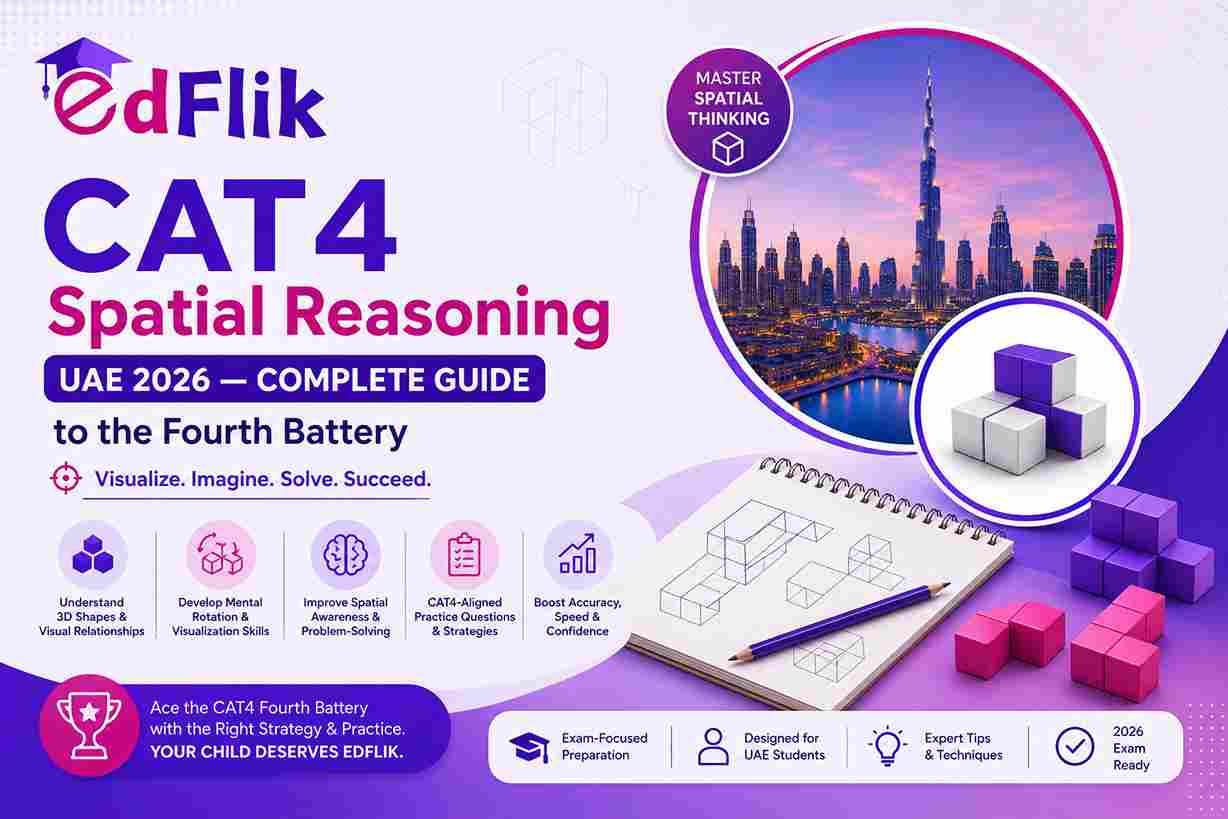
CAT4 Spatial Reasoning is the battery that surprises UAE parents the most. Children who are academically strong, who excel at Verbal and Quantitative Reasoning, and who have never had difficulty with school work encounter the Spatial Reasoning questions and feel genuinely confused. This is completely normal: Spatial Reasoning tests a type of thinking that school curricula do not develop and that most UAE children have had very little practice with. It is also, of the four CAT4 batteries, the one that improves most dramatically with focused preparation. This guide covers all four Spatial Reasoning question types with preparation approaches.
The Four CAT4 Spatial Reasoning Question Types
Question Type 1 — 3D Shape Rotation
A 3D shape (built from cubes or geometric solids) is shown from one angle. One of four or five other images shows the SAME shape rotated to a different orientation. All other images have something wrong — a piece missing, an extra piece, a reflection, or a completely different structure.
Approach: (1) Count the cubes or identify the distinctive feature of the shape (an L-shape, a T-shape, a step pattern). (2) Find the same distinctive feature in the answer options. (3) Eliminate options that have a different number of cubes or a different arrangement. The distinctive feature — the thing that makes this shape unique — is the anchor for identifying the correct rotation.
Most common error: Selecting a reflected (mirror image) rather than rotated shape. A rotation maintains the same handedness; a reflection reverses it. L-shapes are particularly prone to this error: students select the mirror-image L thinking they have found a rotation.
Question Type 2 — Net Folding (2D to 3D)
A 2D flat net (set of connected faces) is shown. One of four or five options shows the 3D shape that results from folding the net. The typical shape is a cube (6 square faces), but rectangular boxes, pyramids, and prisms also appear.
Approach for cube nets: (1) Count the faces — a cube net must have exactly 6 squares. (2) Identify which pairs of faces would be opposite each other when folded — opposite faces in a cube cannot share an edge in the net. (3) If the net has marked faces (dots, crosses, shading), track where each marked face ends up in the folded shape.
|
Net folding
rule |
How it works |
|
6 faces
required |
A cube needs
exactly 6 square faces — any net with more or fewer cannot fold into a cube |
|
Opposite faces
test |
Two faces that
share an edge in the net CANNOT be opposite each other in the folded cube —
they will be adjacent |
|
Cross pattern
folds correctly |
A + shape
(cross) of 5 squares with 1 square attached to either side always folds into
a cube |
|
Tracking
marked faces |
If faces have
different markings, track each face: which face ends up on top? which is
opposite the marked face? |
Question Type 3 — 2D Shape Combination / Reflection
Two 2D shapes are shown. The question asks which of four options results when the two shapes are combined (overlaid or placed adjacent), or what the shape looks like when reflected horizontally or vertically.
Approach for reflections: (1) Identify the axis of reflection (horizontal = flip top to bottom; vertical = flip left to right). (2) For each distinctive feature of the shape, identify where it would appear after reflection. (3) Eliminate options where distinctive features are in the wrong positions.
Question Type 4 — Spatial Pattern Recognition
A sequence or matrix of 3D or layered shapes follows a pattern. The student must identify the rule and select the missing element. This combines the visual pattern recognition of Non-Verbal Reasoning with the 3D spatial reasoning of the other Spatial Reasoning question types.
CAT4 Spatial Reasoning Score Benchmarks
|
SAS Score |
Percentile |
Preparation
Status |
Next Step |
|
125+ |
Top 5% |
Exceptional
spatial reasoning — strong asset in applications |
Maintain;
focus on other batteries |
|
115-124 |
Top 16% |
Above average
— strong spatial profile |
Light practice
to maintain; address weaker batteries |
|
100-114 |
Average range |
On par with
peers — no significant advantage or disadvantage |
Targeted
practice; 30-40 questions per question type |
|
90-99 |
Below average |
A gap that
affects school placement — address before assessment |
Intensive
practice; 60-80 questions across all 4 types over 6-8 weeks |
|
Below 90 |
Well below
average |
Significant
gap — most improvable battery with practice |
Priority
target; 100+ questions with structured progression from easiest to hardest |
6-Week Spatial Reasoning Preparation Plan
• Week 1: 3D rotation practice only — understand the question type with unlimited time; no pressure to be fast
• Week 2: Net folding practice only — learn the cube net rules; draw and fold actual paper nets to develop physical intuition
• Week 3: 2D combination and reflection practice — master horizontal and vertical reflection identification
• Week 4: Spatial pattern questions — apply pattern-recognition approach to spatial contexts
• Week 5: Mixed Spatial Reasoning practice sets — all four types combined with 45-second target per question
• Week 6: Full timed Spatial Reasoning section practice — mimic the CAT4 experience of moving through all four types in sequence
|
EdFlik CAT4
preparation includes dedicated Spatial Reasoning modules — all four question
types with adaptive difficulty progression. Sessions are particularly
effective for students who have been identified as below-average in Spatial
Reasoning and are applying to Repton, Brighton College, Kings', or other CAT4
schools in UAE. From AED 60. Free diagnostic. Book at www.edflik.com or
WhatsApp +91 88788 96600. |
Frequently Asked Questions
Q: What is CAT4 Spatial Reasoning?
The fourth CAT4 battery — tests 3D shape rotation, 2D net folding, 2D shape combination/reflection, and spatial pattern recognition. Assesses thinking in three dimensions. Not taught in UAE school curricula — requires specific preparation.
Q: Why do UAE students score lowest on Spatial Reasoning?
Never taught in UAE curricula; most visually distinctive from any school experience; and digital-native students have less 3D construction experience. It is also the most practice-responsive battery — the largest SAS gains come from Spatial Reasoning preparation.
Q: What does a CAT4 3D rotation question look like?
A 3D shape shown from one angle; four or five options show the same shape from different orientations — student must identify which option is the same shape rotated (not reflected or modified). Incorrect options include reflections, shapes with pieces added/removed, and different shapes.
Q: What is a net in CAT4 Spatial Reasoning?
A 2D flat shape that folds along dotted lines to form a 3D shape — typically a cube or box. Questions show a net and ask which 3D shape results, or show a 3D shape and ask which net folds into it.
Q: How much can Spatial Reasoning improve with practice?
The largest relative improvement of any CAT4 battery. Students starting at SAS 90-95 typically improve 15-25 SAS points over 6-8 weeks of targeted practice — because the baseline is near zero and question types are highly learnable.