CAT4 Verbal and Non-Verbal Reasoning: Top Strategies to Boost Your Child's Test Score in Dubai
Last Updated: October 2026 | By EdFlik Education Team
For families navigating the vibrant international school landscape in the United Arab Emirates—whether enrolled in premier British, IB, or American curriculum academies across Dubai, Abu Dhabi, or Sharjah—the Cognitive Abilities Test (CAT4) is a familiar milestone.
Administered widely by private schools as part of admissions screening, baseline tracking, and progress monitoring, the CAT4 assesses a student's reasoning capabilities across four distinct batteries: Verbal Reasoning, Non-Verbal Reasoning, Quantitative Reasoning, and Spatial Ability.
Unlike curriculum-based exams (such as GCSEs, IGCSEs, or APs) that test memorized facts or mathematical formulas, the CAT4 is designed to measure innate cognitive potential, problem-solving agility, and pattern recognition. However, many parents are surprised to learn that familiarity with test formats and strategic time management can dramatically improve a student's score, helping them unlock their true academic profile.
In this comprehensive, masterclass guide, our expert educational consultants break down the core mechanics of the Verbal and Non-Verbal reasoning batteries, reveal proven problem-solving frameworks, and share high-impact strategies to boost your child's confidence and test scores.
Part 1: Decoding the CAT4 Battery Structure
Before targeting specific test strategies, it is essential to understand what the CAT4 evaluates and why schools place such high emphasis on its results.
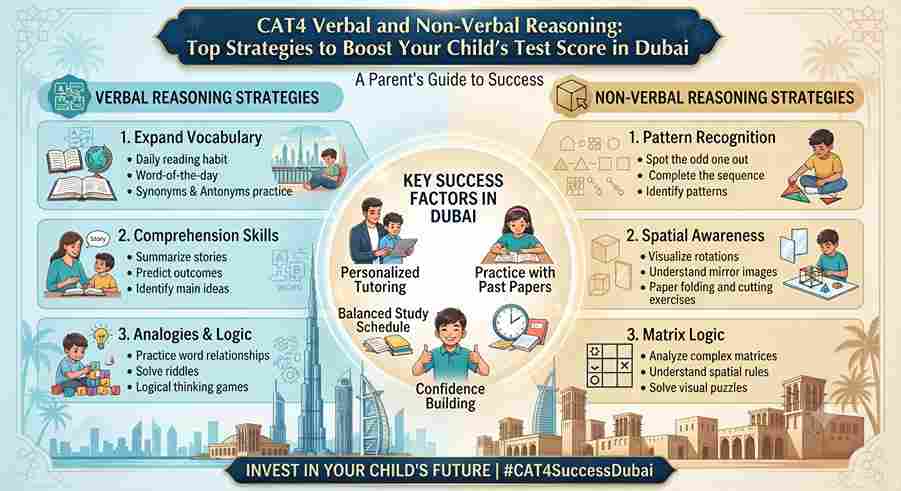
1. Verbal Reasoning Battery (Words and Logic)
This battery evaluates a student's ability to think, reason, and solve problems using words and linguistic relationships. It consists of two sub-tests:
- Verbal Classification: Identifying the common thread among a set of words and selecting the odd one out or finding a word that fits the group.
- Verbal Analogies: Recognizing relationships between word pairs and applying that exact same relationship to a new set of words (e.g., Hot is to Cold as Tall is to...).
2. Non-Verbal Reasoning Battery (Shapes and Abstract Patterns)
This battery measures problem-solving ability using visual patterns, shapes, and figures, entirely independent of language or literacy skills:
- Figure Classification: Identifying the underlying geometric rule linking three shapes and selecting a fourth shape from multiple choices that shares the same rule.
- Figure Matrices: Solving $2 \times 2$ or $3 \times 3$ grid puzzles where shapes undergo geometric transformations (rotation, reflection, scaling, shading).
Part 2: Top Strategies for Mastering Verbal Reasoning
Verbal reasoning questions often trip students up due to vocabulary gaps or misinterpreting subtle semantic relationships. Use these expert techniques to elevate verbal scores:
1. Build an Active Synonym and Antonym Vocabulary
CAT4 Verbal Classification and Analogies require a robust vocabulary. Reading widely across diverse genres—such as historical biographies, scientific articles, and classic literature—exposes students to advanced tier-2 and tier-3 vocabulary words.
- Actionable Practice: Maintain a dedicated vocabulary journal. When encountering unfamiliar words, record their synonyms, antonyms, and root derivations (e.g., Latin and Greek prefixes like bene-, mal-, hydro-).
2. The Relationship Bridge Method for Analogies
When tackling verbal analogies, students often guess based on superficial word association rather than logical structure.
- The Framework: Construct a strict sentence bridge before looking at the multiple-choice options.
- Example: If the prompt is FLOCK : BIRD :: SCHOOL : ?, formulate the bridge: "A flock is a group consisting of birds, just as a school is a group consisting of fish." Testing this rigorous relationship prevents emotional or impulsive guessing.
3. Process of Elimination (PoE) for Classification
In verbal classification questions, students frequently lock onto the first word that seems plausible. Instead, train your child to systematically test every single option against a mandatory rule: "Do three of these share a specific grammatical, categorical, or semantic property that the fourth lacks?"
Part 3: Top Strategies for Mastering Non-Verbal Reasoning
Non-verbal reasoning relies entirely on visual logic and spatial manipulation. Because no language is involved, students must train their brains to detect subtle geometric transformations.
1. The "SCARF" Framework for Shape Analysis
When faced with complex figure matrices or classification grids, encourage your child to analyze shapes systematically using the SCARF checklist:
- S (Size): Are elements scaling up or down across the sequence?
- C (Count): Are the number of sides, vertices, or internal lines increasing or decreasing?
- A (Angle / Rotation): Are shapes rotating clockwise or counterclockwise by fixed degrees ($90^\circ, 180^\circ$)?
- R (Reflection / Symmetry): Are figures mirroring across horizontal or vertical axes?
- F (Filling / Shading): How are textures, dot patterns, or solid shadings alternating?
2. Isolate One Variable at a Time
When looking at a complex $3 \times 3$ matrix with multiple changing elements (e.g., a rotating triangle inside a shaded square with varying numbers of dots), trying to process everything at once causes mental overload.
- The Strategy: Tell your child to look only at the outer shape first, find its rule, and eliminate incorrect options. Then, look only at the inner shape, and finally check the shading. Breaking the problem into single-variable steps guarantees 100% accuracy.
3. Time Management and Pacing Drills
The CAT4 is strictly timed, and rushing leads to careless visual misinterpretations. Practice timed mini-tests where students complete 10 non-verbal questions in 7 minutes, building the stamina to maintain focus under exam pressure.
Part 4: Top 4 Parent Pitfalls to Avoid
- Cramming the Night Before: Because the CAT4 measures cognitive reasoning patterns rather than memorized textbook facts, cramming vocabulary lists or shape puzzles the night before produces anxiety rather than results. Consistent, low-stress practice over weeks is far more effective.
- Focusing Solely on Weaknesses: While it is important to address challenging question types, neglecting a student's strengths can lower overall standardized score bands. Balance practice across all four batteries.
- Ignoring Test Fatigue: The CAT4 requires intense, sustained concentration across multiple modules. Practice full-length diagnostic papers to build mental endurance so your child does not experience fatigue during the final sections.
- Treating Practice Tests as Punishments: Framing CAT4 prep as a chore creates resistance. Approach practice as a fun, puzzle-solving challenge that sharpens brain agility.
Preparing your child for CAT4 admissions or baseline assessments across international schools in Dubai, Abu Dhabi, or the UAE? EdFlik connects students globally with expert, 1-to-1 online reasoning tutors, helping your child master verbal and non-verbal problem-solving strategies and achieve their highest potential.Book a Free Demo Class Today!
Frequently Asked Questions (FAQs)
Q1: What is a "good" CAT4 score for international schools in Dubai?
Ans: CAT4 results are reported as a Standard Age Score (SAS), where the national average is 100. Scores ranging from 108 to 115+ are generally considered above average to high, positioning students well for rigorous academic tracks like IB or AP programs in top-tier Dubai schools.
Q2: Can students actually improve their CAT4 scores through preparation?
Ans: Absolutely. While the CAT4 measures cognitive ability, students often underperform simply due to unfamiliarity with test formats, time pressure, or anxiety. Familiarizing students with question archetypes eliminates test shock and allows their true ability to shine.
Q3: How often do Dubai schools administer the CAT4?
Ans: Most international schools administer the CAT4 during key transition years—such as Year 4 (Grade 3), Year 7 (Grade 6), and Year 9 (Grade 8)—as well as during admissions assessments for incoming transfer students.
Q4: How does EdFlik support students preparing for the CAT4?
Ans: EdFlik connects international school students worldwide with vetted, expert 1-to-1 online tutors specializing in CAT4 verbal, non-verbal, quantitative, and spatial reasoning preparation. Our personalized sessions focus on developing critical thinking frameworks, time management, and test-taking confidence.