
CBSE Sample Papers 2026: How to Use Them Properly (Not Just Solve Them)
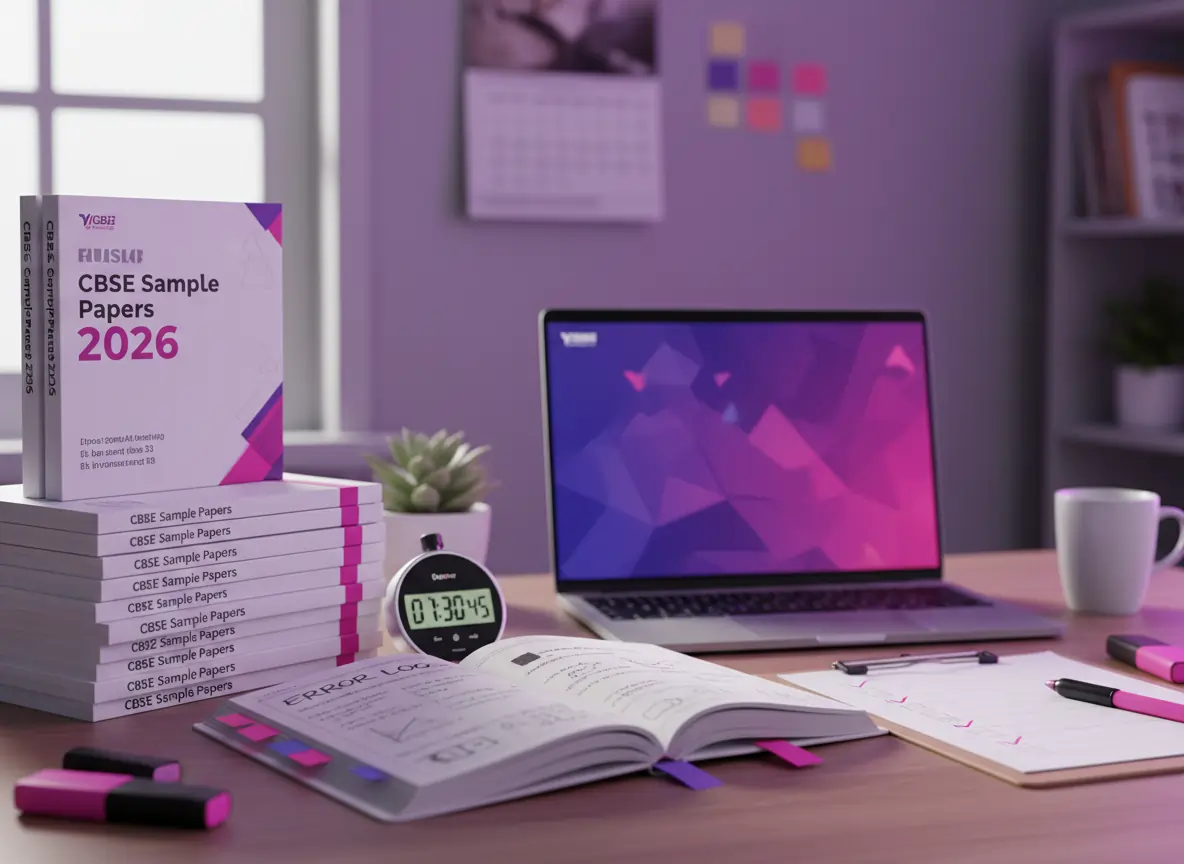
Most CBSE students “solve” sample papers, check the score once, and move on. That feels productive—but it doesn’t improve marks much. The real improvement happens in what you do after the paper: analysing mistakes, fixing weak chapters, rewriting answers in the right format, and repeating the same patterns until they become automatic.This guide shows you exactly how to use CBSE sample papers 2026 the smart way—so every paper you do increases your final board score (Class 10 or Class 12).
1) When Should You Start Sample Papers?
Start sample papers when:
- you have completed most of the syllabus once, and
- you have revised at least the key chapters.
If you start too early, sample papers become confusing and demotivating. If you start too late, you don’t get enough time to fix repeated mistakes.Best time window: last 6–10 weeks before the exam (even earlier if you’re aiming 90%+).
2) The Biggest Mistake: Treating Sample Papers Like “Practice Questions”
A sample paper is not just practice—it is:
- a time management test
- a presentation test
- a stress handling test
- a weakness detector
So your goal is not “finish more papers.”
Your goal is “make fewer mistakes in the next paper.”
3) The Right 5-Step System (Paper → Marks Improvement Loop)
Step 1: Attempt it like the real board exam
Rules:
- Sit with a timer
- No phone
- No breaks
- Use only allowed stationery
- Write full answers (don’t do mental math)
Why: Your brain learns exam speed only under exam conditions.
Step 2: Check strictly (don’t be lenient)
Use:
- marking scheme (if available)
- NCERT keywords (Science/SST)
- step marks (Maths/Physics)
- format rules (English/Hindi writing)
If you check casually, you’ll repeat the same mistakes in the board exam.
Step 3: Do a “Mistake Audit” (this is where marks increase)
Create 4 columns in a notebook:
- Question number
- Mistake type
- Why it happened
- Fix for next time
Mistake types to track
- Concept gap (didn’t know)
- Silly mistake (sign, unit, spelling, wrong option)
- Presentation (not in points, missing keywords, no steps)
- Time issue (left incomplete, rushed)
- Memory issue (forgot formula/reaction/date)
This audit is more valuable than the paper itself.
Step 4: Rewrite only the wrong answers (smart correction)
Don’t rewrite the full paper. Rewrite only:
- wrong answers
- incomplete answers
- answers that lost marks due to format/keywords
Subject-wise correction method
Maths/Physics numericals:
Rewrite with: Given → Formula → Substitution → Answer + unitScience theory:
Rewrite with NCERT keywords + diagram if neededSST:
Rewrite in points (each point = 1 mark) + headingsEnglish/Hindi:
Rewrite with correct format + better paragraphingThis step trains your brain to produce board-ready answers.
Step 5: Re-test the same weak areas after 3 days
This is the “secret” step most students skip.After 3 days:
- redo the same weak chapter questions
- or attempt a mini-test of only those topics
That’s how mistakes stop repeating.
4) How Many Sample Papers Do You Actually Need?
Quality > quantity.A realistic target:
- Class 10: 8–12 full papers per subject (spread out)
- Class 12: 10–15 full papers for core subjects (more for Maths/Physics/Chem)
But only if you follow the correction loop.
If you’re not analysing mistakes, even 30 papers won’t help much.
5) How to Use Sample Papers for Time Management (Practical)
Use “time checkpoints”
During the paper, check time at:
- 30 minutes
- 60 minutes
- 90 minutes (or mid-point based on exam duration)
If you’re behind:
- move to shorter questions
- don’t get stuck on one 5-marker
- come back later
Don’t keep the longest set for the end
Case-based sets, long numericals, and 5-mark answers should be attempted in the middle—so you don’t leave them incomplete.
6) How to Use Sample Papers for Answer Writing (Marks Booster)
Sample papers teach you what boards reward:
- keywords
- steps
- structure
- diagrams
- neat presentation
A simple rule for 3/5 markers
- 1 line intro
- points in bullets
- 1 line conclusion (for 5 marks)
Examiners scan for points. Make it easy for them to award marks.
7) What to Do If Your Score Is Not Improving
If your score stays the same after 3 papers, it usually means:
- you’re not correcting properly, or
- you’re not revising weak chapters, or
- you’re repeating the same mistakes.
Fix it with this plan:
- Stop doing new papers for 3 days
- Revise weak chapters only
- Redo wrong questions
- Then attempt the next paper
Marks improve when your weak areas shrink.
8) The Best Weekly Sample Paper Routine (Repeatable)
Weekdays (Mon–Fri)
- 30–60 minutes: chapter revision + weak-topic practice
- 10 minutes: error log review
Saturday
- 1 full timed sample paper (main subject)
- strict checking + mistake audit
Sunday
- correction + rewrite wrong answers
- mini-test on weak areas
This routine is sustainable and gives real improvement.
9) Final 15 Days Strategy (If Exam Is Very Close)
- Attempt papers on alternate days
- Revise error log daily
- Focus on:
- frequently repeated question types
- presentation + keywords
- time management
In the last 15 days, don’t chase “new books.” Chase “fewer mistakes.”
FAQs:-
Should I solve CBSE sample papers chapter-wise or full-length?
Full-length is better for time management and exam stamina. Chapter-wise is useful only for weak topics.
Should I use the same sample paper again?
Yes—redoing weak questions after 3 days is one of the fastest ways to improve accuracy.
What if I can’t finish the paper on time?
That’s exactly why sample papers matter. Use checkpoints, start with easy questions, and practise writing faster with better structure.
Optional CTA (EdFlik)
EdFlik helps CBSE students use sample papers the right way with timed mocks, detailed corrections, error-log tracking, and personalised revision plans.
Website: https://www.edflik.com
WhatsApp: +918878896600
Email: support@edflik.com
You May Also Like To Read:-