
Challenge ME Maths Exam Guide: Bands, Courses, Grades, Format & Preparation Strategy
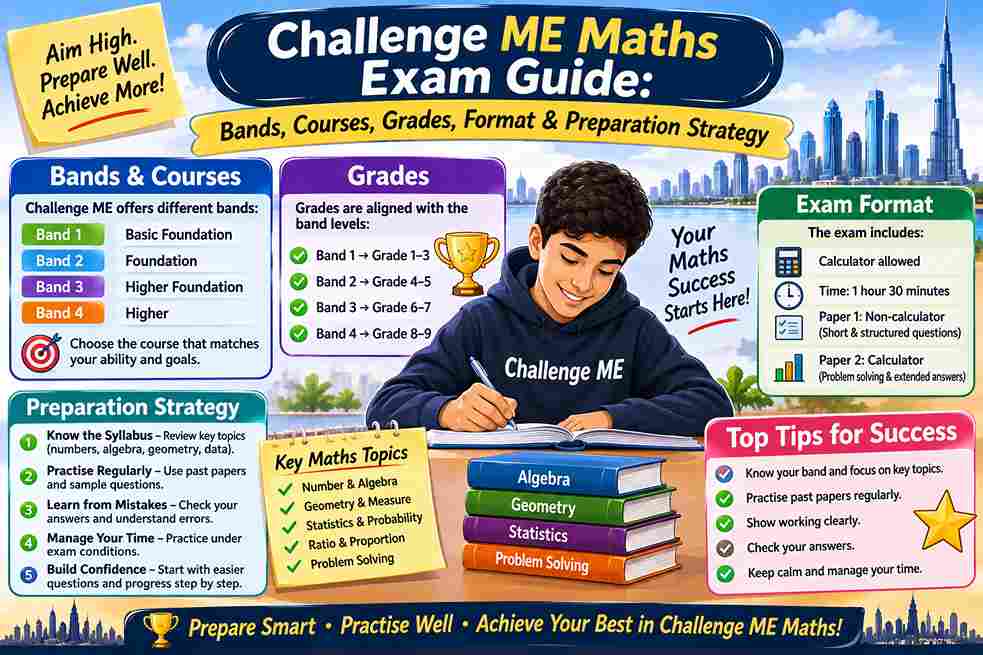
By EdFlik Team | November 20, 2026
For students, parents, and school leaders across the UAE and the wider MENA region, competitive mathematics enrichment is increasingly becoming a defining part of academic growth. Among the standout regional competitions for school-age learners is the Challenge ME Maths Championship ("Challenge Thinking. Celebrate Excellence.")—a multi-stage mathematics competition built for international schools that brings together individual problem-solving and team school spirit.
Unlike routine classroom tests that focus strictly on textbook drills, Challenge ME quests and exams are designed to stretch logical reasoning, pattern recognition, mental agility, and non-routine problem solving under timed conditions. Students compete across age-matched Bands (Bands 1 to 5) spanning primary through senior secondary school, while representing diverse curricula including British, American, IB, SABIS, and international/national tracks.
Whether a student in Dubai, Abu Dhabi, Sharjah, or elsewhere in the region is entering their first school league quest or aiming for the Semi-Finals and Grand Championship Finals, understanding how the bands, competition stages, scoring rules, and syllabus themes work gives them a clear strategic advantage.
This comprehensive guide breaks down the Challenge ME Maths Championship—covering all bands, supported curricula and courses, year/grade alignments and recognition/grades, competition stages and scoring, core topic areas, preparation strategies, and 100% copy-paste JSON-LD schema markup.
Key Takeaways
- Five Age-Matched Bands (Band 1 to Band 5): Students are grouped by school year/grade across primary, lower secondary, upper secondary, and senior secondary levels so every learner faces appropriately pitched mathematical challenges.
- Curriculum-Inclusive Design: Challenge ME supports students across British, American, IB, SABIS, and international/national curricula by emphasizing core mathematical reasoning and problem-solving rather than rote recall of a single textbook.
- Four-Stage Progression & Recognition: The championship progresses from School Leagues and Invitationals to Semi-Finals and Finals, combining individual leaderboard progression, team/school spirit, and finalist/champion recognition rather than traditional school report-card letter grades.
- Speed, Accuracy, and No-Calculator Discipline Matter: Timed quest and exam rules reward careful working on rough paper, avoiding calculators/measuring instruments where prohibited, and submitting clean numerical answers without guesswork errors.
Part 1: All Challenge ME Bands and Year/Grade Alignments
The Challenge ME Maths Championship divides participants into five bands so younger learners build confidence on accessible puzzles while older students tackle deeper analytical and algebraic problems.
| Band | UK Curriculum Years | IB / US / International Grades | Stage & Level Focus |
| Band 1 | Year 12 – Year 13 | Grade 11 – Grade 12 | Senior secondary / pre-university problem solving & advanced reasoning. |
| Band 2 | Year 10 – Year 11 | Grade 9 – Grade 10 | Upper secondary / IGCSE-stage analytical & multi-step reasoning. |
| Band 3 | Year 7 – Year 9 | Grade 6 – Grade 8 | Lower secondary / Key Stage 3 transition, algebra, geometry & logic. |
| Band 4 | Year 5 – Year 6 | Grade 4 – Grade 5 | Upper primary arithmetic fluency, number patterns & visual logic. |
| Band 5 | Year 3 – Year 4 | Grade 2 – Grade 3 | Lower/mid primary foundational number sense, puzzles & early reasoning. |
As shown in the classroom problem-solving scene above, competition-style maths works best when students actively test ideas, collaborate, and learn to break multi-step problems down methodically.
Part 2: Courses, Curricula, and Grades / Recognition Structure
Which Courses and Curricula Does Challenge ME Include?
Rather than locking participants into a single national textbook course, Challenge ME is structured as a cross-curriculum mathematics enrichment championship open to schools across multiple educational tracks:
- British Curriculum (Key Stages 1–5, including Primary, Lower Secondary, IGCSE/GCSE, and A-Level year groups).
- American Curriculum (elementary through high school grade bands).
- International Baccalaureate (IB) (PYP, MYP, and DP grade equivalents).
- SABIS & Other International / National Curricula.
The mathematical "course" of the exam centers on competition problem-solving—applying core arithmetic, number properties, algebra, geometry/mensuration, data/probability, and logical reasoning to unfamiliar, non-routine questions rather than standard routine exercises.
How "Grades" Work in Challenge ME
Students and parents sometimes ask what grades Challenge ME awards. Because Challenge ME is an external mathematics championship rather than a school report-card course or state qualification:
- It does not issue A*–U or A–F academic course grades on a school transcript.
- Instead, performance is tracked through quest scores, leaderboards, stage qualification, school/team standings, finalist placements, and championship/year-group awards across the four stages of the competition.
Part 3: Four Stages, Exam Rules, and Scoring Mechanics
The Challenge ME Maths Championship runs across four progressive stages that take students from online school-based quests to high-stakes live stages:
               CHALLENGE ME FOUR-STAGE CHAMPIONSHIP JOURNEY
                                     |
  Stage 1: School Leagues     ---> Virtual 5-week interschool competition on the digital platform
                                   (practice period + competition quests) building school & individual points.
  Stage 2: Invitationals      ---> Top-performing students from School Leagues advance to compete
                                   at a higher difficulty level.
  Stage 3: Semi-Finals        ---> In-person regional experience (e.g., in Dubai) featuring team challenges,
                                   keynote talks, awards, & the Stage 3 Quest toward Finals.
  Stage 4: Finals             ---> Top-performing students per year/grade group compete in rigorous
                                   final challenges to earn top honors & year-group Champion titles.
Key Exam & Scoring Rules Students Should Expect
While exact stage handbooks set specific parameters for each round, test formats across Challenge ME bands and stages follow consistent competition principles:
- Strict Time Limits: Papers and quests are tightly timed (for example, short sprint tests around 20–30 minutes or longer papers around 40–60 minutes depending on the band and stage).
- Tiered Point Values by Difficulty: Earlier questions typically carry lower point values (such as 3 marks), middle questions carry moderate weight (4 marks), and final/hardest questions carry higher weight (5 marks), rewarding smart time allocation.
- No-Calculator & Clean Answer Rules: Calculators, measuring instruments, and squared paper are generally forbidden during test conditions (while rough paper is permitted), and answers are typically entered in numeral form as integers or decimals unless stated otherwise.
Part 4: Core Syllabus & Topic Areas Across Bands
Because Challenge ME tests applied mathematical thinking across bands, students benefit from mastering core curriculum foundations alongside logic and pattern skills:
| Topic Domain | Key Concepts & Skills Tested | How It Appears in Challenge ME |
| Number & Arithmetic | Integers, order of operations, factors/multiples (HCF/LCM), primes, fractions, decimals, percentages, ratios & proportions. | Fast mental/written calculation, number-property deductions, and percentage/ratio word problems. |
| Algebra & Patterns | Simplifying expressions, substitution, linear/quadratic relationships, inequalities, expansions, factorization & sequences. | Finding general rules in number sequences, balancing equations, and solving symbolic puzzles. |
| Geometry & Mensuration | Angles, triangles, quadrilaterals, polygons, circles, symmetry, perimeter, area, surface area, volume & unit conversions. | Spatial reasoning, decomposing composite shapes, and multi-step measurement calculations. |
| Data, Probability & Coordinate/Transformations | Averages (mean/median/mode), charts/graphs, basic probability, Cartesian coordinates, reflections, rotations & translations. | Interpreting visual/tabular data and predicting outcomes or positions under transformations. |
| Logical Reasoning & HOTS | Number series, missing terms, deduction puzzles, Venn diagrams, coding-decoding & systematic casework. | Unfamiliar multi-step puzzles that test structured trial, elimination, and insight rather than memorized formulas. |
Using clean rough-paper sketches and structured steps—like the geometry and algebra notes shown above—helps prevent careless arithmetic slips when working without a calculator.
Part 5: Actionable Preparation Plan & Common Traps to Avoid
A Practical 4-Step Prep Routine
- Diagnose Untimed First, Then Add the Clock: Start with practice quests or past-style problems untimed to see which topic (e.g., ratios, geometry, or sequence logic) slows you down, then practice under strict exam timers.
- Train Without a Calculator: Practice mental arithmetic, fraction/decimal conversions, and clean written working so you don't lose time when calculators are not allowed.
- Review Why a Trick Worked: After every practice set, write down the core insight behind missed questions (such as testing small numbers, spotting symmetry, or working backward) rather than just checking the final number.
- Build Consistency Across Quests: Weekly practice and review build calm pacing and confidence heading into Invitationals, Semi-Finals, and Finals.
Top 4 Mistakes Students Make in Challenge ME Exams
- Spending 10 Minutes on One Hard Question Early: Higher-mark questions come later, and getting stuck early drains time from solvable problems. Flag tough items, move on, and return if time permits.
- Relying on Calculators During Prep: Practising with a calculator creates dependency and slows down numerical estimation during non-calculator test conditions.
- Misreading Answer Format Instructions: Submitting a fraction or extra text when an integer or decimal in numeral form is requested can cost an otherwise earned answer.
- Skipping Rough-Paper Diagrams: Trying to hold multi-step geometry or logic clues purely in your head increases silly mistakes.
For expert 1-on-1 online tutoring support to build problem-solving speed, strengthen core maths topics across all bands, and prepare for Challenge ME and school exams across the UAE, book a class on EdFlik.
Frequently Asked Questions (FAQs)
Q1: What are the age and grade bands in the Challenge ME Maths Championship?
Ans: Challenge ME features five bands: Band 1 (Year 12–13 / Grade 11–12), Band 2 (Year 10–11 / Grade 9–10), Band 3 (Year 7–9 / Grade 6–8), Band 4 (Year 5–6 / Grade 4–5), and Band 5 (Year 3–4 / Grade 2–3).
Q2: Which school curricula can participate in Challenge ME?
Ans: Students from British, American, IB, SABIS, and other international or national curricula participate across corresponding year and grade bands.
Q3: How many stages are in the Challenge ME Maths Championship?
Ans: The championship runs across four stages: Stage 1 (School Leagues), Stage 2 (Invitationals), Stage 3 (Semi-Finals), and Stage 4 (Finals).
