
Chess Summer Camp for Kids UAE 2026 — Why 10 Days of Chess Builds Lifelong Strategic Thinking (Ages 7-9)
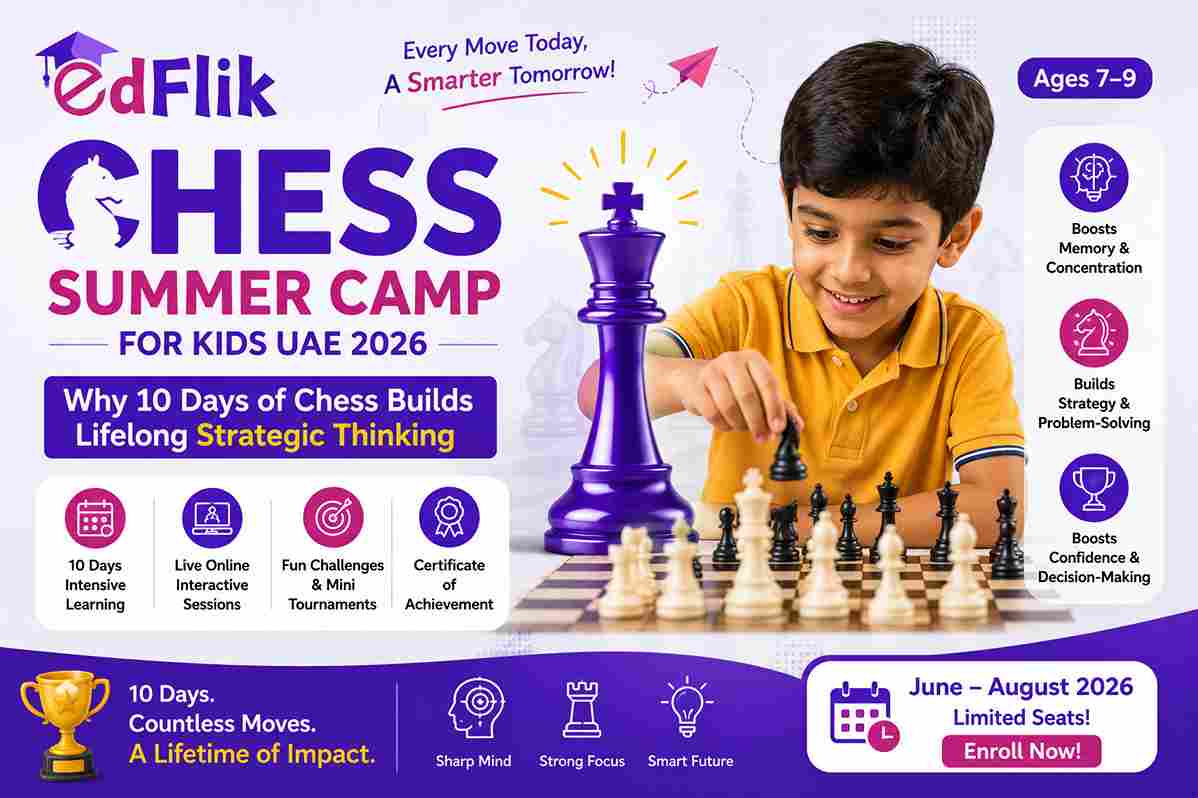
Chess is one of the most researched tools available for developing a young child's cognitive skills, and the ages 7 to 9 window is widely considered the ideal time to start. This guide explains exactly what a structured chess summer camp builds in a young learner, and what EdFlik's 10-day, live online Chess programme for ages 7-9 actually covers.
Why Chess at Ages 7-9 Specifically
By age 7, most children have developed sufficient working memory and pattern-recognition ability to understand piece movement and basic planning. They are also still young enough to build chess as a genuine habit before the demands of upper-primary academics compete for their time.
The Cognitive Skills Chess Actually Builds
|
Skill |
How Chess
Develops It |
Where It
Transfers |
|
Working memory |
Tracking
multiple pieces and possible moves simultaneously |
Mental maths,
multi-step problem-solving, following instructions |
|
Planning ahead |
Thinking
several moves in advance and anticipating responses |
Project
planning, exam strategy, long-term goal setting |
|
Pattern
recognition |
Identifying
recurring tactical structures (forks, pins) |
Maths
patterns, reading comprehension, scientific reasoning |
|
Patience and
impulse control |
Resisting the
first available move without evaluation |
Exam
technique, emotional regulation |
|
Decision-making
under uncertainty |
Evaluating
options with incomplete information |
Real-world
decision-making, confidence in ambiguity |
What EdFlik's 10-Day Chess Programme Covers
EdFlik's Chess curriculum for ages 7-9 is taught by Ms. Laxmi, who holds a B.Com and a Bachelor's degree in Chess, with 6+ years of teaching experience across Talent Gum, Lightning Up Kids, Tutorology, and Level Up.
• Days 1-3: Piece movement and basic board orientation — how each piece moves, value hierarchy, check and checkmate basics
• Days 4-6: Opening principles — controlling the centre, developing pieces, king safety through castling
• Days 7-8: Simple tactical patterns — forks, pins, and discovered attacks through guided practice
• Days 9-10: Independent practice games with live instructor feedback
|
No prior
chess experience is required. The programme is designed for first-time
learners, and children with some existing knowledge are supported at a faster
pace within the same group. |
How Online Chess Instruction Works for Young Children
Effective online chess teaching for ages 7-9 uses an interactive digital chessboard that both instructor and child can see and manipulate in real time. Sessions combine live demonstration, guided practice with immediate correction, and short practice games to apply what was just learned.
The Full 7-9 Summer Camp Programme
Chess is one of three subjects in EdFlik's ages 7-9 track, alongside Financial Literacy (Ms. Samrah, trilingual with CBSE, ICSE, IB and IGCSE experience) and Art & Craft every Friday (Ms. Prabha, BFA Painting, 10 years experience). Each 90-minute session runs across 10 teaching days for 15 hours total.
|
Batch |
Dates |
Slots |
|
Batch 1 —
Pilot |
6 Jul - 18 Jul |
10:00-11:30 AM |
|
Batch 2 —
Scale Up |
20 Jul - 31
Jul |
Morning or
Evening |
|
Batch 3 — Full
Run |
3 Aug - 14 Aug |
Morning or
Evening |
|
EdFlik Chess
Summer Camp 2026 — ages 7-9, taught live by a dedicated Chess specialist.
Part of a 10-day, 15-hour programme also covering Financial Literacy and Art.
Register at www.edflik.com. |
Frequently Asked Questions
Q: What age should a child start learning chess?
Ages 7-9 is widely considered ideal — sufficient working memory and pattern recognition while still young enough to build the habit before later academic demands.
Q: What cognitive skills does chess develop in young children?
Working memory, planning ahead, pattern recognition, patience and impulse control, and decision-making under uncertainty.
Q: Can a child with no chess experience join a 10-day chess summer camp?
Yes — EdFlik's programme takes complete beginners through foundational movement, opening principles, and tactics over 10 days.
Q: How is chess taught online to young children effectively?
Through an interactive digital chessboard, live demonstration, and structured practice games, not static diagrams or passive video.
Q: What else is taught alongside Chess in EdFlik's 7-9 summer camp?
Financial Literacy and Art & Craft on Fridays, across a 10-day, 15-hour live online programme.