Conquering Edexcel IAL Pure Math 3 Trigonometric Identities and Partial Fractions: A Masterclass Guide
Last Updated: October 2026 | By EdFlik Education Team
For students studying Pearson Edexcel International Advanced Level (IAL) Pure Mathematics 3 (WMA13), Paper 3 is widely regarded as one of the most critical turning points in the entire A-Level journey. While Units 1 and 2 build foundational algebraic fluency, Unit 3 introduces advanced calculus, exponential and logarithmic functions, and sophisticated algebraic manipulation.
Among all topics tested in the P3 syllabus, Trigonometric Identities and Partial Fractions consistently serve as the primary gatekeepers between grade $B$ and a top-tier $A^*$. Examiners do not merely test rote formula memorization; they test your ability to synthesize compound identities, manipulate rational expressions under strict algebraic constraints, and execute multi-step proofs without error.
In this comprehensive, exam-focused masterclass guide, our expert IAL mathematics educators break down the core mechanics of partial fractions and advanced trig identities, unpack common student pitfalls, and provide a systematic framework to secure maximum marks on exam day.
Part 1: Mastering Partial Fractions — The Foundation of Advanced Integration
Partial fractions form the bedrock of algebraic manipulation in P3, laying the essential groundwork for advanced integration techniques (such as integration by partial fractions in P4). If your algebraic foundation wobbles here, downstream marks in calculus will vanish.
1. The Core Principle
Converting a complex single rational fraction into the sum of simpler fractions requires proper classification of the denominator. Edexcel IAL exams generally test three distinct denominator structures:
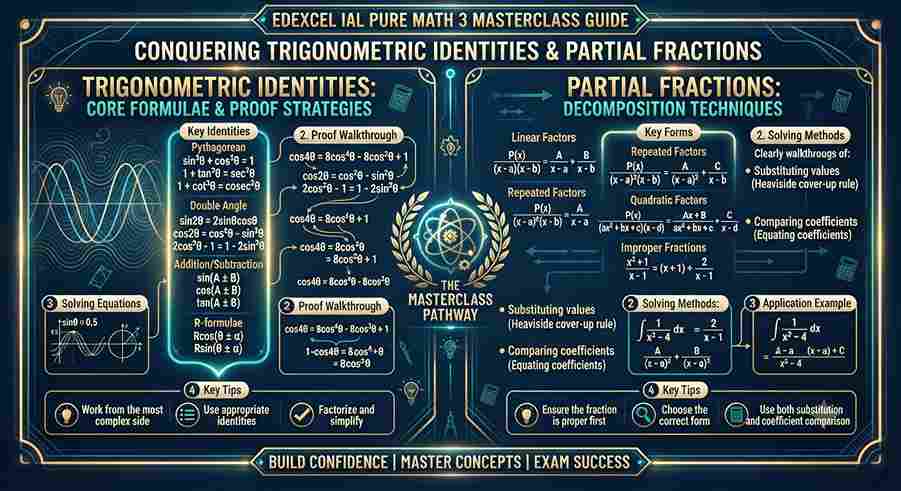
- Case 1: Distinct Linear Factors$$\frac{P(x)}{(ax + b)(cx + d)} \equiv \frac{A}{ax + b} + \frac{B}{cx + d}$$
- Case 2: Repeated Linear Factors$$\frac{P(x)}{(ax + b)^2(cx + d)} \equiv \frac{A}{ax + b} + \frac{B}{(ax + b)^2} + \frac{C}{cx + d}$$
- Case 3: Quadratic Factors (Irreducible)$$\frac{P(x)}{(ax + b)(x^2 + cx + d)} \equiv \frac{A}{ax + b} + \frac{Bx + C}{x^2 + cx + d}$$
2. Improper Fractions (The Hidden Trap)
One of the most common student errors in P3 partial fraction questions occurs when the degree of the numerator is greater than or equal to the degree of the denominator (an improper fraction).
- The Rule: You cannot apply partial fractions directly to an improper fraction.
- The Solution: You must first execute algebraic long division or polynomial inspection to extract the polynomial quotient and proper remainder fraction before splitting into partial fractions. Failing to do this results in an immediate loss of method marks.
Part 2: Advanced Trigonometric Identities — Beyond GCSE and P2
While P2 introduces basic sine, cosine, and tangent graphs along with the fundamental identities $\sin^2\theta + \cos^2\theta \equiv 1$ and $\tan\theta \equiv \frac{\sin\theta}{\cos\theta}$, P3 expands your trigonometric arsenal significantly.
1. Secant, Cosecant, and Cotangent ($\sec\theta, \csc\theta, \cot\theta$)
P3 introduces the three reciprocal trigonometric ratios:
- $$\sec\theta = \frac{1}{\cos\theta} \quad (\text{Undefined where } \cos\theta = 0)$$
- $$\csc\theta = \frac{1}{\sin\theta} \quad (\text{Undefined where } \sin\theta = 0)$$
- $$\cot\theta = \frac{1}{\tan\theta} = \frac{\cos\theta}{\sin\theta} \quad (\text{Undefined where } \sin\theta = 0)$$
2. The Two Pythagorean Identity Extensions
You must commit these two secondary identities to memory, as examiners frequently require you to substitute them into complex proofs or differential equations:
- $$1 + \tan^2\theta \equiv \sec^2\theta$$
- $$1 + \cot^2\theta \equiv \csc^2\theta$$
3. Compound Angle Formulas
Edexcel IAL P3 requires you to apply and manipulate the compound angle formulas for sine, cosine, and tangent:
- $$\sin(A \pm B) = \sin A \cos B \pm \cos A \sin B$$
- $$\cos(A \pm B) = \cos A \cos B \mp \sin A \sin B$$
- $$\tan(A \pm B) = \frac{\tan A \pm \tan B}{1 \mp \tan A \tan B}$$
4. Double Angle Formulas
Derived directly from the compound angle formulas when $A = B$, double angle identities are essential for solving trig equations and simplifying expressions:
- $$\sin(2A) = 2\sin A \cos A$$
- $$\cos(2A) = \cos^2 A - \sin^2 A = 2\cos^2 A - 1 = 1 - 2\sin^2 A$$
- $$\tan(2A) = \frac{2\tan A}{1 - \tan^2 A}$$
Part 3: Proving Identities and Solving Trigonometric Equations
Exam questions in P3 typically split into two types: algebraic proofs (requiring $\equiv$) and equation-solving within a specified domain (e.g., $0 \le \theta < 360^\circ$ or $-\pi \le \theta \le \pi$).
Step-by-Step Approach for Trig Proofs:
- Start with the more complex side (usually the Left-Hand Side, LHS).
- Convert everything to sines and cosines if you get stuck, using $\sec\theta = \frac{1}{\cos\theta}$ and $\csc\theta = \frac{1}{\sin\theta}$.
- Look for Pythagorean opportunities (e.g., spotting $1 - \cos^2\theta$ and substituting $\sin^2\theta$).
- Factorize and simplify algebraic fractions carefully before attempting to force the RHS form.
Part 4: Top 4 Exam Traps That Cost Students P3 Marks
- Improper Fraction Neglect: Forgetting to check if a fraction is top-heavy before applying partial fractions. Always divide first if degree numerator $\ge$ degree denominator!
- Sign Errors in Double Angle Cosine Expansions: Remember that $\cos(2A) = 1 - 2\sin^2A$. Misplacing the negative sign during substitution leads to incorrect quadratic equations.
- Dropping Solutions in Trig Equations: When solving equations like $\sin(2\theta) = \cos\theta$, never divide both sides by $\cos\theta$ blindly; doing so loses valid solutions where $\cos\theta = 0$. Instead, bring all terms to one side and factorize.
- Radian vs. Degree Mode Slips: Check your calculator mode carefully. If the domain is given in radians (e.g., $-\pi \le x \le \pi$), your calculator must be set to Radians, not Degrees.
Struggling with Edexcel IAL Pure Math 3 partial fractions, trigonometric proofs, or past-paper mark schemes? EdFlik connects international school students globally with expert, 1-to-1 online mathematics tutors, helping you master complex proofs and secure top $A^$ grades.*Book a Free Demo Class Today!
Frequently Asked Questions (FAQs)
Q1: How do I know whether to use $\cos(2A) = 2\cos^2A - 1$ or $1 - 2\sin^2A$?
Ans: Look at the rest of your equation. If the equation already contains $\cos\theta$ terms, substitute $2\cos^2A - 1$ so your entire equation is expressed in terms of cosine, making it easy to solve as a standard quadratic.
Q2: Can partial fractions have three or more linear factors in the denominator?
Ans: Yes! The principle remains identical. For three distinct linear factors $(ax+b)(cx+d)(ex+f)$, you simply split the expression into $\frac{A}{ax+b} + \frac{B}{cx+d} + \frac{C}{ex+f}$ and solve for constants $A$, $B$, and $C$ using substitution or coefficient comparison.
Q3: Are formula booklets provided in Edexcel IAL P3 exams?
Ans: Yes, Pearson Edexcel provides the official mathematical formula booklet (IAL Formulae Statistical Tables) during P3 exams, which includes standard trigonometric identities and differentiation derivatives. However, knowing key identities by heart saves precious exam time.
Q4: How does EdFlik support Edexcel IAL Mathematics students?
Ans: EdFlik connects international school students worldwide with vetted, expert 1-to-1 online mathematics tutors specializing in Pearson Edexcel IAL Pure Math 1 through 4, Mechanics, and Statistics. Our personalized coaching focuses on clarifying difficult algebraic techniques, exam pacing, and rigorous past-paper practice.