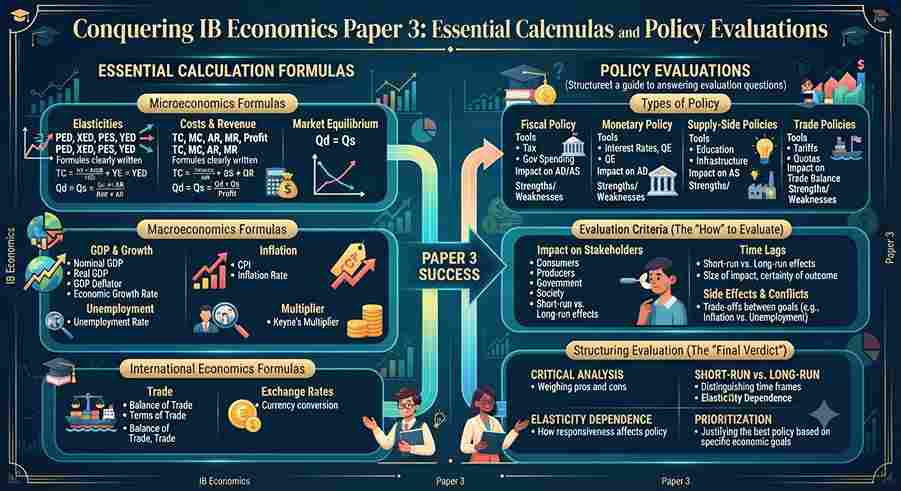
Conquering IB Economics Paper 3: Essential Calculation Formulas and Policy Evaluations
Last Updated: October 2026 | By EdFlik Education Team
For students enrolled in the International Baccalaureate (IB) Diploma Programme Economics course—whether Standard Level (SL) or Higher Level (HL)—Paper 3 is often viewed as both a formidable hurdle and the ultimate opportunity to secure a Grade 7.
Unlike Papers 1 and 2, which rely heavily on extended essay writing and qualitative policy discussions, Paper 3 is the policy and quantitative paper. It tests your ability to manipulate economic data, calculate elasticities, compute multiplier effects, analyze tax burdens, and evaluate economic policies using precise mathematical proofs and structured real-world frameworks.
Many students lose easy marks on Paper 3 not because they struggle with advanced mathematics, but because they memorize formulas without understanding their economic intuition, forget to state units, or fail to structure policy evaluations using the mandatory efficiency, equity, and stakeholder criteria.
In this comprehensive, exam-focused masterclass guide, our expert IB Economics educators break down the essential Paper 3 calculation formulas, quantitative step-by-step frameworks, and qualitative policy evaluation techniques to help you ace the exam.
Part 1: The Quantitative Arsenal — Essential IB Economics Formulas
To score full marks on Paper 3 calculation questions, you must know your formulas inside out. Here are the core mathematical concepts tested by the International Baccalaureate organization:
1. Elasticities
- Price Elasticity of Demand (PED):$$\text{PED} = \frac{\% \text{ change in quantity demanded}}{\% \text{ change in price}} = \frac{\Delta Q / Q_1}{\Delta P / P_1} \times 100$$
- Income Elasticity of Demand (YED):$$\text{YED} = \frac{\% \text{ change in quantity demanded}}{\% \text{ change in real income}}$$
- Cross-Price Elasticity of Demand (XED):$$\text{XED} = \frac{\% \text{ change in quantity demanded of Good A}}{\% \text{ change in price of Good B}}$$
- Price Elasticity of Supply (PES):$$\text{PES} = \frac{\% \text{ change in quantity supplied}}{\% \text{ change in price}}$$
2. Market Efficiency, Taxes, Subsidies, and Tariffs
- Consumer Surplus (CS) & Producer Surplus (PS):$$\text{Area of Triangle} = \frac{1}{2} \times \text{base} \times \text{height}$$
- Tax Burden Distribution:
- Consumer Tax Burden = $(P_{\text{tax}} - P_{\text{equilibrium}}) \times Q_{\text{tax}}$
- Producer Tax Burden = $(P_{\text{equilibrium}} - P_{\text{producer receive}}) \times Q_{\text{tax}}$
- Deadweight Loss (DWL): Calculated using the area of the welfare loss triangle created by market distortions (taxes, subsidies, quotas, tariffs, or monopolies).
3. Macroeconomics: Multipliers and National Income
- Marginal Propensity to Consume (MPC): $\text{MPC} = \frac{\Delta \text{Consumption}}{\Delta \text{Income}}$
- Marginal Propensity to Save (MPS), Tax (MPT), and Import (MPM):$$\text{MPW (Marginal Propensity to Withdraw)} = \text{MPS} + \text{MPT} + \text{MPM}$$
- The Keynesian Multiplier ($k$):$$k = \frac{1}{1 - \text{MPC}} = \frac{1}{\text{MPW}}$$
- Total Change in Real GDP:$$\Delta \text{Real GDP} = k \times \Delta \text{Injection}$$
Part 2: Step-by-Step Quantitative Problem-Solving Framework
When faced with a complex multi-step quantitative question on Paper 3, do not rush into calculations. Use this four-step workflow:
- Define and State the Formula: Always write down the core economic formula in standard algebraic notation before substituting any numbers. This guarantees method marks even if your final arithmetic contains a minor slip.
- Show All Intermediate Working: Clearly indicate how you calculated percentage changes ($\frac{\text{New} - \text{Old}}{\text{Old}} \times 100$). Examiners award separate marks for correct intermediate steps.
- Include Correct Units and Signs: Remember that PED is almost always negative (though economists often discuss its absolute value), YED can be positive (normal goods) or negative (inferior goods), and XED positive (substitutes) or negative (complements). Always attach appropriate currency symbols or units.
- Interpret the Economic Meaning: Many quantitative questions are followed by: "Explain the significance of this result for a firm or government." Connect your number back to real-world business strategy (e.g., "Because PED is elastic (-1.8), the firm should decrease price to increase total revenue").
Part 3: Mastering Policy Evaluations in Paper 3
Paper 3 is not just math; it frequently asks you to evaluate economic policies (e.g., indirect taxes, subsidies, trade protectionism, monetary policy, or supply-side interventions). When evaluating a policy, structure your response around three core criteria:
- Efficiency (Allocation & Market Failure): Does the policy eliminate deadweight loss and move the economy closer to social optimum, or does it create government failure and market distortions?
- Equity (Distribution of Income): Who bears the burden of the policy? For example, regressive indirect taxes (like GST/VAT) disproportionately burden low-income households, whereas progressive subsidies or targeted transfer payments promote equity.
- Stakeholder Analysis: Systematically evaluate the short-term and long-term impacts on:
- Consumers (prices paid, surplus, choice)
- Producers (revenues, costs, international competitiveness)
- Governments (tax revenues, expenditure, budget balance)
- Society / Externalities (environmental impact, public health, employment)
Part 4: Top 4 Traps That Cost IB Economics Marks
- Confusing Percentage Change Formulas: Calculating percentage change incorrectly by dividing by the new value instead of the original base value ($\frac{\text{New} - \text{Old}}{\text{Old}} \times 100$).
- Forgetting to State Assumptions: Failing to mention underlying economic assumptions (e.g., ceteris paribus, linear demand curves, or constant returns to scale) when applying multiplier models or elasticity calculations.
- One-Sided Policy Evaluations: Recommending a policy (like imposing a carbon tax) without analyzing its trade-offs, unintended consequences, or administrative implementation costs. Top-tier evaluations always weigh pros against cons.
- Poor Time Management on Paper 3: Spending 45 minutes obsessing over a single complex quantitative proof and leaving insufficient time for the extended policy evaluation questions at the end of the paper.
Preparing for IB Economics exams and aiming for a Grade 7? EdFlik connects international school students globally with expert, 1-to-1 online IB Economics tutors, helping you master calculation formulas, policy evaluations, and past-paper exam techniques.Book a Free Demo Class Today!
Frequently Asked Questions (FAQs)
Q1: Is Paper 3 required for both SL and HL IB Economics students?
Ans: No. Paper 3 is exclusively written for Higher Level (HL) students. SL students take Paper 1 and Paper 2 only, whereas HL students take Papers 1, 2, and 3. Paper 3 accounts for 30% of an HL student's final IB Economics grade.
Q2: Can I use a calculator on IB Economics Paper 3?
Ans: Yes! An approved graphic or scientific calculator is permitted and essential for Paper 3 calculations. However, you must still show all formula setups and intermediate working steps to earn full credit.
Q3: How should I practice for Paper 3 quantitative questions?
Ans: The best preparation is working backward through past IB Economics Paper 3 exam markschemes. Pay close attention to how the IB awards method marks versus accuracy marks, and keep a dedicated formula flashcard deck.
Q4: How does EdFlik support IB Economics students?
Ans: EdFlik connects international school students worldwide with vetted, expert 1-to-1 online IB tutors specializing in Economics, Mathematics, and Sciences. Our personalized sessions focus on clarifying complex quantitative models, perfecting essay structures, and tackling rigorous past-paper questions.