Conquering IB Physics Option and Core Fields: Flux, Faraday's Law, and Lenz's Law
Last Updated: October 2026 | By EdFlik Education Team
For students tackling IB Physics (Higher Level / Additional Higher Level options), electromagnetic induction represents one of the most intellectually rewarding yet challenging topics in the syllabus. Spanning magnetic flux, flux linkage, Faraday's law, motional electromotive force (emf), and Lenz's law, exam questions frequently test whether students truly understand the underlying energy mechanics or are simply memorizing formulas.
In this comprehensive masterclass guide, our expert physics educators break down the core mechanics of electromagnetic fields, derive essential equations step-by-step, and provide structural problem-solving frameworks to help you secure a top grade $7$.
Part 1: Magnetic Flux ($\Phi$) and Flux Linkage ($N\Phi$)
Before an electric current or electromotive force (emf) can be induced, we must understand how a magnetic field interacts with a given physical space.
1. Defining Magnetic Flux ($\Phi$)
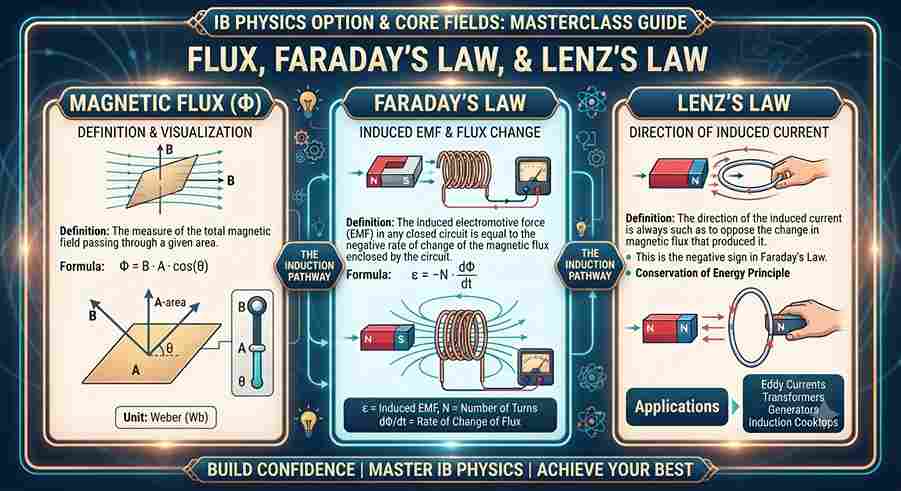
Magnetic flux measures the total component of a magnetic field passing perpendicularly through a specified planar area.
The formula given in your IB Data Booklet is:
$$\Phi = B A \cos(\theta)$$
- $\Phi$ = Magnetic flux measured in Webers ($\text{Wb}$) or Tesla-meters squared ($\text{T m}^2$)
- $B$ = Magnetic flux density measured in Tesla ($\text{T}$)
- $A$ = Area of the surface measured in meters squared ($\text{m}^2$)
- $\theta$ = The angle between the magnetic field lines and the normal (perpendicular line) to the surface.
Crucial Exam Distinction: Be careful with angles! If a question states that the magnetic field is parallel to the plane of the coil, $\theta = 90^\circ$, meaning $\cos(90^\circ) = 0$ and the flux is zero. If the field is perpendicular to the coil face, $\theta = 0^\circ$, meaning $\cos(0^\circ) = 1$ and flux is at its maximum.
2. Magnetic Flux Linkage ($N\Phi$)
When a coil consists of multiple turns of wire ($N$), every individual turn cuts through or links the magnetic field. Therefore, the total magnetic flux linkage is simply the product of the number of turns and the flux through a single turn:
$$\text{Flux Linkage} = N\Phi = N B A \cos(\theta)$$
Part 2: Faraday's Law of Induction
Michael Faraday discovered that a static magnetic field produces nothing; only a changing magnetic flux can induce an electromotive force (emf).
Faraday’s Law of Induction states that the magnitude of the induced emf in a circuit is directly proportional to the rate of change of magnetic flux linkage.
Expressed in standard IB calculus and algebraic form:
$$\varepsilon = -N \frac{\Delta \Phi}{\Delta t}$$
- $\varepsilon$ = Induced electromotive force measured in Volts ($\text{V}$)
- $N$ = Number of turns in the coil
- $\frac{\Delta \Phi}{\Delta t}$ = Rate of change of magnetic flux
- The negative sign ($\mathbf{-}$) is not a mathematical placeholder—it represents Lenz's Law.
Part 3: Lenz's Law and Conservation of Energy
Why is there a negative sign in Faraday's equation? Enter Heinrich Lenz.
Lenz’s Law states that the direction of any induced emf or current is such that it will oppose the change in magnetic flux linkage that produced it.
The Energy Argument
Lenz’s law is a direct application of the Principle of Conservation of Energy. Imagine if the opposite were true—if an induced current reinforced the change that created it. Pushing a magnet into a coil would cause an attracting force that accelerates the magnet inward faster, creating free energy out of nowhere and violating conservation laws.
Instead, when you push a North pole into a solenoid, the solenoid induces its own North pole at that end to actively push back, meaning you must perform mechanical work to push the magnet through. Mechanical work done = Electrical energy generated.
Part 4: Motional EMF in a Straight Conductor
When a physical metal rod of length $L$ moves at a constant velocity $v$ perpendicularly across a uniform magnetic field $B$, free electrons experience a magnetic force ($F = qvB$), causing charge separation and inducing an emf across the ends of the rod.
The magnitude of this motional emf is given by:
$$\varepsilon = B v L$$
- Derived directly from Faraday's law, as the rod sweeps out an area $A = Lv\Delta t$ per second in the magnetic field.
Part 5: Top 4 Exam Traps That Cost IB Physics Marks
- Mixing Up Angle Definitions: Using $\theta$ as the angle between the field and the coil face instead of measuring from the normal line. Always redraw your normal vector!
- Dropping the Negative Sign in Explanations: When asked to explain the significance of the minus sign in $\varepsilon = -N \frac{\Delta \Phi}{\Delta t}$, writing "it shows the direction is negative" instead of explicitly stating "it represents Lenz's law, indicating that the induced emf opposes the change in flux causing it."
- Confusing Flux with Flux Linkage: Forgetting to multiply by the number of turns ($N$) when a multi-turn coil is specified in problem calculations.
- Neglecting Graph Gradients: On a flux linkage ($N\Phi$ versus time $t$) graph, the gradient represents the induced emf (or negative emf). Students often confuse gradient calculations with area under the curve.
Preparing for IB Physics exams or HL options? EdFlik connects international school students globally with expert, 1-to-1 online physics tutors, helping you master complex field derivations, difficult past-paper problem sets, and core mark schemes.Book a Free Demo Class Today!
Frequently Asked Questions (FAQs)
Q1: How can magnetic flux change if the magnetic field itself is constant?
Ans: Flux can change in three distinct ways: by altering the magnetic field strength ($B$), by changing the surface area ($A$) exposed to the field (e.g., pulling a loop out of a field), or by changing the angle ($\theta$) between the field and the normal vector via physical rotation.
Q2: Does Lenz's law apply only to bar magnets and coils?
Ans: No. Lenz's law applies universally to all electromagnetic induction phenomena, including eddy currents in moving metal plates, transformers, and electrical generators.
Q3: What is the difference between magnetic flux and magnetic flux density?
Ans: Magnetic flux density ($B$) is the strength of the magnetic field per unit area measured in Tesla ($\text{T}$). Magnetic flux ($\Phi$) is the total field passing through a specific bounded area measured in Webers ($\text{Wb}$).
Q4: How does EdFlik support IB Physics students?
Ans: EdFlik connects international school students worldwide with vetted, expert 1-to-1 online physics tutors specializing in the IB Diploma Programme (SL and HL). Our personalized sessions focus on clarifying difficult field theory, mastering mathematical problem-solving, and preparing effectively for Paper 1, 2, and 3 examinations.