Conquering Momentum in Two Dimensions: Edexcel IAL Physics Unit 4 Problem-Solving Guide
Last Updated: October 2026 | By EdFlik Education Team
For international high school students preparing for the Pearson Edexcel International Advanced Level (IAL) Physics Unit 4 (specifically Further Mechanics, Fields and Particles), momentum conservation is a cornerstone topic that regularly appears on exam papers. While one-dimensional collisions—where objects move strictly along a straight line—are relatively straightforward, two-dimensional (2D) momentum collisions and explosions present a significant hurdle for many students.
On the Edexcel IAL Unit 4 exam, 2D momentum problems test your ability to resolve vectors into components, apply the Principle of Conservation of Linear Momentum in both the $x$ and $y$ directions independently, utilize kinetic energy equations to determine whether collisions are elastic or inelastic, and handle oblique glancing impacts.
In this comprehensive, exam-focused masterclass guide, our expert Edexcel IAL physics educators break down the vector mathematics of 2D collisions, expose common pitfalls, and provide a step-by-step problem-solving framework to help you secure full marks.
Part 1: The Core Principles — Vector Momentum Conservation
The fundamental law governing all collision problems is the Principle of Conservation of Linear Momentum:
"Provided no external resultant force acts on a system, the total linear momentum of the system in any given direction remains constant."
In one dimension, you simply assign positive and negative signs to velocities moving left or right. In two dimensions, momentum is a vector quantity. This means that total momentum must be conserved independently along two perpendicular axes (usually chosen as the horizontal $x$-axis and vertical $y$-axis):
- Conservation of Momentum in the $x$-direction:$$\sum p_{initial, x} = \sum p_{final, x} \implies m_1 u_1 \cos\theta_1 + m_2 u_2 \cos\theta_2 = m_1 v_1 \cos\phi_1 + m_2 v_2 \cos\phi_2$$
- Conservation of Momentum in the $y$-direction:$$\sum p_{initial, y} = \sum p_{final, y} \implies m_1 u_1 \sin\theta_1 + m_2 u_2 \sin\theta_2 = m_1 v_1 \sin\phi_1 + m_2 v_2 \sin\phi_2$$
Part 2: Step-by-Step Problem-Solving Framework for 2D Collisions
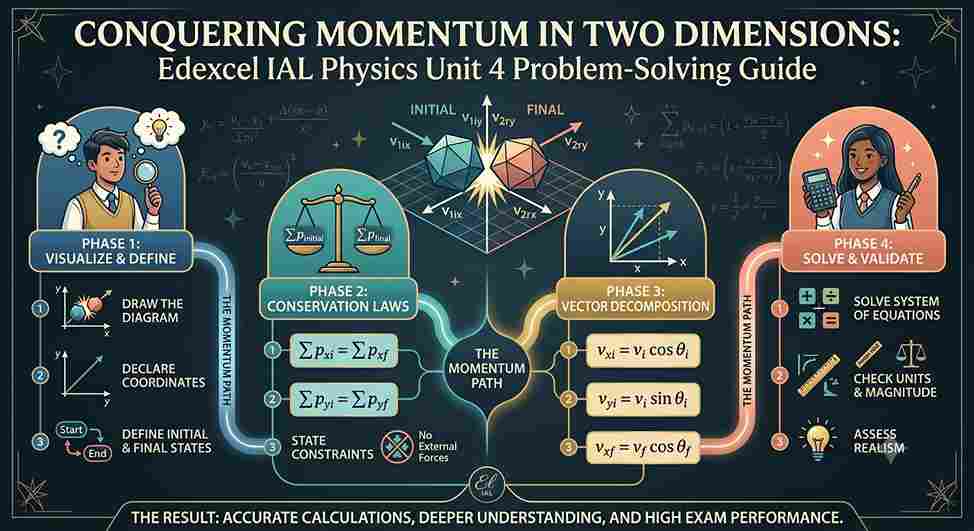
When faced with a complex 2D collision or explosion question on Edexcel Unit 4, do not guess angles or plug numbers into random formulas. Follow this rigorous four-step workflow:
Step 1: Set Up a Clear Coordinate System and Sketch the Diagram
Always begin by sketching a clean coordinate grid showing the paths of all objects before and after the collision.
- Align one of your axes (usually the $x$-axis) along the initial velocity of the moving projectile whenever possible. This eliminates one velocity component entirely from the $y$-equation, simplifying your algebra.
Step 2: Resolve All Velocities Into $x$ and $y$ Components
If an object moves at an angle $\theta$ to the horizontal, resolve its velocity vector immediately:
- Horizontal component: $v_x = v \cos\theta$
- Vertical component: $v_y = v \sin\theta$
- Calculator Check: Ensure your calculator is set to Degrees (unless radians are explicitly specified in the angular measurements).
Step 3: Formulate Simultaneous Equations for $x$ and $y$
Write out your two independent conservation equations:
- Equate total initial momentum in the $x$-direction to total final momentum in the $x$-direction.
- Equate total initial momentum in the $y$-direction to total final momentum in the $y$-direction (note that if an object is initially stationary or moving purely along the $x$-axis, its initial $y$-momentum is zero!).
Step 4: Solve for Unknowns and Test for Elasticity
Solve your simultaneous equations for unknown speeds or deflection angles.
- Bonus Part Check: Edexcel Unit 4 questions frequently follow up by asking: "Determine whether this collision is elastic or inelastic." To answer this, calculate the total kinetic energy before and after the collision:$$\text{KE} = \frac{1}{2}mv^2$$
- If $\Sigma \text{KE}_{\text{initial}} = \Sigma \text{KE}_{\text{final}}$, the collision is perfectly elastic.
- If $\Sigma \text{KE}_{\text{initial}} > \Sigma \text{KE}_{\text{final}}$, energy was lost (converted to heat/sound/deformation), making it inelastic.
Part 3: Elastic vs. Inelastic Collisions in 2D
Understanding the distinction between energy conservation and momentum conservation is vital for Unit 4:
- Momentum Conservation: Always holds true in all collisions and explosions (provided no external friction or external forces act during the impact).
- Kinetic Energy Conservation: Only holds true in perfectly elastic collisions. In inelastic collisions, kinetic energy decreases. (Note: Total energy is always conserved according to the First Law of Thermodynamics, but kinetic energy specifically can transform into other energy stores).
Part 4: Top 4 Traps That Cost Students Marks in Edexcel Unit 4
- Treating Momentum as a Scalar: Adding speeds directly without accounting for directions and angles (e.g., adding $v_1 + v_2$ instead of resolving vector components). Momentum has direction; signs and angles matter!
- Forgetting Initial $y$-Momentum in Off-Axis Collisions: Assuming that if a particle approaches at an angle, its initial $y$-momentum is zero. You must include $m u \sin\theta$ in your initial $y$-equation if the approach is not parallel to the $x$-axis.
- Mixing Up Sine and Cosine: Confusing adjacent and opposite sides when resolving velocity vectors, especially when angles are measured relative to the vertical $y$-axis instead of the horizontal $x$-axis. Always double-check your trig functions against your diagram.
- Incorrect Units and Significant Figures: Failing to convert grams to kilograms ($\text{kg}$) or milliseconds to seconds ($\text{s}$), or rounding intermediate answers too early. Pearson Edexcel requires final answers to be given to 2 or 3 significant figures with correct SI units ($\text{kg}\cdot\text{m}\cdot\text{s}^{-1}$ or $\text{N}\cdot\text{s}$).
Preparing for Edexcel IAL Physics Unit 4 exams and aiming for an A grade? EdFlik connects international school students globally with expert, 1-to-1 online IAL physics tutors, helping you master vector mechanics, electric/magnetic fields, momentum conservation, and past-paper exam techniques.* Book a Free Demo Class Today!
Frequently Asked Questions (FAQs)
Q1: Can momentum be conserved in only one direction during a 2D collision?
Ans: Momentum is conserved vectorially across the entire system. However, when analyzing components independently, momentum is conserved along the $x$-axis and along the $y$-axis separately, provided no external forces act in those respective directions.
Q2: How do I know if an angle should be positive or negative in vector calculations?
Ans: Establish a standard Cartesian coordinate system where motion to the right is positive $x$, motion upward is positive $y$, motion to the left is negative $x$, and motion downward is negative $y$. Maintain these sign conventions consistently when substituting velocity components into your momentum equations.
Q3: Is kinetic energy ever created in an explosion?
Ans: Yes! In an explosion (the reverse of a collision), chemical, nuclear, or elastic potential energy stored within the objects is released and converted into kinetic energy. Therefore, total kinetic energy increases during an explosion.
Q4: How does EdFlik support Edexcel IAL Physics students?
Ans: EdFlik connects international school students worldwide with vetted, expert 1-to-1 online tutors specializing in Pearson Edexcel IAL Physics (Units 1–6), Mathematics, and Chemistry. Our personalized sessions focus on clarifying complex mechanics problems, practicing past-paper questions, and mastering exam technique.