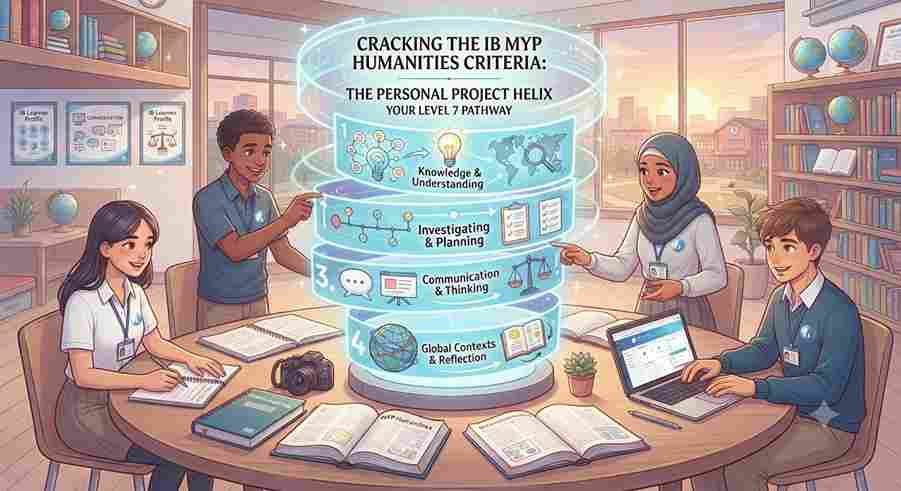
Cracking the IB MYP Humanities Criteria: How to Score a Level 7 in Personal Projects
Last Updated: September 2026 | By EdFlik Education Team
For students navigating the International Baccalaureate (IB) Middle Years Programme (MYP)—typically spanning Grades 6 to 10 (ages 11–16)—two major milestones define academic excellence: mastering Humanities (Individuals and Societies) assessment criteria and successfully executing the MYP Personal Project in Year 5 (Grade 10).
Achieving a Level 7 in these areas is the ultimate goal for ambitious students. However, because the IB MYP is inquiry-driven, holistic, and heavily focused on conceptual understanding rather than rote memorization, many students stumble. They might write brilliant essays or build incredible project artifacts, yet miss out on top marks because they didn't align their work with the official IB assessment criteria.
In this comprehensive guide, our expert MYP tutors break down how to decode the Humanities assessment criteria and secure a prestigious Level 7 on your Personal Project.
Part 1: Decoding the IB MYP Humanities (Individuals and Societies) Criteria
In MYP Humanities, teachers evaluate student work across four equal criteria (Criterion A to D), each graded on a scale of 0 to 8. To walk away with a final 7, you need to master what examiners look for in every single category:
Criterion A: Knowing and Understanding
This criterion tests your factual knowledge, use of terminology, and comprehension of economic, historical, geographic, or political concepts.
- How to Hit Level 7–8: Do not just retell a story or summarize a historical event. Use precise, high-level subject terminology (e.g., opportunity cost, globalization, topography, or geopolitics). Support your explanations with specific, accurate facts, dates, and statistics rather than vague generalizations.
Criterion B: Investigating
Humanities is rooted in research. Criterion B evaluates how well you formulate research questions, select sources, and evaluate them for reliability.
- How to Hit Level 7–8: Start with a focused, analytical research question. When using sources, explicitly apply the OPVL framework (Origin, Purpose, Value, Limitation) to critically evaluate your sources. Never rely on just one or two websites; integrate a balanced variety of academic articles, primary documents, and statistical databases.
Criterion C: Communicating
This assesses how effectively you organize your writing, communicate information, and reference sources.
- How to Hit Level 7–8: Structure your essays with a clear introduction, logical body paragraphs, and a synthesised conclusion. Use effective formatting (subheadings, maps, graphs where appropriate) and maintain a formal, objective academic tone. Always include complete citations (MLA or APA format) and a bibliography.
Criterion D: Thinking Critically
This is where top-tier students separate themselves. Criterion D evaluates your ability to analyze data, synthesize information, and evaluate different perspectives.
- How to Hit Level 7–8: Never present a one-sided argument. To score at the highest level, you must discuss multiple perspectives (e.g., economic vs. environmental impacts, or government vs. citizen viewpoints). Formulate reasoned judgments supported by your investigated evidence.
Part 2: Cracking the MYP Personal Project (Level 7 Blueprint)
The Personal Project is an independent, student-led inquiry completed in MYP Year 5 (Grade 10). It requires students to create a product/outcome based on a personal interest, guided by a Global Context. The project is assessed across four criteria: Planning (A), Applying Skills (B), Reflecting (C), and Report (D).
Here is your step-by-step blueprint to securing a Level 7:
Step 1: Choose a Passion-Driven Topic with a Clear Global Context
- The Trap: Choosing a project that is too broad ("I want to help the environment") or too simple ("I want to bake a cake").
- The Level 7 Approach: Combine a genuine personal hobby with one of the six IB Global Contexts (e.g., Fairness and Development or Scientific and Technical Innovation). For example: "How can I design and code a mobile app to help local UAE expat students track and reduce their household food waste?"
Step 2: Establish a Rigorous Criteria for Success (Criterion A)
- Before you create anything, you must establish clear, measurable specifications for your final product. If your product is a website, your criteria should specify user-interface responsiveness, accessibility features, and target audience engagement metrics. Examiners look for detailed planning and a timeline (Gantt chart) that shows how you managed your time over months.
Step 3: Showcase Self-Management and Research Skills (Criterion B)
- The Personal Project report isn't just about what you made—it’s about how you grew as a learner.
- Explicitly highlight your Approaches to Learning (ATL) skills (Thinking, Communication, Social, Self-Management, and Research skills). Document challenges you faced during the creation process and explain how you used critical thinking or resilience to overcome them.
Step 4: Write a Reflective, Insightful Report (Criterion C & D)
- Your report must reflect deeply on the impact of your project on yourself and your community. Evaluate the success of your final product against the criteria you set in Criterion A. Discuss what you learned about your topic and about yourself as an independent learner. Keep your writing concise, structured, and strictly within word limits.
Struggling to meet MYP Humanities criteria or feeling overwhelmed by your Personal Project? EdFlik offers expert, 1-to-1 online tutoring customized for the IB MYP curriculum, helping students build research skills, refine essays, and achieve top scores.Book a Free Demo Class Today!
Frequently Asked Questions (FAQs)
Q1: What is the grading scale for the IB MYP?
Ans: Each MYP subject is graded on a scale from 1 to 7, derived by combining the scores of its four assessment criteria (each scored out of 8). A final score of 7 represents exceptional performance across all criteria.
Q2: Is the MYP Personal Project compulsory?
Ans: Yes. Completion of the Personal Project is a mandatory requirement of the IB Middle Years Programme for students in their final year (MYP Year 5 / Grade 10). Final grades are externally moderated by the IB.
Q3: How are sources evaluated in MYP Humanities?
Ans: Students are expected to use the OPVL method (Origin, Purpose, Value, Limitation) to critically analyze primary and secondary sources, demonstrating that they understand author bias and historical context.
Q4: How can EdFlik help my child succeed in MYP Humanities and Personal Projects?
Ans: EdFlik connects students with experienced, certified 1-to-1 online tutors who specialize in the IB MYP framework. Our tutors help students structure research questions, refine essays to meet criteria A-D, and guide them step-by-step through their Personal Project reports.