Creating a Standout IGCSE Art Coursework Portfolio: From Initial Sketchbook to Final Piece
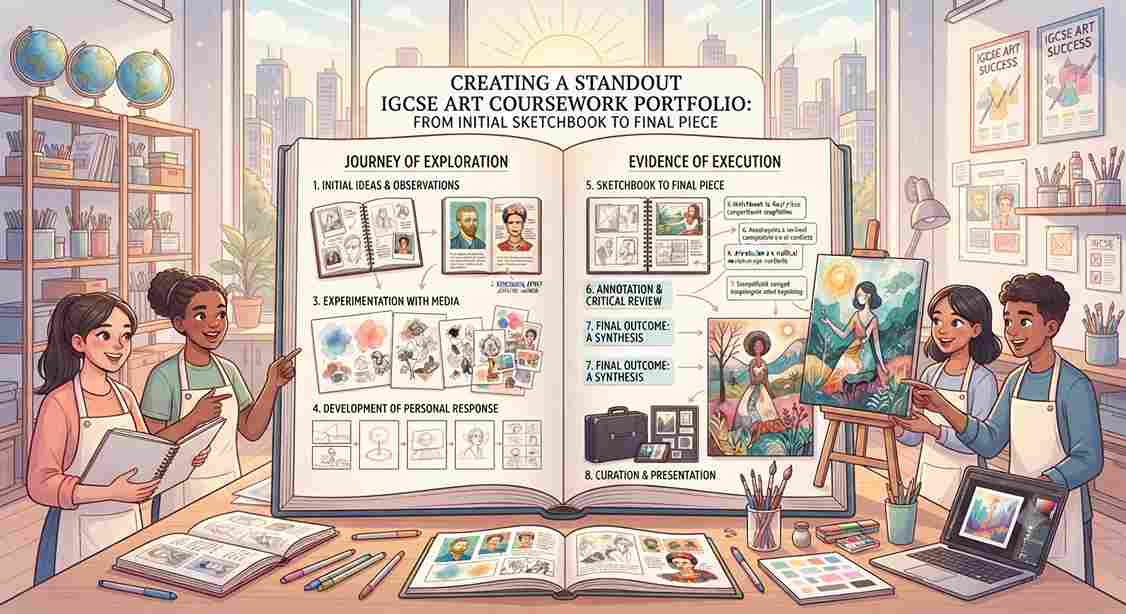
Last Updated: September 2026 | By EdFlik Education Team
For students studying Cambridge IGCSE Art & Design (0400) or Pearson Edexcel GCSE Art and Design, the coursework portfolio (Component 1) is the ultimate test of your creative vision, technical skill, and sustained artistic inquiry. Accounting for a massive 50% of your final IGCSE grade, the coursework portfolio is not just a collection of nice drawings—it is a documented visual journey that tells a story from your initial spark of inspiration to a polished final masterpiece.
Many students fall into the trap of treating their sketchbook like a random scrapbooking exercise or focusing solely on the final piece. However, top-tier portfolios require rigorous planning, critical artist research, experimental media exploration, and clear developmental links.
In this comprehensive guide, our expert IGCSE art and design mentors break down the four official assessment objectives, walk you through step-by-step sketchbook execution, and share professional strategies to secure an $A^*$ grade.
Part 1: Deconstructing the Four IGCSE Assessment Objectives
Before putting pen to paper or picking up a paintbrush, you must understand how examiners grade your portfolio. Both Cambridge and Edexcel assess coursework across four equally weighted criteria (typically worth 25 marks each, totaling 100 marks):
- AO1: Gathering, Recording, and Research: Investigating your chosen theme through primary observation (drawing from real life, taking your own photographs) and secondary sources (artist research, museum visits, cultural artifacts).
- AO2: Exploration and Experimentation: Trying out different media, techniques, and processes (e.g., combining charcoal with watercolor, experimenting with monoprinting, digital manipulation, or clay sculpting) and reviewing what works and what doesn't.
- AO3: Development and Selection: Refining your ideas, showing how your concept evolves from initial brainstorms to resolved compositions, and selecting strong directions to pursue.
- AO4: Presentation and Realization: Presenting a personal, meaningful, and fully resolved final piece (or series of pieces) that connects seamlessly to your preparatory studies.
Part 2: Step-by-Step Blueprint for Your Coursework Portfolio
A successful portfolio typically spans three to four comprehensive sketchbook projects or extended investigations leading up to your final submission. Here is how to structure your workflow from start to finish:
Step 1: Choosing a Captivating Theme
Avoid clichéd, overdone topics like "Nature" or "Portraits" unless you have a completely unique angle. Instead, choose a specific, personal, and visually rich theme:
- Examples: "Industrial Decay and Urban Flora," "Interwoven Identities: Traditional Textures in Modern Architecture," or "Transient Shadows and Captured Motion."
Step 2: Primary Observation & AO1 Research (Weeks 1–4)
- Draw from Life: Never rely exclusively on Google Images. Go out with a camera and sketchbook. If your theme is architecture, sketch local buildings on-site, capture dramatic lighting angles, and collect tactile textures (rubbings, leaves, fabrics).
- In-Depth Artist Studies: Research 3 to 4 diverse artists or cultures related to your theme. Don't just paste their biography; analyze how they use line, tone, color, and composition. Create master copies or experimental studies in the style of those artists.
Step 3: Media Experimentation & AO2 (Weeks 5–8)
- This is your creative playground. Take your observational drawings and test them across diverse media:
- Dry media: Charcoal, ink pens, pastel, oil pastels.
- Wet media: Acrylics, watercolors, gouache, coffee staining, bleach wash.
- Printmaking/Mixed media: Lino printing, collage, tissue paper layering, cyanotype, or digital sketching.
- Critical Annotation: Write brief, reflective notes next to your experiments. Did the watercolor bleed too much? Did the lino cut create striking high-contrast lines? Examiners love seeing your critical decision-making process.
Step 4: Refining Composition & Planning Final Pieces (Weeks 9–11)
- Don't jump straight from a tiny sketch to a massive canvas. Create multiple thumbnail compositions (viewfinder studies) exploring different cropping, lighting, and focal points.
- Experiment with color palettes before starting your final piece.
Step 5: Executing the Final Piece & Presentation (Weeks 12–14)
- Your final piece should be the crowning glory of your portfolio. It should clearly demonstrate the skills, techniques, and concepts you developed throughout your sketchbook pages.
- Mount your final piece cleanly on heavy-weight paper or board, ensuring neat borders and careful packaging.
Part 3: Top 4 Strategies to Secure an $A^*$ in IGCSE Art
- Prioritize Primary Sources: Examiners heavily penalize portfolios that look like they were compiled entirely from Pinterest or Google search results. Always prove you looked at the real subject matter yourself.
- Show "Happy Accidents" and Mistakes: Art is an experimental process. If a print smears or a painting goes in an unexpected direction, don't rip the page out. Annotate it! Explain how you fixed it or changed direction. This proves high-level problem-solving (AO3).
- Keep Annotations Concise and Insightful: You don't need essays in your sketchbook. Keep writing focused on why you chose a technique, how it connects to your artist reference, and what you will do next.
- Maintain High Aesthetic Standards Throughout: Your sketchbook itself is evaluated as a work of art. Pay attention to page layouts, neat backgrounds, clean margins, and thoughtful organization.
Struggling to build your IGCSE Art coursework portfolio, develop artist connections, or refine your final piece? EdFlik offers expert, 1-to-1 online tutoring customized specifically for international school art students worldwide, helping you unlock your creative potential and secure top $A^$ grades.*Book a Free Demo Class Today!
Frequently Asked Questions (FAQs)
Q1: How many sketchbook pages should my IGCSE Art coursework portfolio contain?
Ans: While there is no strict page limit, most successful IGCSE art portfolios contain between 20 to 30 well-curated double-page spreads (or a comparable digital portfolio format) that thoroughly cover all four assessment objectives without unnecessary filler.
Q2: Can I use digital art and photography in my IGCSE Art portfolio?
Ans: Yes! Digital media, graphic design, tablet illustration, and photography are fully accepted and welcomed by Cambridge and Edexcel, provided you demonstrate the same rigorous planning, experimentation, and critical evaluation as traditional fine art mediums.
Q3: How much does the final piece weigh compared to the sketchbook?
Ans: Both the preparatory work (sketchbooks/studies) and the final outcome carry equal weight across the assessment objectives. A stunning final piece with a weak, empty sketchbook will never achieve a top grade.
Q4: How can EdFlik support my IGCSE Art and Design studies?
Ans: EdFlik connects international school students globally with vetted, experienced 1-to-1 online tutors specializing in IGCSE Art, Design Technology, and Humanities. Our personalized sessions focus on developing creative themes, mastering techniques, and organizing top-tier portfolios.