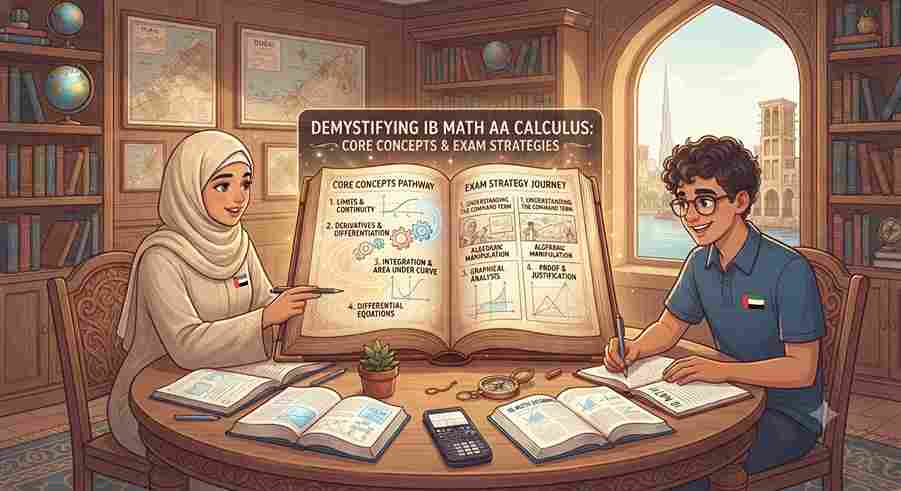
Demystifying IB Math AA Calculus: Core Concepts and Exam Strategies for Dubai High Schools
Last Updated: September 2026 | By EdFlik Education Team
For students enrolled in the International Baccalaureate (IB) Diploma Programme (DP) Mathematics: Analysis and Approaches (AA) Higher Level (HL) or Standard Level (SL) across top international schools in Dubai and the wider UAE, calculus is universally regarded as the ultimate academic hurdle. Spanning everything from intuitive limits and first-principles derivatives to complex integration techniques and differential equations, calculus accounts for a massive chunk of your final Paper 1 and Paper 2 marks.
While Algebra and Functions build the scaffolding of the AA course, Calculus is the engine room. Mastering it requires more than memorizing derivative rules; it demands rigorous abstract reasoning, algebraic fluency, and strategic calculator usage.
In this comprehensive, in-depth guide, our expert IB Mathematics tutors break down the core calculus concepts you must master, common student pitfalls, and the exact exam strategies needed to lock in a Grade 7.
Part 1: Differentiation — The Mathematics of Instantaneous Rate of Change
Differentiation allows us to analyze how things change at any exact micro-moment. Whether you are studying SL or HL, you must move beyond basic polynomial power rules into advanced functional mechanics.
1. The Core Rules You Must Know Cold
Examiners expect seamless navigation between standard derivatives. You must master:
- The Chain Rule: Used for composite functions (a function inside a function):$$\frac{dy}{dx} = \frac{dy}{du} \times \frac{du}{dx}$$
- The Product Rule: Used when two distinct functions are multiplied together:$$\frac{d}{dx}(u \cdot v) = u\frac{dv}{dx} + v\frac{du}{dx}$$
- The Quotient Rule: Used for algebraic fractions:$$\frac{d}{dx}\left(\frac{u}{v}\right) = \frac{v\frac{du}{dx} - u\frac{dv}{dx}}{v^2}$$
2. HL Exclusive: Implicit Differentiation and Related Rates
If you are taking Math AA HL, implicit differentiation is non-negotiable. When equations cannot be easily rearranged into the form $y = f(x)$ (such as circles or complex curves like $x^3 + y^3 = 3xy$), you must differentiate with respect to $x$ treating $y$ as a function of $x$ (applying the Chain Rule and multiplying by $\frac{dy}{dx}$ wherever you differentiate a $y$ term).
- Related Rates Tip: Always define your variables with respect to time ($t$), write down what you are given (e.g., $\frac{dr}{dt} = 2 \text{ cm/s}$), identify what you need to find, and substitute values only after taking the derivative.
3. Applications of Differentiation
Expect multi-part questions on optimization and kinematics:
- Stationary Points: Set $f'(x) = 0$. Use the second derivative test ($f''(x))$ or first-derivative sign test to classify local minima ($f''(x) > 0$), local maxima ($f''(x) < 0$), and points of inflection ($f''(x) = 0$ with a change in concavity).
- Kinematics: Displacement $s(t)$, velocity $v(t) = s'(t)$, and acceleration $a(t) = v'(t)$. Remember that total distance traveled requires integrating the absolute value of velocity, whereas displacement is standard integration.
Part 2: Integration — Accumulation and Area Under Curves
Integration is the reverse process of differentiation, but conceptually, it represents accumulation—calculating total areas, volumes, and work done under curves.
1. Standard Integrals and Techniques
You must be fluent in standard antiderivatives found in your IB Formula Booklet. Beyond basic polynomials, pay special attention to:
- Integrating exponential functions ($e^{ax}$) and logarithmic functions ($\frac{1}{x}$).
- Trigonometric integrals (e.g., integrating $\sin(ax)$, $\cos(ax)$, and $\sec^2(ax)$).
2. HL Exclusive: Advanced Integration Techniques
Math AA HL students face rigorous integration questions that require advanced manipulation:
- Integration by Substitution: The reverse of the Chain Rule. Always look for a function and its derivative present in the integrand.
- Integration by Parts (HL Only): Based on the product rule, using the formula:$$\int u \frac{dv}{dx} dx = uv - \int v \frac{du}{dx} dx$$(Pro-Tip: Use the LIATE rule to choose your $u$: Logarithmic, Inverse trigonometric, Algebraic, Trigonometric, Exponential).
- Partial Fractions: Decomposing complex rational expressions into simpler fractions before integrating.
3. Differential Equations (HL Core)
Differential equations link a function with its derivatives. You will be tested on separation of variables:
- Rearrange the equation so all $y$ terms and $dy$ are on one side, and all $x$ terms and $dx$ are on the other.
- Integrate both sides simultaneously.
- Crucial Mark Saver: Do not forget to include the constant of integration ($+ C$) immediately after integrating, and use boundary conditions ($x$ and $y$ values provided in the prompt) to solve for $C$ before answering the final question.
Part 3: Mastering Paper 1 vs. Paper 2 Calculus Strategies
One of the biggest pitfalls for Dubai IB students is failing to adjust their strategy based on the calculator policy of the exam paper.
1. Paper 1 (Non-Calculator): Algebraic Purity
On Paper 1, your algebraic manipulation must be pristine. Examiners test your exact understanding of limits, chain rule execution, and exact values (e.g., leaving answers in terms of $\pi, e$, or exact fractions like $\frac{3\sqrt{3}}{2}$ rather than decimals). Practice manual sketching of gradient functions and derivative graphs.
2. Paper 2 (Calculator Active): Strategic Technological Use
On Paper 2, your Graphic Display Calculator (GDC)—whether a TI-Nspire or Casio ClassPad—is your best friend, but over-reliance without showing analytical setup will lose you method marks.
- GDC Mastery: Know how to use your calculator to find numerical derivatives at a point, definite integrals, intersections of curves, and solutions to differential equations instantly.
- Show Your Setup: Even when using a GDC solver, write down the integral expression or derivative equation in your exam booklet. Mark schemes allocate method marks for setting up the correct mathematical expression before calculating the final answer.
Part 4: Top 4 Habits of Students Who Score a 7 in IB Math AA
- Memorize the Formula Booklet Inside Out: Don't waste precious exam time searching for standard derivative or integration formulas. Know what is provided and what you need to derive in your head.
- Annotate Past Paper Command Terms: Notice how questions transition from "Find the derivative" (straight calculation) to "Hence or otherwise, find the area..." (using your previous answer strategically). The word "Hence" means your previous working is mandatory.
- Practice Sketching Without a GDC: Calculus questions often feature abstract functions with unknown constants ($a, k, p$). Being able to sketch curves and analyze tangent lines by hand builds deep conceptual intuition.
- Error Log Maintenance: Keep a dedicated log of every calculus mistake you make during homework or timed past papers—whether it's dropping a negative sign during the chain rule or forgetting $+ C$. Review this log weekly.
Struggling with IB Math AA Calculus, complex integration by parts, or preparing for your upcoming mock exams? EdFlik offers expert, 1-to-1 online tutoring customized specifically for the IB Diploma Programme, helping you build mathematical confidence and secure a Grade 7.Book a Free Demo Class Today!
Frequently Asked Questions (FAQs)
Q1: What is the main difference between Math AA HL and SL calculus?
Ans: While both SL and HL cover basic differentiation, optimization, kinematics, and basic definite/indefinite integration, Math AA HL dives significantly deeper. HL students must master implicit differentiation, related rates, integration by substitution and parts, partial fractions, Maclaurin series, and differential equations.
Q2: Can I use my GDC for all calculus questions on Paper 2?
Ans: You can use your GDC for numerical calculations, graphing, definite integrals, and finding roots or turning points. However, if a question asks you to "show that" an analytical expression is true or requires algebraic proof, calculator output alone will earn zero marks.
Q3: How much does calculus contribute to the final IB Math AA exam score?
Ans: Calculus is heavily weighted across both SL and HL syllabi, frequently representing 30% to 40% of total exam marks across Paper 1, Paper 2, and Paper 3 (HL).
Q4: How can EdFlik help me achieve a Grade 7 in IB Math AA?
Ans: EdFlik connects you with experienced, certified 1-to-1 online tutors who specialize in the IB DP Mathematics curriculum. Our tutors break down intimidating calculus topics into manageable steps, provide targeted past paper drills, and help you master both analytical techniques and GDC shortcuts.