Drawing Truth Tables from Complex Logic Statements in Cambridge IGCSE Computer Science
Last Updated: October 28, 2026 | By EdFlik Team
In the Cambridge International IGCSE Computer Science (0478 / 0984) specification, Boolean logic and logic circuits form an essential component of Paper 1 (Computer Systems) and Paper 2 (Algorithms, Programming and Logic). Questions requiring candidates to evaluate complex logic statements, interpret logic gate diagrams, and construct complete truth tables carry high-tariff marks.
Students frequently drop marks on these questions not due to a lack of understanding of basic gates like AND, OR, and NOT, but because of structural disorganization: skipping binary input rows, misinterpreting operator precedence or parentheses, and failing to break down multi-clause expressions into manageable intermediate columns.
This comprehensive masterclass guide breaks down the standard gate functions, outlines a step-by-step protocol for evaluating complex logic expressions, provides a fully worked example, exposes common student pitfalls, and supplies a 100% copy-paste JSON-LD schema markup.
Part 1: Core Logic Gates and Truth Table Foundations
Before tackling multi-variable statements, you must master the fundamental behavior of the six standard logic gates recognized by Cambridge IGCSE:
                       SUMMARY OF IGCSE LOGIC GATES
                                     |
  • AND  ( . ) : Output is 1 ONLY if BOTH inputs are 1. Otherwise 0.
  • OR   ( + ) : Output is 1 if AT LEAST ONE input is 1. Otherwise 0.
  • NOT  ( ¯ ) : Inverts the single input (0 becomes 1; 1 becomes 0).
  • NAND       : The exact inverse of an AND gate (0 only when both are 1).
  • NOR        : The exact inverse of an OR gate (1 only when both are 0).
  • XOR  ( ⊕ ) : Output is 1 if inputs are DIFFERENT (one is 0 and one is 1).
Part 2: Step-by-Step Protocol for Constructing Truth Tables
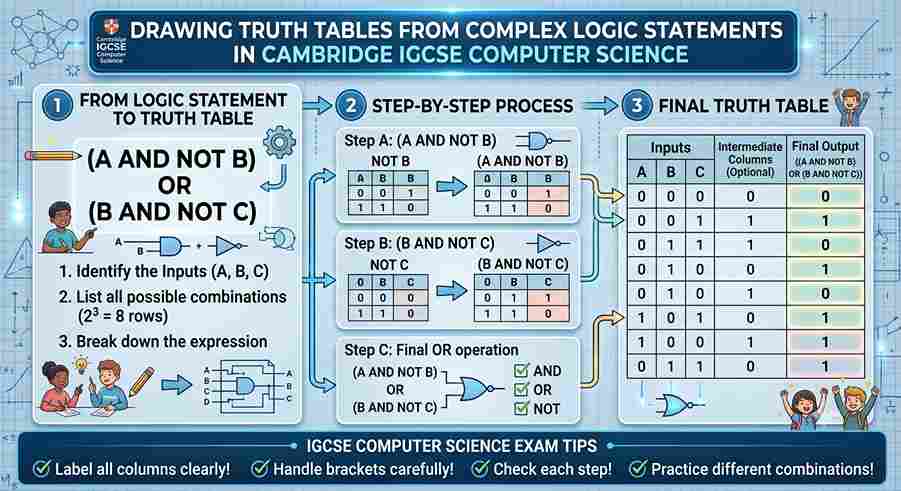
When faced with a complex logic statement (such as $X = \text{NOT}(A \text{ AND } B) \text{ OR } (B \text{ AND } C)$), never attempt to compute the final output column in your head. Follow this 4-step execution protocol:
                  THE 4-STEP TRUTH TABLE CONSTRUCTION PROTOCOL
                                   |
  Step 1: Count Inputs & Rows      ---> Determine number of inputs ($n$). Total rows = $2^n$ (e.g., 3 inputs = 8 rows).
  Step 2: Establish Binary Inputs  ---> Write inputs in standard binary sequence from `000` through `111`.
  Step 3: Add Intermediate Columns ---> Break the expression down inside parentheses into separate sub-columns.
  Step 4: Evaluate Final Output    ---> Combine intermediate columns using the final logical operator to get $X$.
Part 3: Fully Worked Exam-Style Example
Exam Question:
Complete the truth table for the following complex logic statement:$$X = \text{NOT}(A \text{ AND } B) \text{ OR } (B \text{ AND } C)$$
Step 1 & 2: Set Up Input Combinations ($2^3 = 8$ rows)
List all possible combinations of binary inputs for $A$, $B$, and $C$ in standard sequential order:
| Row | A | B | C |
| 1 | 0 | 0 | 0 |
| 2 | 0 | 0 | 1 |
| 3 | 0 | 1 | 0 |
| 4 | 0 | 1 | 1 |
| 5 | 1 | 0 | 0 |
| 6 | 1 | 0 | 1 |
| 7 | 1 | 1 | 0 |
| 8 | 1 | 1 | 1 |
Step 3: Add Intermediate Columns for Sub-Expressions
Break the expression into its two parenthetical components:
- Intermediate Column 1 ($P$): $\text{NOT}(A \text{ AND } B)$
- Intermediate Column 2 ($Q$): $B \text{ AND } C$
Let's compute each row step-by-step:
Row 1 (0,0,0): $A \cdot B = 0 \rightarrow \text{NOT} = 1$. $B \cdot C = 0$.
- Row 2 (0,0,1): $A \cdot B = 0 \rightarrow \text{NOT} = 1$. $B \cdot C = 0$.
- Row 3 (0,1,0): $A \cdot B = 0 \rightarrow \text{NOT} = 1$. $B \cdot C = 0$.
- Row 4 (0,1,1): $A \cdot B = 0 \rightarrow \text{NOT} = 1$. $B \cdot C = 1 \cdot 1 = 1$.
- Row 5 (1,0,0): $A \cdot B = 0 \rightarrow \text{NOT} = 1$. $B \cdot C = 0$.
- Row 6 (1,0,1): $A \cdot B = 0 \rightarrow \text{NOT} = 1$. $B \cdot C = 0$.
- Row 7 (1,1,0): $A \cdot B = 1 \cdot 1 = 1 \rightarrow \text{NOT} = 0$. $B \cdot C = 0$.
- Row 8 (1,1,1): $A \cdot B = 1 \cdot 1 = 1 \rightarrow \text{NOT} = 0$. $B \cdot C = 1 \cdot 1 = 1$.
Step 4: Complete the Full Truth Table with Final Output ($X$)
Combine Intermediate Column 1 ($P$) and Intermediate Column 2 ($Q$) with an OR operator ($X = P \text{ OR } Q$):
| A | B | C | Intermediate 1: NOT(A AND B) | Intermediate 2: B AND C | Final Output: X |
| 0 | 0 | 0 | 1 | 0 | 1 |
| 0 | 0 | 1 | 1 | 0 | 1 |
| 0 | 1 | 0 | 1 | 0 | 1 |
| 0 | 1 | 1 | 1 | 1 | 1 |
| 1 | 0 | 0 | 1 | 0 | 1 |
| 1 | 0 | 1 | 1 | 0 | 1 |
| 1 | 1 | 0 | 0 | 0 | 0 |
| 1 | 1 | 1 | 0 | 1 | 1 |
Part 4: Top 4 Traps That Cost Students Marks in IGCSE Logic Exams
- Skipping Binary Input Rows: Writing input combinations out of order (e.g., jumping from
000to110) or missing one of the 8 rows for a 3-input circuit, which forfeits method and consistency marks. - Misinterpreting Operator Precedence: Evaluating operations left-to-right instead of respecting parentheses or standard Boolean hierarchy (NOT evaluated first, then AND, then OR).
- Forgetting to Invert NAND / NOR Outputs: Treating a NAND gate like a standard AND gate, or forgetting that the small circle (bubble) on a logic symbol denotes a NOT inversion.
- Omitting Working Columns: Trying to complete complex multi-gate tables without writing intermediate columns on exam paper rough working space, leading to careless arithmetic errors.
Frequently Asked Questions (FAQs)
Q1: How many rows are required in a truth table for 4 inputs?
Ans: The number of rows is calculated using the formula $2^n$, where $n$ is the number of inputs. For 4 inputs, $2^4 = 16$ rows are required.
Q2: Are calculators allowed for logic and truth table questions in IGCSE Computer Science?
Ans: No. Truth table evaluations require manual binary reasoning and systematic step-by-step logic tracing without electronic calculation aids.
Q3: Can I simplify a logic statement before drawing its truth table?
Ans: Unless explicitly instructed to simplify using Boolean algebra laws, Cambridge mark schemes expect you to evaluate the statement exactly as given, utilizing intermediate columns to mirror the expression structure.