
Dubai College Entrance Exam Prep 2027 Entry: The Complete AI-Powered Ecosystem
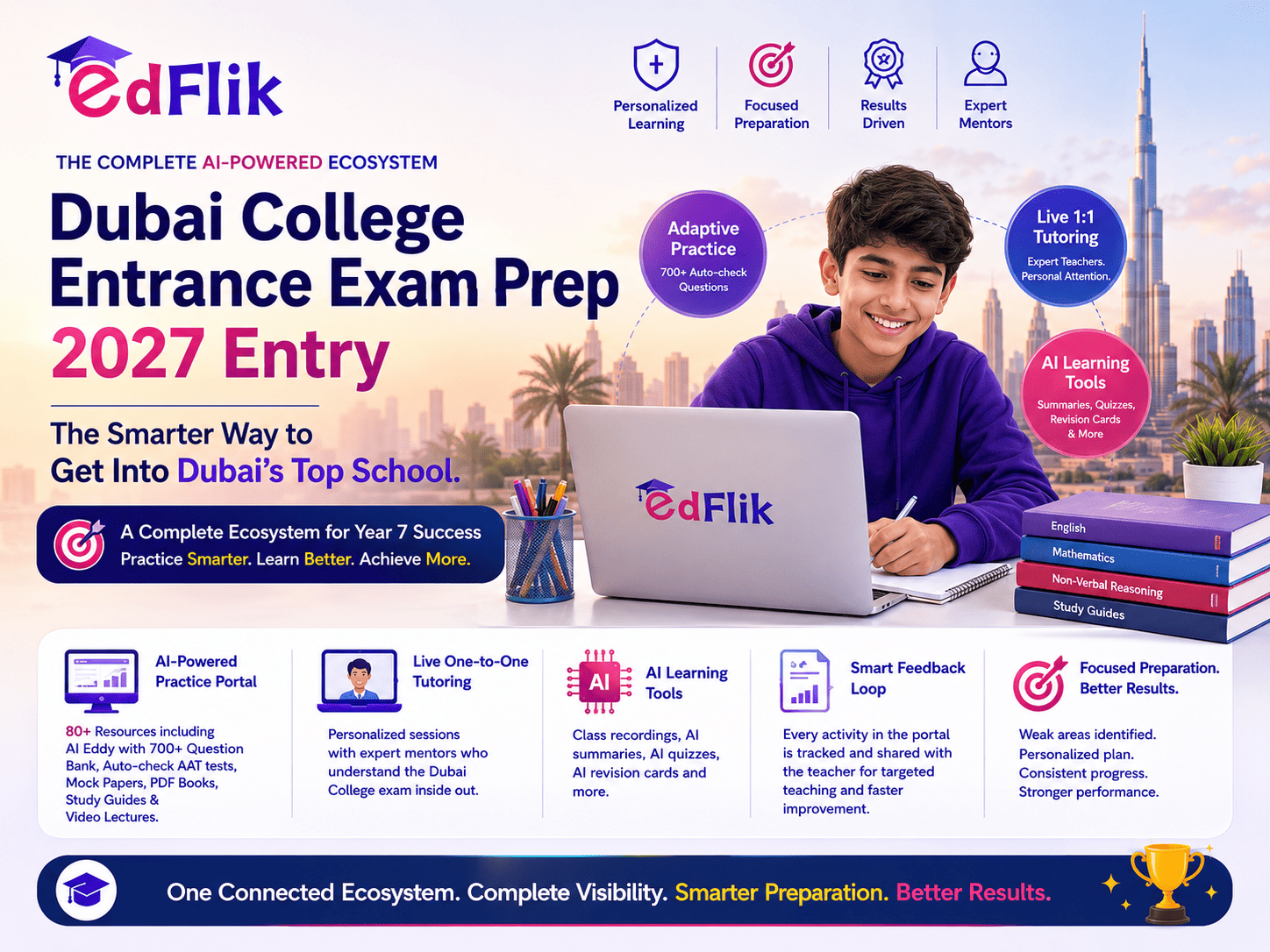
Every year, several hundred families across Dubai begin preparing a Year 6 child for one of the most competitive school assessments in Dubai — and most of them prepare in fragments. A workbook here. A weekly tutor there. A folder of downloaded past papers nobody ever marks. The child works hard. The parent spends money. And nobody in the process can answer the one question that actually matters: where, specifically, is my child still weak, and what is being done about it this week?
That gap is the reason EdFlik built its Dubai College entrance preparation as a connected ecosystem rather than a product. This guide explains what the Dubai College Year 7 entrance assessment actually involves for August 2027 entry, why fragmented preparation underperforms, and how EdFlik's practice portal, live one-to-one tutoring, and AI learning tools work as a single loop.
What the Dubai College Year 7 entrance assessment actually is
Before any preparation strategy makes sense, the format has to be understood precisely. According to Dubai College's own admissions information for the most recent published cycle:
- Entry point: Dubai College admits at Year 7 only, with 176 places available.
- Assessment format: An adaptive online assessment of approximately two hours.
- Modules assessed: English, Mathematics and Non-Verbal Reasoning. Dubai College states the platform and question style are similar to standard online testing programmes such as CAT4 and GL Progress Tests.
- Arabic: Students registered with an Arab nationality, or who wish to study Arabic A, are also assessed in Arabic A.
- Supporting evidence: The Admissions Panel also considers the end of Year 5 school report, end of Year 5 GL Progress Test results (PTE, PTM, PTS) for students schooled in Dubai, and the most recent CAT4 or standardised test results.
- One attempt: Candidates may sit the Year 7 entrance assessment once only.
- Timing: Applications for entry in August 2027 open from September 2026, with the assessment historically held in November and results communicated in January.
Two consequences follow from that list, and they shape everything else in this guide.
First, "one attempt" changes the risk profile. There is no resit, no second sitting, no averaging of a good day and a bad day. A capable child who has never practised timed adaptive testing can underperform their true ability on a single Sunday morning in November — and that outcome is final.
Second, an adaptive test rewards a different kind of preparation. In a conventional paper, every candidate answers the same questions and difficulty is fixed. In an adaptive assessment, difficulty adjusts in real time to the student's responses. Volume of practice at a comfortable level does very little. What moves the needle is range — the ability to stay accurate and calm as questions get progressively harder, and to keep pace without stalling on a single item.
Dates, fees and format are set by Dubai College and can change between admissions cycles. Always confirm current details on the official Dubai College admissions pages before making decisions.
A note on Verbal Reasoning
You will see many preparation providers advertise four modules — English, Maths, Verbal Reasoning and Non-Verbal Reasoning — because the wider AAT-style assessment family includes Verbal Reasoning. Dubai College's published information specifies three assessed modules plus Arabic A where applicable. EdFlik's position is straightforward: prepare thoroughly for the three modules DC names, and treat Verbal Reasoning practice as useful general reasoning development rather than confirmed exam content. Parents deserve that distinction stated plainly rather than blurred for marketing convenience.
Why fragmented preparation underperforms
Most DC preparation fails in one of three predictable ways.
1. Practice without diagnosis
A child completes 400 questions over six months. Nobody can say which of the four Non-Verbal Reasoning question types they consistently get wrong, or whether accuracy collapses after minute forty. Effort was expended; information was not generated.
2. Tutoring without data
A tutor arrives each week and asks, reasonably, "what shall we work on today?" The answer comes from the parent's impression or the child's mood — not from evidence. Weeks of expensive one-to-one time get spent on topics the child had already mastered.
3. Data without action
Some platforms produce beautiful analytics that nobody acts on, because the person teaching the child never sees them. A dashboard that does not change what happens in the next lesson is decoration.
The common failure is not effort or ability. It is that the practice system and the teaching system never talk to each other.
The EdFlik ecosystem: three pillars, one loop
Practice Smarter. Learn Better.
A complete AI-powered ecosystem designed for Dubai College entrance preparation — practice portal, live expert tutoring, and smart AI learning tools working from the same performance data.
Pillar 1 — The AI-Powered Practice Portal
The portal is where the daily work happens and where the evidence is generated. It gives a student a structured place to practise every day rather than a folder of loose PDFs.
| Component | What it does |
|---|---|
| AI Eddy question bank | 700+ auto-checked practice questions across entrance modules, spanning multiple difficulty tiers so practice can move upward rather than plateau. |
| Adaptive AAT-style tests | Practice in the adaptive format itself, so the real assessment is not the first time a child meets rising difficulty. |
| Full mock papers | Timed, full-length simulations that build stamina and pacing discipline under exam conditions. |
| Video lectures & study guides | Topic-wise teaching for concepts that need building rather than drilling — particularly Non-Verbal Reasoning, which most primary schools never teach as a named subject. |
| PDF books & downloadables | 80+ resources for offline work, printed practice and screen-free sessions. |
| Reports & progress analytics | Instant results, weak-area identification, and performance tracking over time — the evidence layer the rest of the system runs on. |
Pillar 2 — Live One-to-One Tutoring
Practice reveals what is wrong. A teacher explains why it is wrong. Software is very good at the first and still cannot replace a human for the second — especially for a ten or eleven year old whose error is conceptual rather than careless.
EdFlik's live sessions with DC entrance mentors cover:
- A personalised learning plan built from diagnostic results, not a generic syllabus.
- Concept clarity and doubt solving — attacking the reasoning behind repeated mistakes.
- Focused preparation strategy — pacing, question triage, and when to move on from a hard item.
- Regular assessment and feedback, including honest conversations with parents about realistic positioning.
Pillar 3 — Smart Learning Features
The layer that makes the other two compound rather than evaporate between sessions:
- Class recordings — every session is rewatchable, so a concept explained in September is still available in November.
- AI summaries of classes — the key points of a lesson condensed into something a child can actually revise from.
- AI quizzes — generated practice that reinforces what was just taught, immediately after it was taught.
- AI revision cards — spaced, retrieval-based revision for the facts and patterns that need to become automatic.
The loop that connects them
How the ecosystem works in practice
Student practises in the portal → AI analyses accuracy, speed and weak areas → performance reports are shared automatically with the assigned teacher → the teacher adapts the next live session to those specific weaknesses → new practice is assigned to consolidate → the loop repeats.
The parent sees the same picture the teacher sees. There is no gap between what the child is practising and what the tutor is teaching, and no month of expensive one-to-one time spent guessing.
A realistic preparation timeline for November 2026
If your child is sitting the assessment for August 2027 entry, the window is shorter than it feels. Working backwards from a November assessment:
| Period | Focus |
|---|---|
| 10–12 months out (Nov–Jan) | Diagnostic baseline. Identify true starting level across English, Maths and NVR. No pressure, no timing — just information. |
| 6–9 months out (Feb–May) | Foundation building. Close curriculum gaps in Maths, build reading fluency and inference in English, and introduce NVR question types systematically. |
| 3–5 months out (Jun–Aug) | Difficulty escalation. Move deliberately above comfort level. Introduce timing. Summer is the single largest usable block of preparation time in the cycle. |
| 1–3 months out (Sep–Oct) | Full timed mocks in adaptive format. Pacing strategy. Targeted repair of persistent weak areas. Application submission. |
| Final 2 weeks | Light revision, sleep, routine, familiarity. No new content. Confidence is the deliverable at this stage. |
Module by module: what strong candidates demonstrate
English
Reading fluency and precision under time pressure. The ability to extract information accurately from an unseen passage, handle inference rather than literal recall, and manage vocabulary above age-typical level. The most common weakness is not comprehension ability — it is speed of comprehension.
Mathematics
Secure Year 5–6 number, fractions, ratio, measure and geometry, applied to multi-step problem solving rather than single-operation recall. Students from strong schools are frequently well drilled in procedure and under-practised in problem interpretation.
Non-Verbal Reasoning
This is where preparation makes the largest measurable difference, for one simple reason: NVR is rarely taught as a named subject in most primary schools. Students meet figure classification, figure series, figure matrices and spatial rotation for the first time in the assessment itself. Systematic exposure to the question types before November is not an advantage — it is the removal of an avoidable disadvantage.
Five mistakes that cost places
- Starting in September. Two months is enough to build familiarity, not capability.
- Practising only at comfortable difficulty. On an adaptive test, the ceiling is where offers are decided.
- Ignoring Non-Verbal Reasoning because it does not appear on a school report.
- Untimed practice all the way through. Accuracy without pace is not the skill being measured.
- Over-preparation. A child who arrives exhausted and anxious in November performs below their ability. Dubai College states it looks for well-rounded students who will thrive in a demanding environment — not students who have been drilled to depletion.
Who this ecosystem is for
- Year 5 families beginning early with diagnostics and foundation work.
- Year 6 families in the active preparation window for November.
- Families preparing for other schools using CAT4-style or GL Assessment-based entrance testing, where the underlying reasoning skills overlap substantially. Confirm your target school's specific published format first.
Frequently asked questions
What is the format of the Dubai College Year 7 entrance exam?
Dubai College's published information describes an adaptive online assessment of approximately two hours, covering English, Mathematics and Non-Verbal Reasoning, with Arabic A additionally assessed for eligible students. Question difficulty adjusts in real time based on the student's responses. Confirm the current format on the official Dubai College admissions pages.
When should preparation begin for August 2027 entry?
Applications open from September 2026 and the assessment has historically been held in November. A structured programme of six to twelve months is realistic for most students; two months is generally too short to change underlying capability.
Can my child resit the Dubai College entrance assessment?
No. Dubai College states that candidates may appear only once for the Year 7 entrance assessment.
Does Dubai College consider anything besides the entrance assessment?
Yes. The Admissions Panel also considers the end of Year 5 school report, end of Year 5 GL Progress Test results for students schooled in Dubai, and the most recent CAT4 or standardised test results.
Is EdFlik affiliated with Dubai College?
No. EdFlik is an independent preparation provider operated by Starscraper Enterprises. It is not affiliated with, endorsed by, or produced in partnership with Dubai College, GL Assessment, or any other school or assessment body. All materials are built to publicly available information about the assessment format.
Does EdFlik guarantee admission to Dubai College?
No. No preparation provider can guarantee admission, a specific score, or any particular outcome. Results depend on many factors beyond any preparation programme, including the individual student's ability and effort, the strength of the applicant pool in a given year, and the school's own admissions criteria.
Can the portal be used without live tutoring?
Yes. The practice portal is structured for independent use. Families who combine it with live one-to-one sessions get the full feedback loop, where teaching is directed by the student's actual performance data.
Where to start
The most useful first step is not buying material. It is finding out precisely where your child currently stands across the three assessed modules — because everything that follows should be built on that, not on assumption.
Start with a diagnostic assessment
Practice. Learn. Improve. One connected ecosystem — complete visibility for parents, teachers and students.
Related reading
- Dubai College Year 7 Entrance Exam: Complete Preparation Guide
- Dubai College AAT Practice Questions: Inside Adaptive Eddy
- The Complete DC Entrance Study Material Package
- A Practical DC Year 7 Preparation Guide
- Dubai College Tutors: GCSE, A-Level and Year 7 Entry
Important disclaimers
Independence. EdFlik is an independent education service operated by Starscraper Enterprises, India. EdFlik is not affiliated with, endorsed by, sponsored by, or produced in partnership with Dubai College, GL Assessment, the Centre for Evaluation and Monitoring, or any other school, examination board or assessment provider. School names and assessment names are used for identification and descriptive purposes only and remain the property of their respective owners.
No guarantee of outcomes. Use of EdFlik's materials, portal, AI tools or tutoring services does not guarantee admission to Dubai College or any other school, nor any particular score, ranking or result. Outcomes depend on factors outside EdFlik's control, including the individual student's ability and effort, the competitiveness of the applicant pool in a given cycle, and each school's own admissions criteria and discretion.
Accuracy of exam information. Details of the entrance assessment — including format, modules, duration, dates, fees and application deadlines — are set by Dubai College and are subject to change without notice. Information in this article reflects publicly available sources at the time of writing (July 2026) and may not reflect the current admissions cycle. Parents must verify all details directly with Dubai College's official admissions pages before making any decision.
Practice materials. EdFlik's practice questions, mock papers and adaptive tests are original materials created by EdFlik to reflect publicly documented assessment formats. They are not past papers, are not reproductions of any live or retired examination, and are not sourced from any school or assessment provider.
AI-generated content. Certain features — including AI summaries, AI-generated quizzes and AI revision cards — are produced using automated systems. While designed for accuracy, AI-generated output may occasionally contain errors and should be reviewed alongside teacher guidance rather than relied upon as a sole source of truth.
Pricing and availability. Prices, package contents, promotional offers and feature availability are subject to change. Current terms are those published at edflik.com at the time of purchase.
General guidance only. This article is provided for general informational purposes and does not constitute educational, psychological or admissions advice for any individual student.