Dubai College Tutor 2026 — A-Level Maths, Sciences and Economics Technique Guide
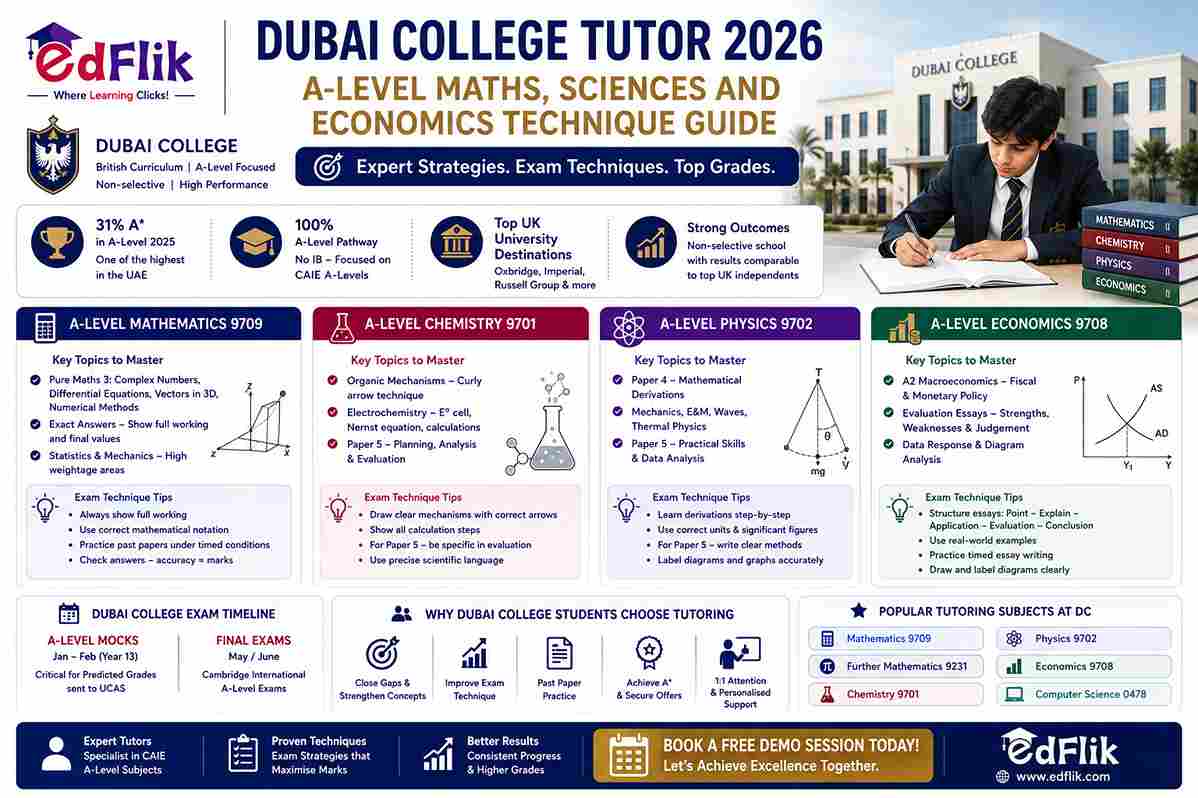
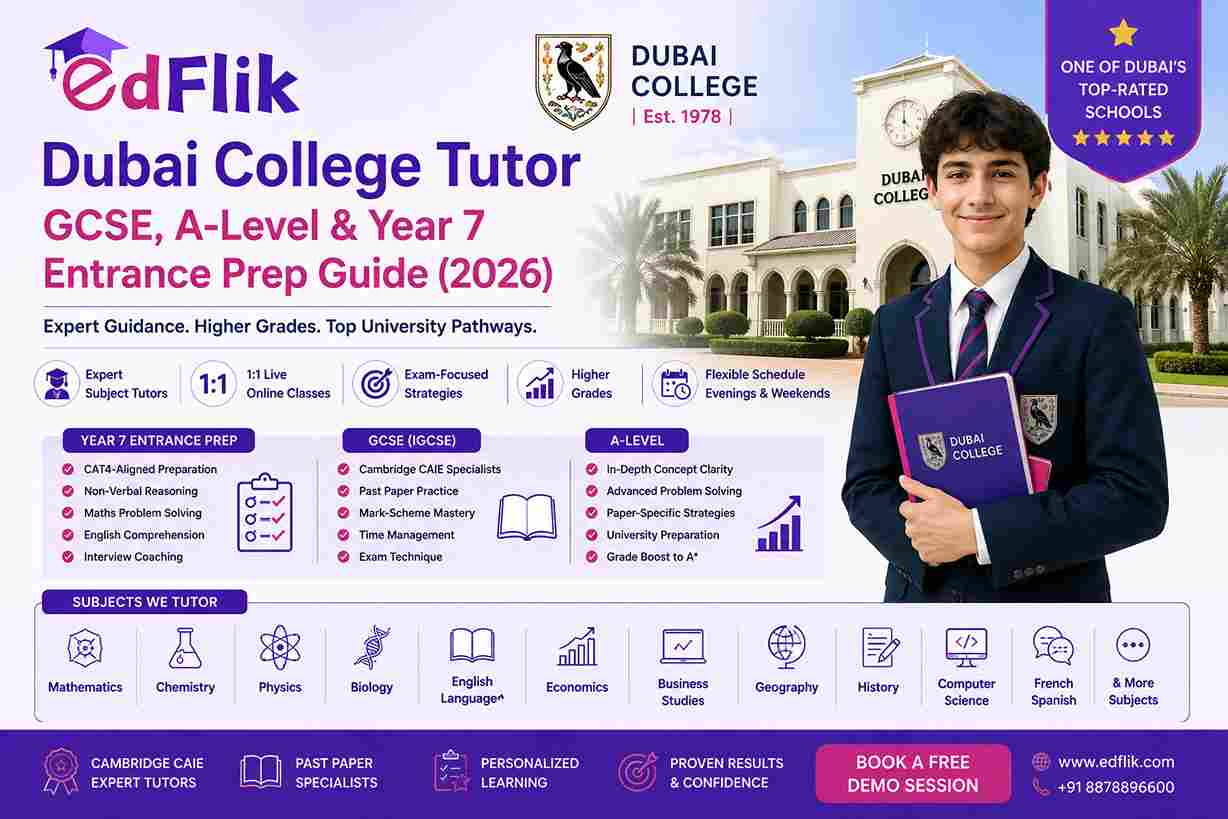
Dubai College in Al Sufouh is the UAE's most academically accomplished state-funded British school — a non-selective government school that consistently produces A-Level results comparable to England's leading independent schools. In 2025, 31% of DC A-Level grades were A*, placing the school among the very highest-performing British-curriculum A-Level centres in the Middle East. DC students overwhelmingly target UK universities — many applying to Oxbridge, Imperial, LSE, and UCL — and the tutoring demand profile at DC is therefore different from almost every other UAE school. Students are not seeking to move from D to C or from C to B. They are seeking to move from A to A*, and the precise technique that achieves this at A-Level is what EdFlik's subject-code-specific tutors provide.
Dubai College — Academic Profile and A-Level Context
|
Feature |
Detail |
|
Location |
Al Sufouh, Dubai (adjacent to Dubai Internet City, near Knowledge
Village) |
|
School type |
Non-selective state-funded British school — government-funded,
academically operated |
|
Curriculum |
National Curriculum for England; GCSE/Cambridge IGCSE (Years
10–11); Cambridge CAIE A-Level (Years 12–13) |
|
Post-16 pathway |
Cambridge CAIE A-Level only (no IB Diploma) |
|
A-Level 2025 results |
31% A* — among the highest A*-rate A-Level schools in the Middle
East |
|
Primary university destinations |
Oxbridge, Imperial, UCL, LSE, Russell Group UK; significant
medical school applicants |
|
Annual fees |
Up to AED 110,305 per year for Year 13 (KHDA fee cap — highest in
the regulated range) |
|
Exam board |
Cambridge CAIE — all DC students sit Cambridge papers |
A-Level at Dubai College — The A to A* Technique Challenge
The specific tutoring need at Dubai College is distinct. A student who is achieving A grades in A-Level Mathematics and Chemistry at DC and needs A* for an Oxbridge conditional offer is not a student with knowledge gaps. They are a student with technique gaps — specific presentation habits that cost them the precision marks at the top of the grade distribution. EdFlik tutors work with these students differently from students at other schools: the starting point is the past paper, and the session analysis is at the level of individual mark points rather than topic coverage.
A-Level Mathematics 9709 — The A* Differentiators at DC
For DC students targeting A* in Cambridge A-Level Mathematics 9709, three technique differences separate A* from A performance across the entire paper series:
• Exact form answers: Cambridge 9709 requires exact answers unless the question specifies decimal form. 3√2 not 4.243; ln 3 not 1.099; 3π not 9.42. DC students who habitually write decimal approximations lose accuracy marks on every question requiring exact form — a habit that must be changed in the first tutoring session.
• Paper 3 derivation completeness: Pure Mathematics 3 questions require complete algebraic derivations — no steps skipped, no 'it can be shown that' shortcuts. The A* student writes every intermediate algebraic step explicitly, even when those steps seem obvious, because each step that Cambridge examiners can see earns a potential method mark.
• Integration constant discipline: every indefinite integral must include + c. DC students who forget + c in any indefinite integration lose the accuracy mark for that question. After years of practice, this becomes automatic — but it must be specifically reinforced.
A-Level Chemistry 9701 — Organic Mechanism Precision
For DC students targeting A* in A-Level Chemistry 9701, organic mechanism drawing is the highest-precision assessment component in the qualification. Cambridge 9701 examiner reports consistently identify curly arrow errors as the most common cause of mark loss in mechanism questions. The three most frequent errors: arrows starting from the leaving group (should start from the nucleophile lone pair or the pi bond); arrows pointing in the wrong direction (should point toward the new bond forming); intermediate species drawn without charges shown. See /a-level-chemistry-9701-uae-technique-guide/ for the complete mechanism framework with all four mechanism types.
A-Level Physics 9702 — Mathematical Derivation Marks
Cambridge A-Level Physics 9702 Paper 4 regularly requires mathematical derivations — showing each step from the fundamental physical law to the derived result. DC students targeting A* must be able to derive equations from first principles: deriving the period of a simple harmonic oscillator, deriving the relationship between current and drift velocity, deriving the capacitor charging/discharging equations using differential equations. Each derivation step earns a mark. Presenting the derived result without the derivation earns zero method marks regardless of whether the result is correct.
A-Level Economics 9708 — Policy Essay Evaluation Under Time Pressure
Cambridge A-Level Economics 9708 Paper 4 essays require genuine two-sided evaluation under time pressure — 45 minutes per essay including diagrams and quantitative examples. DC Economics students typically have strong economic knowledge but lose marks by writing too much on one side and running out of time for the counter-argument and conclusion. The evaluation discipline: allocate 10 minutes to reading and planning before writing; spend equal time on both sides of the argument; draw diagrams first (they earn marks before a word of analysis is written); write the evaluative conclusion before polishing the earlier paragraphs.
GCSE/IGCSE at Dubai College — The Foundation for A-Level Success
GCSE and IGCSE grades at DC directly determine sixth form A-Level subject entry. For the most competitive subjects — Mathematics, Further Mathematics, Physics, Chemistry — DC requires A* in the related GCSE or IGCSE. This entry requirement means that Year 10 and 11 technique-building is not just about GCSE performance — it is about keeping the post-16 subject options open. EdFlik GCSE/IGCSE tutors for DC students focus on method mark compliance from the very first session, because this single habit determines the difference between A and A* across Cambridge Mathematics, Sciences, and English Language.
Frequently Asked Questions — Dubai College Tutor 2026
Q: What curriculum does Dubai College offer?
A: National Curriculum for England; GCSE/Cambridge IGCSE (Years 10–11); Cambridge CAIE A-Level (Years 12–13). No IB Diploma — dedicated A-Level pathway school. In 2025: 31% A* at A-Level. Primary university destinations: Oxbridge, Imperial, UCL, LSE, Russell Group medical schools.
Q: Which subjects do Dubai College students most need tutoring for?
A: A-Level: Mathematics 9709 (exact answers, Paper 3 content), Further Mathematics 9231, Chemistry 9701 (organic mechanisms, Paper 5), Physics 9702 (Paper 4 derivations), Economics 9708 (policy essays with two-sided evaluation under time pressure). GCSE/IGCSE: Extended Maths (method marks), Sciences (cause-effect chains, observation language), English Language (inference technique).
Q: What university destinations do Dubai College students target?
A: Primarily Oxbridge, Imperial, UCL, LSE, and Russell Group including medical schools. Conditional offers often specify A* in Mathematics and/or the relevant science subject. DC tutoring demand is therefore focused on moving from A to A*, not from C to B — technique precision at the highest level.
Q: When are Dubai College A-Level mock exams?
A: Typically January to February of Year 13, approximately 4 months before the May/June Cambridge A-Level series. Mock results directly inform UCAS predicted grades submitted in January. GCSE/IGCSE mocks typically November to December of Year 11. Confirm specific dates with DC directly each year.
How EdFlik Supports Dubai College Students
EdFlik Cambridge CAIE A-Level specialists matched by subject code — 9709, 9701, 9702, 9708. Session focus: A to A* technique precision. Past paper analysis at the mark level. GCSE/IGCSE from AED 60; A-Level from AED 75. Free demo. www.edflik.com.