
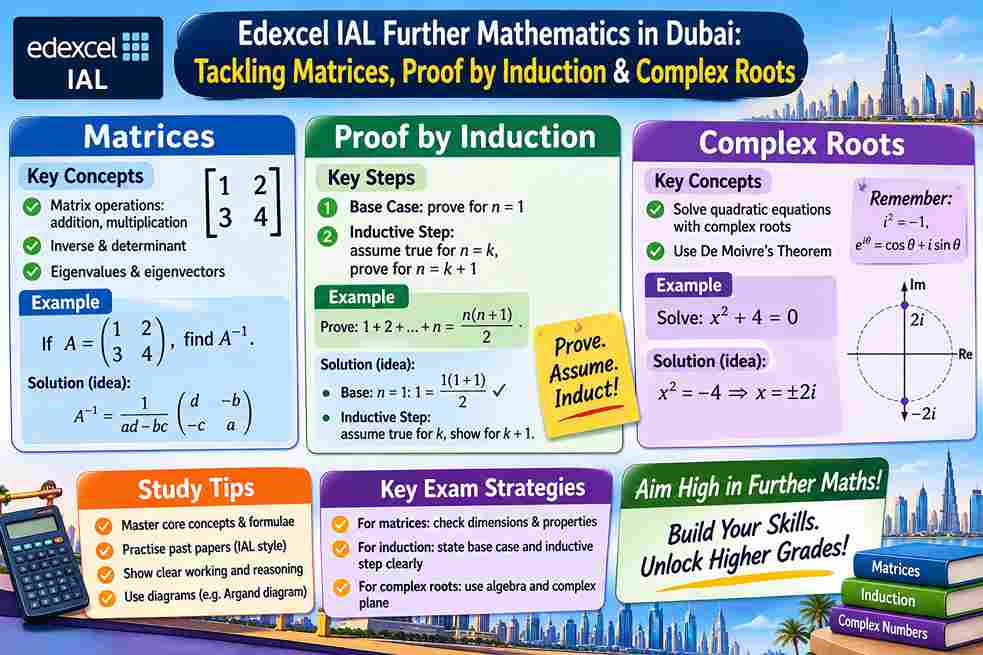
Edexcel IAL Further Mathematics in Dubai: Tackling Matrices, Proof by Induction & Complex Roots
By EdFlik Team | November 23, 2026
For Key Stage 5 students across Dubai—from Jumeirah, Dubai Hills Estate, and Arabian Ranches to Al Barsha, Mirdif, and Dubai International Academic City—choosing Pearson Edexcel International Advanced Level (IAL) Further Mathematics (XFM01 / YFM01) is one of the strongest signals of academic ambition on a university application. Whether aiming for Engineering, Computer Science, Mathematics, Physics, Quantitative Finance, or Economics at top universities in the UK, US, UAE, Europe, or Asia, Further Mathematics demonstrates the ability to reason abstractly far beyond standard A-Level Mathematics.
Within the modular Edexcel IAL Further Mathematics structure, Further Pure Mathematics 1 (FP1 — Unit WFM01/01) is the mandatory foundation unit for both the International AS (IAS) and full International A-Level (IAL) qualifications, examined via a 1-hour-30-minute, 75-mark written paper. Across almost every exam session, three foundational topics carry enormous weight and separate Grade A/$A^*$ candidates from mid-tier scorers: Matrices & 2D Linear Transformations, Proof by Mathematical Induction, and Complex Numbers & Polynomial Roots.
Many high-achieving Dubai students who excel at routine calculus in P1–P4 hit an unexpected wall in FP1 because calculator shortcuts are strictly penalized ("Solutions relying entirely on calculator technology are not acceptable"), matrix multiplication is non-commutative, and proof by induction requires airtight logical wording—not just algebraic manipulation.
This comprehensive masterclass guide breaks down Matrices & Transformations, Proof by Mathematical Induction, and Complex Polynomial Roots for Edexcel IAL Further Mathematics, includes full step-by-step worked exam solutions, exposes common mark-scheme traps, and provides 100% copy-paste JSON-LD schema markup.
Key Takeaways
- Respect Non-Commutativity in Matrix Transformations: In 2D matrix transformations, applying matrix $\mathbf{A}$ followed by matrix $\mathbf{B}$ is represented by the product $\mathbf{B}\mathbf{A}$ (right-to-left order), and $\vert{}\det(\mathbf{M})\vert{}$ gives the area scale factor of the transformation (with a negative determinant indicating an orientation reversal/reflection).
- Use the 4-Step Mark-Scheme Template for Proof by Induction: Never skip the Base Case ($n = 1$), Inductive Hypothesis ("Assume true for $n = k$"), Inductive Step ($n = k + 1$), or the Mandatory Concluding Statement linking both steps to all positive integers $n \in \mathbb{Z}^+$.
- Use the Conjugate Root Theorem for Real-Coefficient Polynomials: Whenever a polynomial $f(z)$ has real coefficients and $a + bi$ ($b \neq 0$) is a root, its complex conjugate $a - bi$ is automatically a root—allowing you to form a real quadratic factor $(z - (a + bi))(z - (a - bi)) = z^2 - 2az + (a^2 + b^2)$ and divide $f(z)$ cleanly.
- Show Every Algebraic Stage Explicitly: Edexcel IAL FP1 papers explicitly warn that answers generated purely by graphical or calculator methods earn zero method marks; always display intermediate matrix entries, polynomial division steps, and induction algebra.
Part 1: Matrices & 2D Linear Transformations (Unit FP1)
In Edexcel IAL Further Pure 1, matrices connect algebraic operations (addition, multiplication, determinants, and inverses) directly to geometric transformations in the $xy$-plane.
As shown in the linear transformation diagram above, the columns of a $2 \times 2$ matrix $\mathbf{M} = \begin{pmatrix} a & b \\ c & d \end{pmatrix}$ represent the images of the unit basis vectors $\mathbf{i} = \begin{pmatrix} 1 \\ 0 \end{pmatrix}$ and $\mathbf{j} = \begin{pmatrix} 0 \\ 1 \end{pmatrix}$, mapping the unit square onto a parallelogram whose area equals $\vert{}\det(\mathbf{M})\vert{} = \vert{}ad - bc\vert{}$.
Essential $2 \times 2$ Transformation Matrices to Memorize
| Transformation in the xy-Plane | Standard Matrix M | Determinant det(M) | Key Exam Check |
| Reflection in the $x$-axis ($y = 0$) | $\begin{pmatrix} 1 & 0 \\ 0 & -1 \end{pmatrix}$ | $-1$ | Orientation reversed ($\det \lt 0$). |
| Reflection in the $y$-axis ($x = 0$) | $\begin{pmatrix} -1 & 0 \\ 0 & 1 \end{pmatrix}$ | $-1$ | Orientation reversed ($\det \lt 0$). |
| Reflection in the line $y = x$ | $\begin{pmatrix} 0 & 1 \\ 1 & 0 \end{pmatrix}$ | $-1$ | Swaps $x$- and $y$-coordinates. |
| Reflection in the line $y = -x$ | $\begin{pmatrix} 0 & -1 \\ -1 & 0 \end{pmatrix}$ | $-1$ | Swaps and negates both coordinates. |
| Anticlockwise Rotation by $\theta$ about $(0,0)$ | $\begin{pmatrix} \cos\theta & -\sin\theta \\ \sin\theta & \cos\theta \end{pmatrix}$ | $+1$ | Test $\begin{pmatrix} 1 \\ 0 \end{pmatrix} \to \begin{pmatrix} \cos\theta \\ \sin\theta \end{pmatrix}$ to verify sign! |
| Enlargement scale factor $k$ center $(0,0)$ | $\begin{pmatrix} k & 0 \\ 0 & k \end{pmatrix}$ | $k^2$ | Area scales by $k^2$. |
Crucial Matrix Rules for FP1 Exams:
- Singular vs. Non-Singular Matrices: If $\det(\mathbf{M}) = ad - bc = 0$, the matrix is singular and has no inverse ($\mathbf{M}^{-1}$ does not exist). If $\det(\mathbf{M}) \neq 0$, then:$$\mathbf{M}^{-1} = \frac{1}{ad - bc} \begin{pmatrix} d & -b \\ -c & a \end{pmatrix}$$
- Combined Transformations Order: If transformation $T_1$ (matrix $\mathbf{A}$) is applied first, followed by transformation $T_2$ (matrix $\mathbf{B}$), the single combined transformation matrix is $\mathbf{B}\mathbf{A}$—because $\mathbf{B}(\mathbf{A}\mathbf{v}) = (\mathbf{B}\mathbf{A})\mathbf{v}$.
- Inverse of a Matrix Product: Always reverse the order when inverting a product:$$(\mathbf{A}\mathbf{B})^{-1} = \mathbf{B}^{-1}\mathbf{A}^{-1}$$
Part 2: Proof by Mathematical Induction (Series, Divisibility & Matrices)
Proof by mathematical induction in Edexcel IAL FP1 typically tests three contexts: summation of finite series, divisibility expressions, and $n^{\text{th}}$ powers of matrices. Examiners award marks not merely for algebra, but for strict logical structure.
               EDEXCEL FP1 PROOF BY INDUCTION BLUEPRINT
                                   |
  1. Base Case (n = 1)        ---> Substitute n = 1 into LHS and RHS separately; show
                                   LHS = RHS (or matrix/divisibility holds), so true for n = 1.
  2. Inductive Assumption     ---> Write explicitly: "Assume the result is true for n = k,
                                   where k is a positive integer (k ∈ Z+)."
  3. Inductive Step (n = k+1) ---> Use the n = k assumption to prove the statement holds
                                   when n is replaced by k + 1, matching the target form.
  4. Concluding Statement     ---> "If true for n = k, then true for n = k + 1. Since it is
                                   true for n = 1, by mathematical induction it is true for
                                   all positive integers n."
Worked Exam Problem 1: Matrix Proof by Induction (6 Marks)
Question: Given$\mathbf{M} = \begin{pmatrix} 3 & -2 \\ 2 & -1 \end{pmatrix}$, prove by mathematical induction that for all positive integers $n \in \mathbb{Z}^+$:
$$\mathbf{M}^n = \begin{pmatrix} 2n + 1 & -2n \\ 2n & 1 - 2n \end{pmatrix}$$
Full Mark-Scheme Solution:
- Base Case ($n = 1$):
- $\text{LHS} = \mathbf{M}^1 = \begin{pmatrix} 3 & -2 \\ 2 & -1 \end{pmatrix}$
- $\text{RHS} = \begin{pmatrix} 2(1) + 1 & -2(1) \\ 2(1) & 1 - 2(1) \end{pmatrix} = \begin{pmatrix} 3 & -2 \\ 2 & -1 \end{pmatrix}$
- Since $\text{LHS} = \text{RHS}$, the statement is true for $n = 1$.
- Inductive Hypothesis:
- Assume the statement is true for $n = k$ ($k \in \mathbb{Z}^+$):$$\mathbf{M}^k = \begin{pmatrix} 2k + 1 & -2k \\ 2k & 1 - 2k \end{pmatrix}$$
- Inductive Step ($n = k + 1$):
- Consider $\mathbf{M}^{k+1} = \mathbf{M}^k \mathbf{M}$:$$\mathbf{M}^{k+1} = \begin{pmatrix} 2k + 1 & -2k \\ 2k & 1 - 2k \end{pmatrix} \begin{pmatrix} 3 & -2 \\ 2 & -1 \end{pmatrix}$$
- Multiply row by column carefully:
- Top-left: $3(2k + 1) + (-2k)(2) = 6k + 3 - 4k = 2k + 3 = 2(k + 1) + 1$
- Top-right: $-2(2k + 1) + (-2k)(-1) = -4k - 2 + 2k = -2k - 2 = -2(k + 1)$
- Bottom-left: $3(2k) + (1 - 2k)(2) = 6k + 2 - 4k = 2k + 2 = 2(k + 1)$
- Bottom-right: $-2(2k) + (1 - 2k)(-1) = -4k - 1 + 2k = -2k - 1 = 1 - 2(k + 1)$
- Thus:$$\mathbf{M}^{k+1} = \begin{pmatrix} 2(k + 1) + 1 & -2(k + 1) \\ 2(k + 1) & 1 - 2(k + 1) \end{pmatrix}$$
- Which is the exact target formula with $n$ replaced by $k + 1$.
- Conclusion:
- Therefore, if the result is true for $n = k$, it is also true for $n = k + 1$. Since it is true for $n = 1$, by mathematical induction the result is true for all positive integers $n \in \mathbb{Z}^+$.
Part 3: Complex Roots of Polynomials & Argand Diagrams
In Edexcel IAL FP1, complex numbers ($z = x + iy$, where $i^2 = -1$) are tested through arithmetic, modulus-argument form ($\vert{}z\vert{} = \sqrt{x^2 + y^2}$, $\arg(z) \in (-\pi, \pi]$), Argand diagrams, and solving cubic and quartic equations with real coefficients.
As illustrated on the complex plane diagram above, complex roots on an Argand diagram have a horizontal real axis ($\text{Re}(z)$) and vertical imaginary axis ($\text{Im}(z)$)—and for any polynomial with real coefficients, non-real roots always appear as symmetric mirror-image conjugate pairs across the real axis.
Worked Exam Problem 2: Solving a Quartic Equation Given One Complex Root (7 Marks)
Question: Given that $z = -1 + 3i$ is a root of the quartic equation:
$$f(z) = z^4 + 2z^3 + 26z^2 + 32z + 160 = 0$$
Use algebra to find the other three roots of $f(z) = 0$.
Full Mark-Scheme Solution:
- Apply the Complex Conjugate Root Theorem (1 mark):
- Since all coefficients of $f(z)$ are real, the complex conjugate $z_2 = -1 - 3i$ is also a root.
- Form the Real Quadratic Factor (2 marks):
- Sum of roots: $(-1 + 3i) + (-1 - 3i) = -2$
- Product of roots: $(-1 + 3i)(-1 - 3i) = (-1)^2 - (3i)^2 = 1 - (-9) = 10$
- Using $z^2 - (\text{sum})z + (\text{product}) = 0$, the quadratic factor is:$$z^2 + 2z + 10$$
- Factorize $f(z)$ by Polynomial Division or Coefficient Comparison (2 marks):
- Let $z^4 + 2z^3 + 26z^2 + 32z + 160 \equiv (z^2 + 2z + 10)(z^2 + az + b)$:
- Constant term: $10b = 160 \implies b = 16$
- Coefficient of $z^3$: $a + 2 = 2 \implies a = 0$
- Check $z^2$ term: $16 + 2(0) + 10 = 26$ (Matches!) and $z$ term: $2(16) + 10(0) = 32$ (Matches!).
- So $f(z) = (z^2 + 2z + 10)(z^2 + 16) = 0$.
- Let $z^4 + 2z^3 + 26z^2 + 32z + 160 \equiv (z^2 + 2z + 10)(z^2 + az + b)$:
- Solve the Remaining Quadratic Factor (2 marks):$$z^2 + 16 = 0 \implies z^2 = -16 \implies z = \pm 4i$$
- Therefore, the other three roots are $z = -1 - 3i$, $z = 4i$, and $z = -4i$.
Part 4: Top 4 Exam Traps That Cost Dubai IAL Further Maths Students Marks
- Multiplying Matrices in the Wrong Order for Combined Transformations: Remember that $T_1$ followed by $T_2$ is $\mathbf{M}_2\mathbf{M}_1$, not $\mathbf{M}_1\mathbf{M}_2$. Always verify by testing the image of a simple point like $(1, 0)$.
- Writing Circular Logic in Proof by Induction: Never start your inductive step by writing the final $n = k + 1$ equation as if it were already true and working on both sides simultaneously. Always start from one side (e.g., $\text{LHS}_{k+1}$) and transform it step-by-step into $\text{RHS}_{k+1}$.
- Sign Errors When Expanding $(z - (a + bi))(z - (a - bi))$: Remember that $i^2 = -1$, so $(a + bi)(a - bi) = a^2 + b^2$ (always positive!), never $a^2 - b^2$.
- Relying on Calculator Root-Finders Without Algebraic Working: Edexcel FP1 mark schemes explicitly withhold method and accuracy marks when cubic or quartic roots appear without polynomial division or coefficient matching.
For expert 1-on-1 online tutoring support to master Pearson Edexcel IAL Further Mathematics (FP1, FP2, M1/M2, S1/S2, D1) and secure Grade A/$A^*$ results in Dubai, book a class on EdFlik.
Frequently Asked Questions (FAQs)
Q1: Which Edexcel IAL Further Mathematics unit covers Matrices, Proof by Induction, and Complex Roots?
Ans: All three core topics—Matrices and 2D Linear Transformations, Proof by Mathematical Induction, and Complex Numbers and Polynomial Roots—are examined in Further Pure Mathematics 1 (FP1 — Unit WFM01/01), a compulsory 75-mark, 90-minute paper for both IAS and IAL Further Mathematics.
Q2: Why do students lose marks on Proof by Induction even when their algebra is right?
Ans: Edexcel mark schemes reserve dedicated marks for formal proof communication: clearly verifying the base case ($n = 1$), explicitly stating the assumption for $n = k$, showing where the assumption is substituted in the $n = k + 1$ step, and writing a complete concluding sentence tying both steps together.
Q3: How can Dubai students prepare effectively for Edexcel IAL FP1 alongside regular A-Level Maths?
Ans: Start practicing topical past-paper questions from January 2020 onward alongside legacy FP1 papers early in Year 12, enforce strict no-calculator working on algebra and induction proofs, and review official Edexcel mark schemes line by line to mirror required phrasing.