English as Additional Language Tutoring Dubai 2026 — EAL Support for UAE Students in British and IB Schools
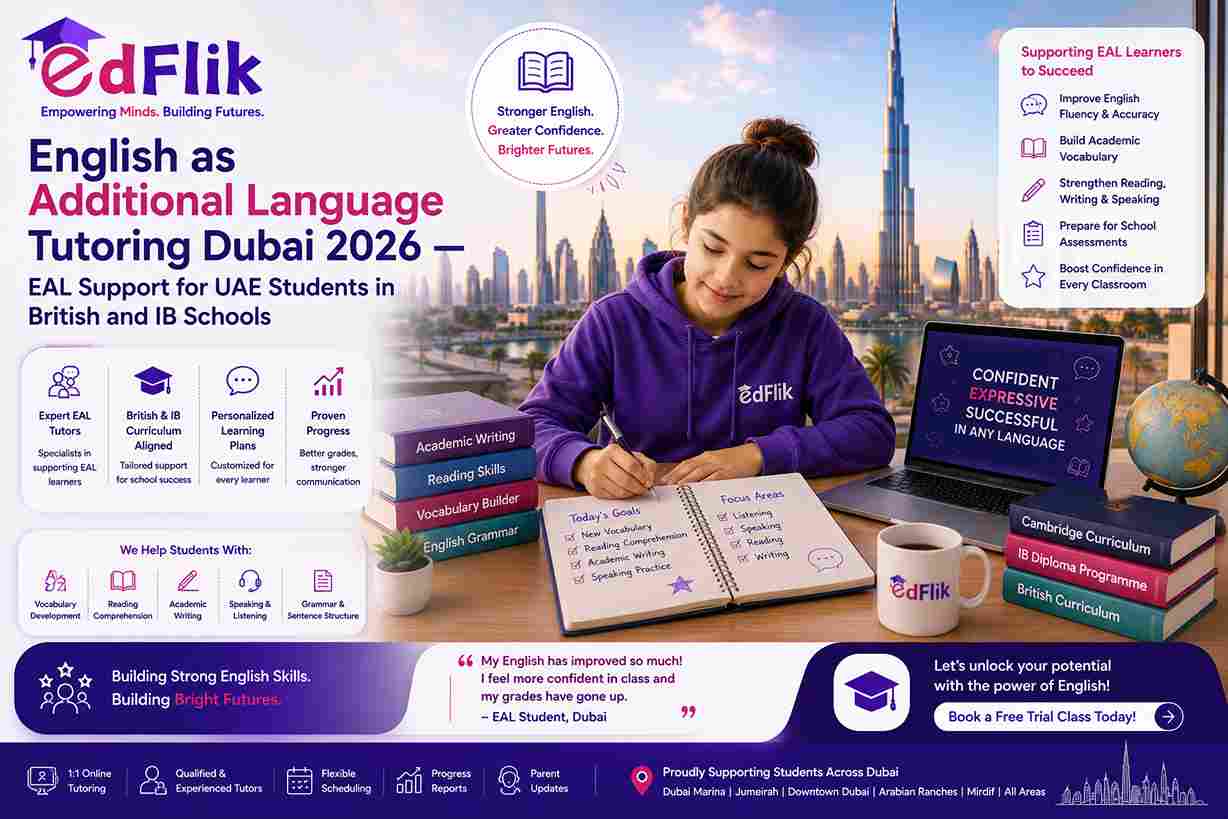
Dubai's international school population is one of the most linguistically diverse on earth — with significant communities of students from Arabic, South Asian (Hindi, Urdu, Malayalam, Tagalog), and East Asian home language backgrounds studying in English-medium schools. Many of these students are fully conversational in English but underperform in academic English tasks — the written essays, comprehension responses, and analytical reports that determine IGCSE and IB grades. This gap between conversational fluency and academic English proficiency is the defining EAL challenge in UAE international schools, and it is consistently underestimated.
The BICS-CALP Gap — Why "But They Sound Fluent" Is Not the Whole Story
Applied linguistics research (Jim Cummins, 1979) identified two distinct levels of English language proficiency that develop at very different rates:
• BICS (Basic Interpersonal Communication Skills): Conversational English. Developed in 1-2 years of immersion. Sufficient for playground conversation, classroom discussion, and everyday school social interaction.
• CALP (Cognitive Academic Language Proficiency): Academic English. Research consistently shows this takes 5-7 years to develop to native-equivalent level. Required for reading complex academic texts, writing analytical essays, and performing in IGCSE and IB examinations.
The practical implication for UAE international school families: a student who arrived from a non-English-medium school at age 11 (Year 7) and "sounds fluent" within two years still has 3-5 more years of academic English development ahead of them at age 13. The Year 10 IGCSE examination at age 15-16 may arrive before academic English proficiency is fully developed — even for students who appear linguistically capable in everyday school life.
Academic English Skills by Subject — What UAE EAL Students Must Develop Explicitly
|
Subject |
Key Academic
English Skill Required |
Most Common
EAL Gap |
Specific
Target for Tutoring |
|
IGCSE English
Language (0500) |
Text-based
inference; supported comprehension responses; directed writing in specific
register |
Quoting
without embedding; answer too short (insufficient support) or too long
(strays from text); directed writing in wrong register (too informal) |
Question-first
comprehension method; quotation embedding technique; register analysis for
directed writing (formal letter vs review vs article) |
|
IGCSE English
Literature |
Analytical
essay with embedded textual evidence; tracking authorial intent |
Narrative
retelling instead of analysis; point-evidence-explanation paragraph structure
with analysis link missing |
PEE/PEEL
paragraph structure explicitly taught; practise moving from description to
analysis in sentence-level rewrites |
|
IB Language A |
Literary
analysis with close reading; Individual Oral discussion using IB academic
register |
Over-summary;
difficulty developing an interpretive argument beyond the obvious surface
meaning |
Argument
development from observation: observation → interpretation → significance →
global issue link |
|
IB Humanities
(Economics, History, Business) |
Evaluation
essays with both sides; command term compliance (analyse vs evaluate vs
discuss) |
All command
terms answered with the same general response depth; evaluation section
missing or superficial |
Command term
drills; evaluation checklist (both sides, specific evidence, justified
conclusion) |
|
IB and A-Level
Sciences |
Investigation
report writing; method section; data analysis commentary |
Method section
— passive voice required but used inconsistently; data analysis in colloquial
language instead of precise scientific register |
Passive voice
practice specifically for science methods; data commentary sentence starters
("The data suggest that...", "This anomalous result may be
attributed to...") |
Tier 2 Academic Vocabulary — The Most Efficient EAL Intervention
Tier 2 academic words are high-frequency words used across academic subjects in ways that differ from their everyday meaning. These words are rarely explicitly taught in school but appear constantly in academic texts and mark schemes. Examples:
• "Significant" — in everyday English means important; in academic English also carries a statistical/analytical meaning ("significant increase" vs "significant" in casual speech)
• "Demonstrate" — in academic English means to show evidence or prove; not merely to "show"
• "Account for" — means to explain the reasons for; EAL students frequently interpret this as "list" or "describe"
• "Evaluate" — means to weigh both sides and reach a justified conclusion; consistently interpreted by EAL students as "describe" or "discuss generally"
Systematic Tier 2 vocabulary development — working through the Academic Word List (AWL) Sublists 1-4, which cover approximately 80% of academic text vocabulary — produces the fastest measurable improvement in academic English performance for EAL secondary school students.
|
EdFlik EAL
tutoring is embedded in the specific subject and qualification: IGCSE English
Language comprehension and directed writing technique; IB Language A literary
analysis; IB and A-Level academic writing conventions; Tier 2 academic
vocabulary development. Not generic "English lessons" — targeted
academic English support matched to the specific CAIE or IB assessment
requirements. From AED 55 per session. Free diagnostic. Book at
www.edflik.com or WhatsApp +91 88788 96600. |
Frequently Asked Questions
Q: What is EAL and which UAE students need EAL support?
EAL (English as Additional Language) support is for students studying in English when it is not their home language. High demand in Dubai from Arabic, Hindi/Urdu, Tagalog, Malayalam, and Mandarin home language communities studying in British or IB schools. Most commonly needed for academic English tasks (essays, comprehension, analytical writing) even when conversational English is strong.
Q: How is EAL tutoring different from general English tutoring?
EAL tutoring targets the gap between conversational fluency (BICS) and academic language proficiency (CALP). Specific focus: Tier 2 academic vocabulary, academic sentence structures, subject-specific text types (essay, report, analysis), and command term compliance for IGCSE/IB. More efficient than general grammar tuition for secondary school EAL students.
Q: Which EAL languages experience the most difficulty with English academic writing?
Arabic speakers: article usage (a/the) and sentence structure differences. Hindi/Urdu/Malayalam speakers: subject-verb agreement, article usage, idiom-heavy prose. Tagalog speakers: tense and aspect distinctions. Mandarin speakers: no grammatical gender, articles, or tense morphology in Chinese — all three create consistent English challenges.
Q: How long does it take for an EAL student to reach academic English proficiency?
Conversational English (BICS): 1-2 years of school immersion. Academic English (CALP): 5-7 years without targeted intervention. Targeted EAL academic English tutoring significantly compresses this timeline. The IGCSE/IB examination gap often appears when conversational fluency is established but CALP development is still in progress.
Q: What academic English skills should EAL tutoring focus on for IGCSE and IB students?
Tier 2 academic vocabulary (AWL Sublists 1-4); IGCSE comprehension question-first method and quotation embedding; IB command term compliance (analyse vs evaluate vs discuss each requiring different depth); subject-specific writing conventions (Biology report passive voice, Economics evaluation structure, History OPCVL analysis).