Evaluating Labour Market Imperfections and Monopsony Power in Cambridge A2 Economics (9708)
By EdFlik Team | November 19, 2026
For Key Stage 5 students across Dubai, Abu Dhabi, Sharjah, and the Northern Emirates studying Cambridge International AS & A-Level Economics (9708), the A2 Microeconomics unit introduces higher-order analytical frameworks that move well beyond introductory supply-and-demand shifts. Among the highest-weighting topics in Paper 3 (Multiple Choice) and Paper 4 (Data Response and Essays) is labour market imperfections, particularly monopsony power and its interactions with trade unions, national minimum wages, and wage differentials.
In a perfectly competitive labour market, an individual firm is a wage-taker facing a horizontal (perfectly elastic) supply curve of labour, hiring workers up to the point where the Marginal Revenue Product of Labour ($MRP_L$) equals the market wage ($W = MRP_L$). In reality, however, labour markets frequently exhibit imperfections—such as monopsony power, occupational and geographical immobility, imperfect information, and asymmetric bargaining power.
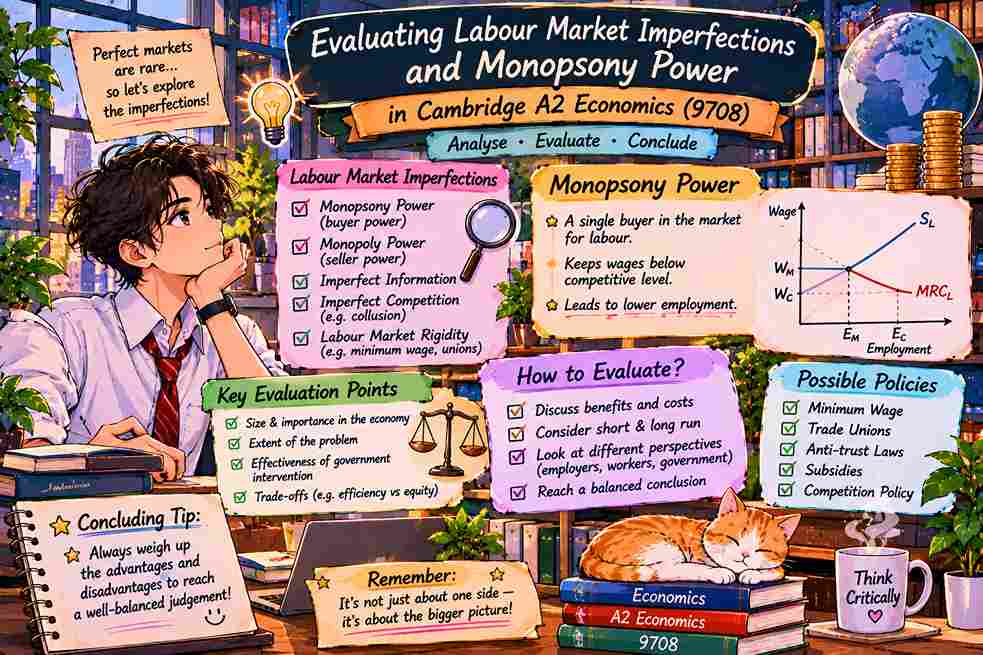
When a single dominant employer—or a small group of employers acting in concert—commands significant buying power over a specific type of labour (such as specialized healthcare professionals in a region, niche aviation engineers, or dominant logistics/industrial employers), the firm faces an upward-sloping supply curve of labour ($S_L = AC_L$). Consequently, hiring one additional worker requires raising the wage not only for that new hire, but also for existing workers (unless wage discrimination is practiced), pushing the Marginal Cost of Labour ($MCL$) above the supply curve.
Securing top marks in Cambridge 9708 A2 Economics requires more than drawing a standard monopsony diagram. Examiners reward candidates who can link microeconomic theory to real-world labour market evidence, analyze policy interventions (such as statutory minimum wages or collective bargaining) with nuanced evaluation, and weigh short-run versus long-run effects.
This masterclass guide breaks down the mechanics of monopsony power and labour market imperfections in Cambridge A2 Economics (9708), explains key diagrams and policy effects, outlines high-scoring Paper 4 evaluation chains, highlights common exam traps, and includes 100% copy-paste JSON-LD schema markup.
Key Takeaways
- Monopsony Faces an Upward-Sloping Labour Supply Curve: Because the monopsonist is a wage-maker rather than a wage-taker, $MCL$ lies above the supply of labour ($AC_L$) curve, causing profit-maximizing employment ($MCL = MRP_L$) to fall short of the competitive allocative outcome ($S_L = MRP_L$).
- Wage Suppression and Under-Employment: A pure monopsonist typically pays a wage below the worker's $MRP_L$ (exploiting labour in the economic sense) and employs fewer workers than in a competitive market, creating deadweight welfare loss.
- Minimum Wages and Unions Can Counter Monopsony: Under specific conditions, an effective minimum wage floor or trade union bargaining can raise wages and potentially increase or maintain employment up to the competitive level—unlike in a competitive labour market where a binding minimum wage above equilibrium creates excess supply (unemployment).
- Strong Evaluation Requires Market Context: In Cambridge 9708 Paper 4 essays, always evaluate price/wage elasticity of labour supply, degree of monopsony power, worker mobility, and possible unintended consequences (such as automation, reduced hiring, or passing costs on to consumers).
Part 1: Mechanics of Monopsony Power in the Labour Market
In Cambridge A2 Economics (9708), a firm's demand for labour is a derived demand determined by the Marginal Revenue Product of Labour ($MRP_L$):
$$MRP_L = MPP_L \times MR$$
where $MPP_L$ is the Marginal Physical Product of an extra worker and $MR$ is the Marginal Revenue earned from selling the additional output produced.
                 MONOPSONIST COST & HIRING LOGIC (A2 9708)
                                     |
  +----------------------------------+----------------------------------+
  |                                                                     |
1. UPWARD-SLOPING LABOUR SUPPLY (AC_L)     2. MARGINAL COST OF LABOUR (MCL)
  • To attract more workers, the firm        • Hiring +1 worker at a higher wage
    must offer a higher wage rate.           raises pay for inframarginal workers
  • Represents Average Cost of Labour        (if paid a single uniform wage).
    per unit of labour hired.              • Therefore, MCL > AC_L at all Q > 0.
As illustrated in the monopsony diagram above:
- The profit-maximizing firm hires labour up to the quantity where $MCL = MRP_L$ (rather than where $S_L = MRP_L$).
- Once that employment level is chosen, the wage rate is read down onto the Supply of Labour ($AC_L$) curve—resulting in a lower wage and lower employment than at the competitive intersection of $S_L$ and $MRP_L$.
Part 2: Other Key Labour Market Imperfections in Cambridge 9708
While monopsony power is central to A2 wage theory, labour market imperfections arise from several interacting sources:
| Labour Market Imperfection | Economic Mechanism | Impact on Wages & Allocation |
| Monopsony / Oligopsony Power | One or few dominant employers control hiring in a specific occupation or locality. | Suppresses wages below $MRP_L$ and restricts employment below competitive levels. |
| Occupational Immobility | Lack of specialized skills, qualifications, or training prevents workers from switching roles. | Creates persistent wage differentials and structural skill shortages even when unemployment exists. |
| Geographical Immobility | Relocation costs, housing constraints, family ties, or visa/licensing friction restrict movement. | Leaves high-wage vacancies unfilled in one area while excess labour persists elsewhere. |
| Information Asymmetry / Imperfection | Workers lack full awareness of alternative job offers, true working conditions, or progression paths; firms face imperfect productivity signals. | Slows wage adjustment, leads to suboptimal job matching, and reinforces employer bargaining power. |
| Trade Unions & Collective Bargaining | Worker associations negotiate wages and working conditions collectively rather than individually. | Can push wages above competitive levels (risking job losses) or counteract monopsony wage depression. |
Part 3: Evaluating Policy Interventions Against Monopsony Power
A classic Cambridge A2 Paper 4 essay question asks whether a national minimum wage or trade union power inevitably causes unemployment or improves efficiency. Your answer depends heavily on whether the baseline market is competitive or monopsonistic.
1. Introducing a Minimum Wage in a Monopsonistic Market
- Theoretical Gain: If a statutory minimum wage is set above the monopsony wage but below or at the competitive wage where $S_L$ meets $MRP_L$, the firm's marginal cost of hiring additional workers becomes horizontal along the wage floor up to the point where the floor meets the original supply curve. This can increase both wages and employment while reducing deadweight welfare loss.
- Limitation / Evaluation: If regulators set the minimum wage too high (above the competitive equilibrium wage), marginal cost jumps upward and employment falls. Furthermore, firms may respond by substituting capital for labour (automation), cutting non-wage benefits, or raising product prices.
2. Trade Union Intervention in a Monopsonistic Market
- Bilateral Monopoly Dynamics: When a strong trade union negotiates with a monopsonist, a bilateral monopoly emerges. The final wage lies within a bargaining range between the monopsonist's desired low wage and the union's desired high wage, depending on relative bargaining power, strike leverage, and macroeconomic conditions.
- Evaluation: Collective bargaining can restore fairer wages and improve worker retention/productivity (efficiency wage effects), but overly aggressive wage demands can squeeze profit margins, reduce investment, or trigger redundancies.
Part 4: High-Scoring Paper 4 Essay & Evaluation Structure
In Cambridge 9708 Paper 4, strong analysis alone rarely secures top-band marks without balanced evaluation:
                 A2 PAPER 4 EVALUATION CHAIN FRAMEWORK
                                     |
  Step 1: Define & Diagram          ---> Define monopsony, MRP, & MCL; draw a clear, labeled
                                         wage-quantity diagram showing competitive vs. monopsony outcomes.
  Step 2: Explain Core Mechanism      ---> Explain why MCL > AC_L and why hiring stops where MCL = MRP_L.
  Step 3: Apply Policy / Context      ---> Analyze minimum wages, unions, or mobility barriers in context.
  Step 4: Weigh Counter-Arguments &   ---> Evaluate elasticity, time horizon (SR vs. LR), automation,
          Overall Judgment               and market structure before giving a clear final judgment.
Four High-Impact Evaluation Angles for Examiners:
- Degree of Monopsony Power & Elasticity: If labour supply is relatively wage-elastic (workers can switch jobs easily), the gap between $MCL$ and $AC_L$ is smaller, limiting wage suppression.
- Short Run vs. Long Run: In the short run, workers face geographical or skill immobility. Over the long run, higher pay differentials or training programs may increase elasticity and mobility.
- Productivity & Retention Effects: Higher wages in an underpaying market can reduce staff turnover, lower recruitment/training costs, and raise morale—partially offsetting higher wage bills.
- Unintended Side Effects: Even where minimum wages or union deals raise pay for retained staff, marginal or lower-skilled workers may still face fewer hours or stricter hiring criteria.
Part 5: Top 4 Exam Traps That Cost 9708 Students Marks
- Labeling the Vertical Axis "Price ($P$)" Instead of "Wage Rate ($W$)" in Labour Diagrams: Always label the vertical axis Wage Rate ($W$) (or average/marginal cost of labour/MRP in monetary terms) and the horizontal axis Quantity of Labour ($Q$ or $L$) in labour market diagrams.
- Treating a Minimum Wage as Always Causing Unemployment: Automatically claiming that any minimum wage creates excess supply of labour ignores the monopsony case, where a carefully calibrated wage floor can raise both wages and employment.
- Confusing Marginal Product ($MPP_L$) with Marginal Revenue Product ($MRP_L$): Remember $MRP_L$ multiplies physical output per extra worker ($MPP_L$) by marginal revenue ($MR$). Falling $MRP_L$ reflects diminishing marginal returns, imperfect competition in the goods market, or both.
- Adding Tacked-On "Evaluation" Paragraphs Without Depth: Writing "However, this may not always work" at the end of an essay without explaining why (e.g., elasticity, mobility, or firm profitability) keeps responses in lower mark bands.
For expert 1-on-1 online tutoring support to master Cambridge A2 Economics (9708), Paper 3 multiple-choice precision, and Paper 4 data-response and essay evaluation across the UAE, book a class on EdFlik.
Frequently Asked Questions (FAQs)
Q1: How does a monopsonist determine both the wage rate and the number of workers hired?
Ans: The monopsonist determines the profit-maximizing quantity of labour where Marginal Cost of Labour ($MCL$) equals Marginal Revenue Product of Labour ($MRP_L$), and then sets the wage at the height of the Supply of Labour ($AC_L$) curve at that quantity—resulting in a wage lower than $MRP_L$ and employment lower than the competitive equilibrium.
Q2: Can a national minimum wage ever increase employment?
Ans: Yes, in theory, if the labour market has monopsony power and the minimum wage is set above the depressed monopsony wage but below (or at) the competitive wage where supply meets $MRP_L$. In a competitive labour market, however, a binding minimum wage above equilibrium typically creates excess labour supply (unemployment).
Q3: What causes labour market imperfections besides monopsony power?
Ans: Key imperfections in Cambridge 9708 include occupational and geographical immobility (preventing workers from moving to higher-wage jobs), imperfect or asymmetric information about wages and vacancies, barriers to entry/licensing, and collective bargaining by trade unions or employer bodies.