
Executive Function Skills for UAE Students — Building Organisation, Planning, and Time Management Without a Diagnosis
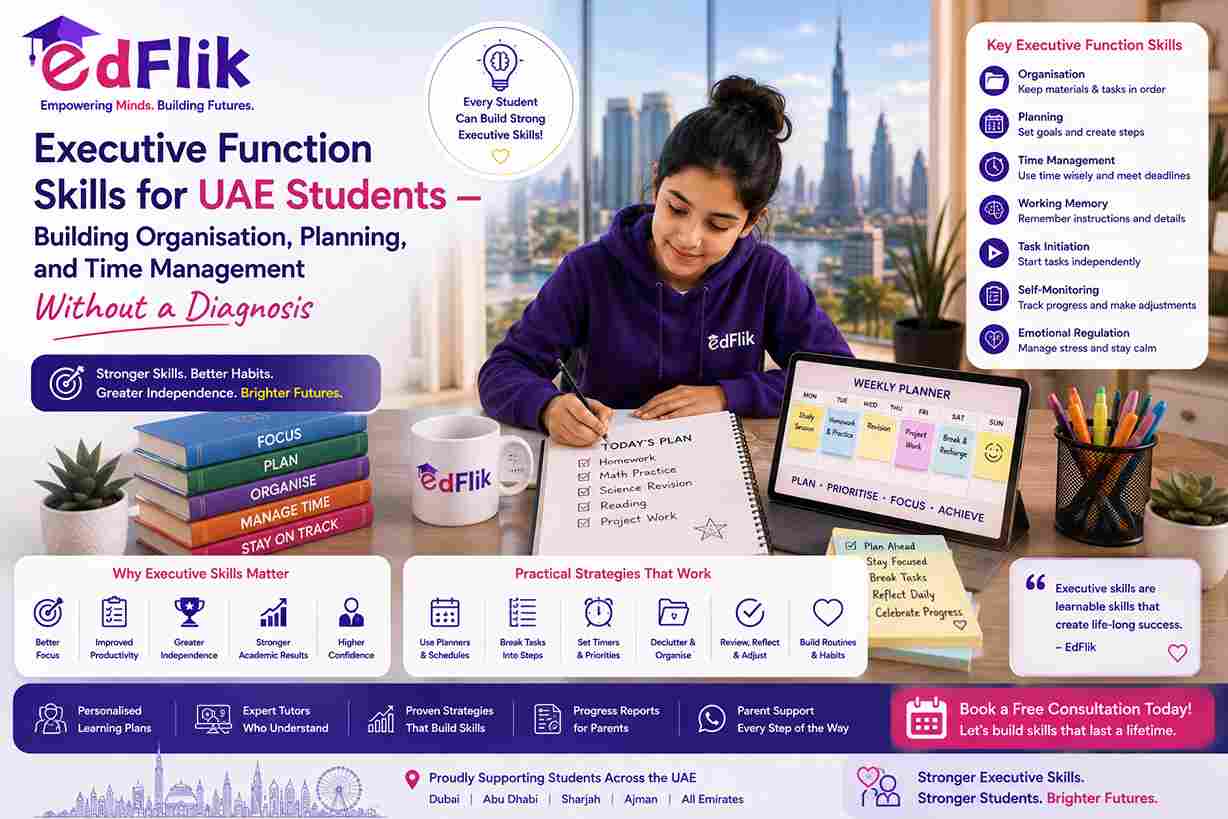
Every UAE tutoring conversation eventually arrives at some version of the same parent complaint: "He understands the material perfectly when we go through it together — he just doesn't do the work on his own." This is rarely a knowledge problem, and it is rarely explained by laziness either. In most cases, it is an **executive function** problem — and it affects a far wider range of UAE students than the ones with a formal ADHD or learning difference diagnosis.
Most existing content on this topic in the UAE tutoring space is written specifically for students with diagnosed attention or learning differences. That leaves a large, quieter group of families without much practical guidance: perfectly capable students who simply have not yet developed the planning, sequencing, and self-monitoring skills that independent secondary-level study demands.
## What Executive Function Actually Means
Executive function is the set of cognitive processes that let a person plan a task, hold a plan in mind while carrying it out, monitor their own progress, and adjust when something isn't working. In a school context, it covers:
- **Planning**: breaking a large task (a coursework essay, an IA, a revision plan) into a workable sequence of smaller steps
- **Working memory**: holding instructions or a multi-step process in mind long enough to act on it
- **Time estimation**: judging realistically how long a task will actually take
- **Task initiation**: starting a task without needing an external deadline pressure to force the start
- **Self-monitoring**: noticing, mid-task, whether the current approach is working
Crucially, executive function is largely independent of intelligence or subject knowledge. A student can be conceptually strong in IB Chemistry and still consistently underperform simply because they cannot reliably plan the sequence of tasks needed to prepare a lab report, revise a syllabus, or manage a multi-subject exam period.
## Why UAE's Academic Calendar Makes This Especially Visible
UAE international schools tend to compress a genuinely demanding set of independent-work skills into a short window, particularly at key transition points:
- **The IGCSE and A-Level jump.** Cambridge and Edexcel systems place enormous weight on a student's ability to self-direct revision across 8–10 subjects with a single terminal exam series — a very different demand from the more incremental assessment structure of earlier years.
- **The MYP-to-Diploma transition.** IB Diploma students must simultaneously manage six subjects, the Extended Essay, Theory of Knowledge, CAS hours, and internal assessment deadlines that fall at different points across two years — a genuinely complex, self-managed workload that MYP does not fully prepare students for.
- **The American AP/coursework model.** Ongoing assignments across multiple AP subjects require consistent, self-initiated pacing rather than crammed, deadline-triggered effort.
A student who was perfectly capable through Grade 8 or 9, when teachers and parents were still doing much of the organisational work, can appear to suddenly "struggle" in Grade 10 or 11 — when in reality, the academic demands simply shifted to require executive function skills the student had not yet needed to build.
## Signs a Student's Struggle Is Executive-Function-Related, Not Ability-Related
- Understands material well in conversation or tutoring but produces little independent work between sessions
- Consistently underestimates how long tasks will take, leading to last-minute, rushed submissions
- Starts assignments only once a deadline feels immediate, regardless of how far in advance it was set
- Loses track of which tasks are outstanding across multiple subjects, despite understanding each subject individually
- Reports "not knowing where to start" on open-ended tasks (essays, IAs, revision plans) despite having the subject knowledge to complete them
## Building Executive Function Skills — What Actually Works
Executive function skills, unlike some cognitive traits, respond well to explicit teaching and practice — they are genuinely learnable, not fixed.
- **External scaffolding before internal habit.** A visible, physical or digital task breakdown (a checklist, a planner, a shared calendar) does the planning work externally at first, gradually shifting inward as the student internalises the pattern. Removing the scaffold too early is a common mistake — it should fade gradually, not disappear all at once.
- **Backward planning from the deadline**, taught explicitly rather than assumed. Many students have never been shown how to work backward from a submission date to a realistic sequence of milestones — this is a teachable technique, not an innate skill.
- **Time estimation practice with feedback.** Having a student predict how long a task will take, then comparing the prediction to the actual time spent, builds calibration over repeated cycles — most students significantly underestimate at first and improve measurably with practice.
- **Task initiation triggers.** Pairing the start of a task with a fixed cue (a specific time, a specific location, a specific short warm-up routine) reduces the reliance on motivation or looming deadline pressure to get started.
- **Structured check-ins rather than only structured deadlines.** A mid-task review point — even a brief one — catches a student going off track early, rather than only discovering the problem once the final deadline arrives.
## Where 1:1 Tutoring Fits Naturally Into Executive Function Development
Live 1:1 tutoring offers something a classroom setting structurally cannot: a tutor who works with the same student repeatedly can model planning and backward-scheduling explicitly within sessions, set specific between-session tasks with realistic time estimates attached, and follow up at the next session on whether the plan actually held. This is fundamentally different from subject tutoring alone — it is teaching the *process* of independent study alongside the *content*. EdFlik's tutors, working one-to-one and matched to a student over an extended period rather than a single session, are well placed to build this kind of scaffolding consistently, with monthly progress reports giving parents visibility into whether organisational habits are actually improving over time, not just whether grades are.
## Frequently Asked Questions
**Q: Is a struggle with executive function the same as ADHD?**
A: No — executive function difficulties are a core feature of ADHD, but they occur widely in students without any diagnosis at all, particularly at key academic transition points where independent workload demands increase sharply.
**Q: At what age should UAE parents start building these skills deliberately?**
A: Executive function develops gradually through childhood and adolescence, but the demands of IGCSE, IB, and A-Level make Grades 8–10 a particularly high-value window to build these skills explicitly, before the terminal exam workload arrives.
**Q: Can executive function skills actually improve, or are they fixed?**
A: They are genuinely learnable — research on executive function consistently shows meaningful improvement with explicit practice in planning, time estimation, and self-monitoring, particularly when scaffolding is faded gradually rather than removed abruptly.
**Q: How is this different from ordinary subject tutoring?**
A: Subject tutoring addresses whether a student understands the content; executive function coaching addresses whether the student can independently plan, sequence, and complete the work around that content — both matter, and many UAE students need more support with the second than the first.
*EdFlik provides live, 1:1 online tutoring for students aged 3–18 across all seven emirates, covering IB, IGCSE, A-Level, American, ICSE, SAT, AP, and MOE curricula. Sessions start from AED 45. Free trial class available at [www.edflik.com](https://www.edflik.com).*