
Financial Literacy Classes for Kids UAE | EdFlik
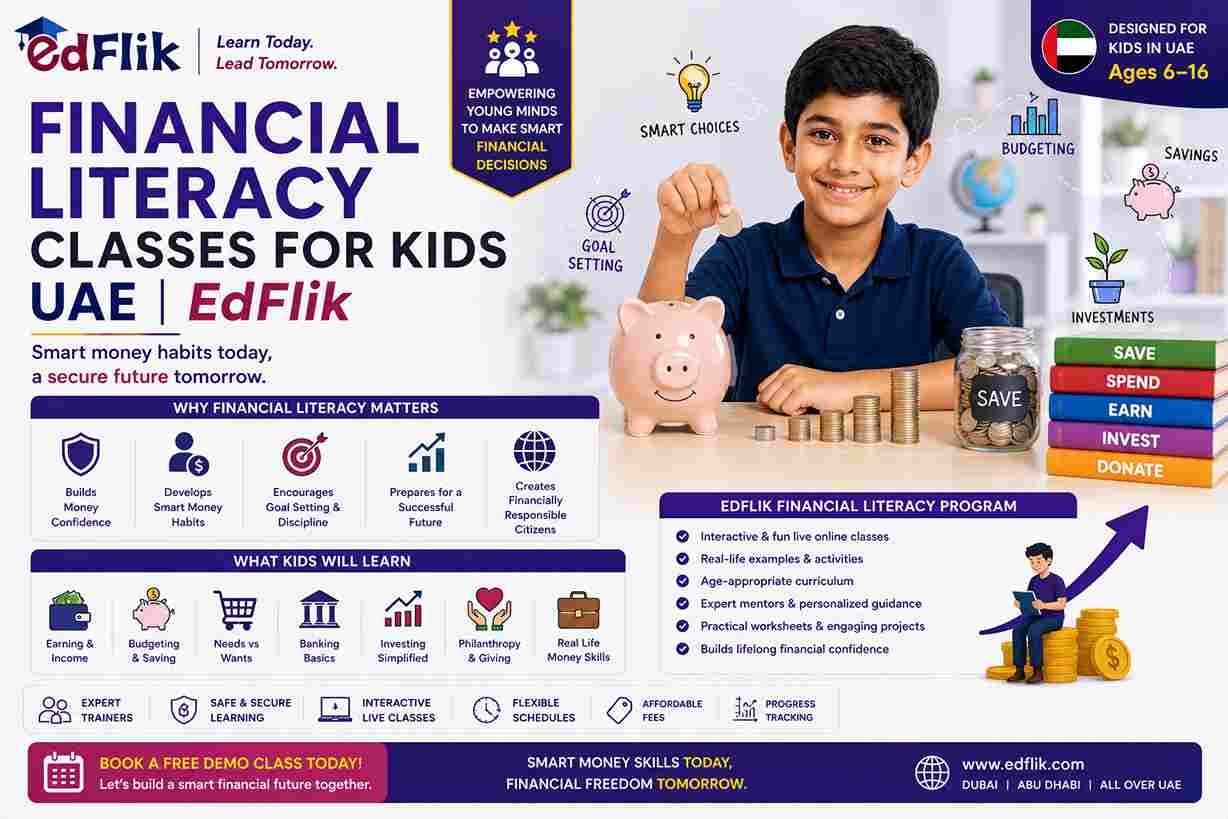
Financial Literacy Classes for Kids in the UAE: Why It Matters and How EdFlik Teaches It
Financial literacy is one of the most valuable skills a parent can give their child — and one of the least covered in international school curricula across the UAE. Children who understand how money works, how to save toward goals, and how investment grows over time are better equipped for adulthood than those who enter it without this foundation. EdFlik offers live, one-to-one financial literacy classes for children aged 8 to 18 across the UAE, starting from AED 45 per session.
Why UAE Children Need Financial Literacy Education
The UAE is one of the world's most expensive consumer environments. Children growing up in Dubai, Abu Dhabi, and Sharjah are surrounded by luxury goods, premium experiences, and seamless digital payment systems that make spending frictionless. For families raising children in this environment, building financial awareness is not optional — it is essential.
The gap between what UAE schools teach about finance and what children actually need to know is wide. Business Studies and Economics appear in some IGCSE and A-Level curricula, but these subjects are theoretical and examination-focused. They do not teach a child how to think about their own money, how to make a budget, or what compound interest means for their actual future.
Expat families in the UAE face an additional layer: their children are often aware that the family may not settle permanently in the UAE, that financial decisions involve multiple currencies, and that long-term financial planning has a different shape for an international family than it does for those with a single-country financial base. Financial literacy education that acknowledges this context is more relevant than generic programmes designed for a single-country context.
What Financial Literacy for Kids Actually Covers
Ages 8–10: Foundations
At this stage, the goal is to build a healthy relationship with money. Classes cover what money is and how it works in everyday life; the difference between needs and wants; the concept of earning, spending, and saving; and how to set a simple saving goal. Activities use practical, relatable scenarios — pocket money decisions, family shopping choices, and simple planning tasks.
Ages 11–13: Building Financial Thinking
Students at this age are capable of engaging with more abstract financial concepts. Classes introduce budgeting — how to plan spending across categories; banking basics — how current accounts, savings accounts, and interest work; the concept of borrowing and its cost; and simple investment thinking, including what it means for money to grow over time through compound interest.
Ages 14–18: Real-World Finance
Older students benefit from a more sophisticated curriculum: understanding credit, credit scores, and debt; introduction to equity, bonds, and investment funds; entrepreneurship and business thinking; tax basics in different countries; and making financial decisions with incomplete information. For UAE students with aspirations to study business, economics, or management, this content builds genuine foundational understanding that strengthens both university applications and early career performance.
How EdFlik Teaches Financial Literacy
EdFlik's financial literacy classes are delivered live, one-to-one by experienced teachers with backgrounds in economics, business, and financial education. Sessions are interactive — students work through real-world scenarios, make decisions, and discuss the implications — rather than passive lecturing. Content is adapted to the student's age, background, and specific goals, whether that is building basic money habits or preparing for a business school application.
Sessions are available across the UAE for students aged 8 to 18. Pricing starts from AED 45 per session with a free trial class available before any commitment.
Frequently Asked Questions
At what age should children start learning about money and finance?
Research in financial education suggests that foundational money concepts — the difference between needs and wants, the idea of saving toward a goal, and basic understanding of earning — are teachable and retained from as young as age 6 or 7. More structured financial literacy — budgeting, interest, investment basics — becomes accessible and relevant from around age 10 to 12, when abstract reasoning develops enough for concepts like compound interest or the time value of money to make sense. EdFlik's financial literacy programme for children is designed for ages 8 to 18, with the curriculum adapted to the cognitive and practical context of each age group.
What does EdFlik's financial literacy curriculum for kids include?
EdFlik's financial literacy classes for children cover: the concept of money and how economies work, needs vs wants and decision-making, earning, spending, and saving, budgeting and tracking money, understanding banking and financial institutions, the basics of investment and compound interest, entrepreneurship concepts and business thinking, and for older students, an introduction to credit, insurance, and financial planning. Content is always practical, age-appropriate, and presented through real-world examples and scenarios relevant to children living in the UAE.
Is financial literacy taught in UAE schools?
Financial literacy is an inconsistently covered topic across UAE international school curricula. While the UAE Ministry of Education and some private schools have incorporated elements of financial education into programmes, there is no comprehensive, standalone financial literacy curriculum in the mainstream international school sector. Students who want meaningful financial education — beyond brief mentions in Business Studies or Economics classes — typically need it delivered outside the standard school timetable. This is the gap EdFlik's financial literacy classes are designed to fill.
Why is financial literacy particularly important for children growing up in the UAE?
Children growing up in the UAE often live in a high-consumption environment with easy access to both goods and digital payment. Without financial literacy, the default pattern is spending-oriented rather than saving or investing-oriented. Additionally, UAE expat families frequently navigate multiple currencies, cross-border financial considerations, and uncertainty about long-term residency — giving financial literacy an additional layer of practical relevance. Teaching children to understand money, evaluate financial decisions, and think about the long-term implications of financial choices is genuinely useful for the environment they are growing up in.
Book a Free Financial Literacy Trial Class
EdFlik's financial literacy programme for children aged 8 to 18 in the UAE is delivered live and one-to-one by qualified teachers. Sessions from AED 45. Free trial at edflik.com.