GEMS Wellington International School Tutor 2026 — Subject Technique Guide for WIS Students
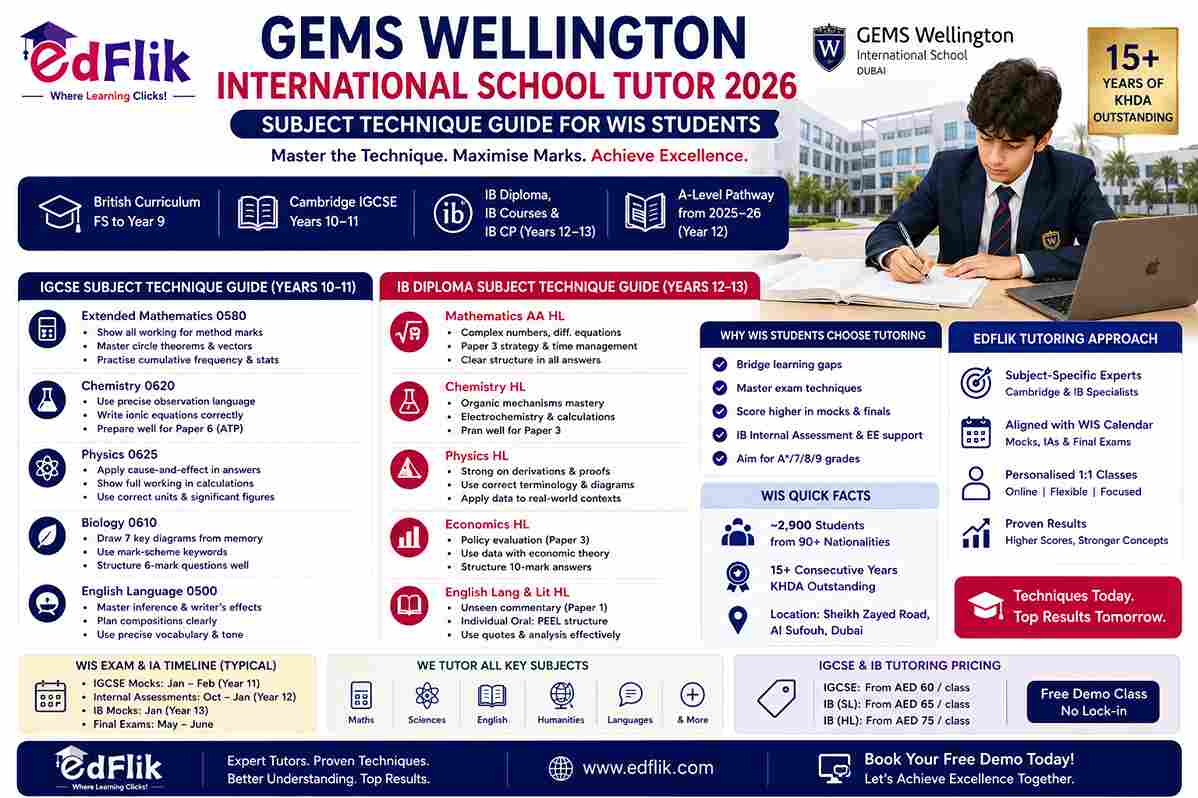
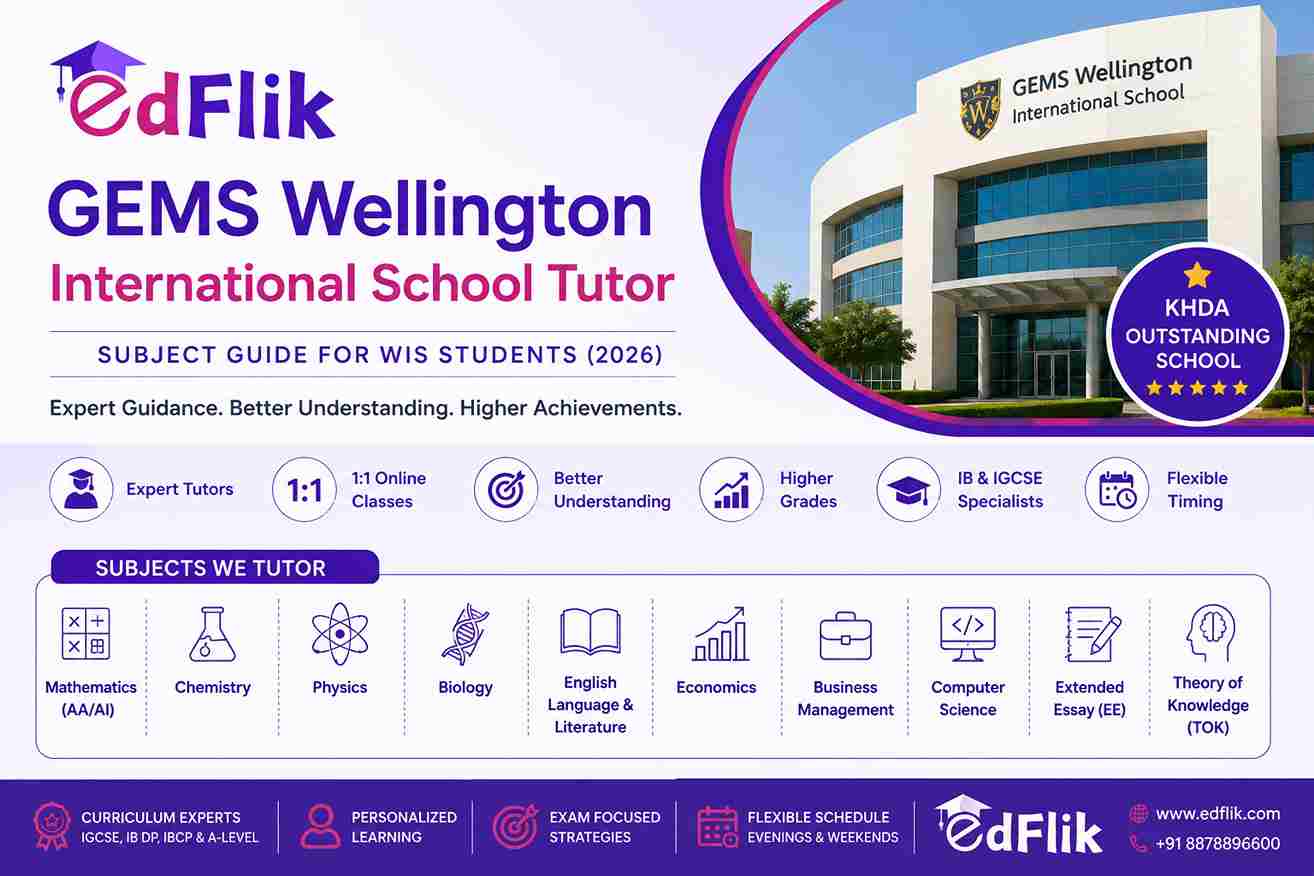
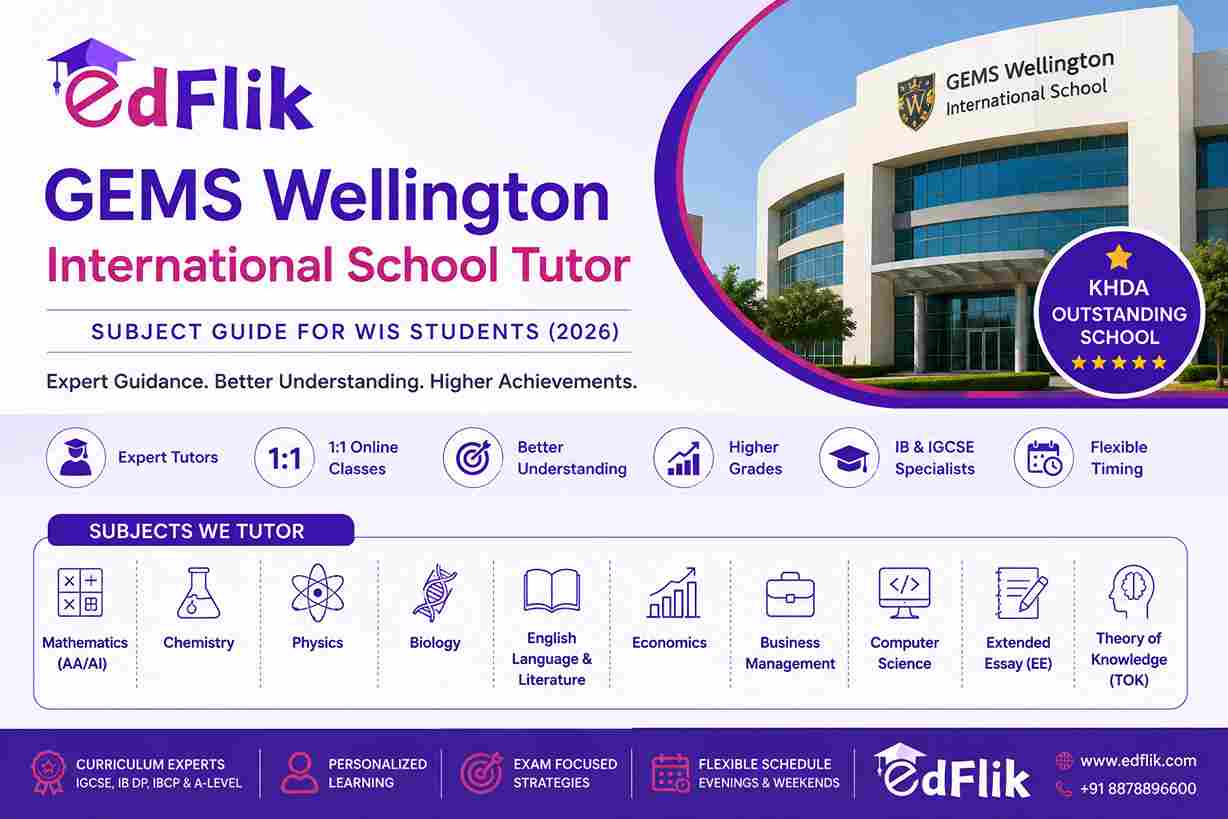
GEMS Wellington International School on Sheikh Zayed Road in Al Sufouh is one of Dubai's most consistently high-performing British-curriculum schools — 15 consecutive KHDA Outstanding ratings, 96% of IGCSE entries graded 4 to 9 in 2025, and an IB Diploma programme that consistently produces students admitted to Russell Group and global top-50 universities. It is also a school where the academic expectations are genuinely high, the peer group is academically competitive, and the difference between a grade 6 and a grade 7 — or between an A and an A* in IGCSE — matters significantly for post-16 subject entry and university application outcomes. This guide covers exactly what WIS students at IGCSE and IB Diploma level need from specialist tutoring, and how EdFlik's board-specific approach differs from generic tutoring.
GEMS Wellington — Academic Profile and Post-16 Pathways
|
Year Group |
Programme |
Board |
Key
Qualifications |
University
Context |
|
Years 10–11 |
IGCSE |
Cambridge CAIE |
IGCSE in 8 to 10 subjects — typically Extended tier across all
core subjects |
IGCSE grades determine sixth form subject entry requirements; IB
HL subject entry typically requires A or A* in related IGCSE |
|
Years 12–13 (IB Diploma) |
Full IB Diploma Programme |
IB Organisation |
6 subjects (HL and SL) + EE + TOK + CAS; maximum 45 points |
Strong IB DP average — DIA WIS IB scores above global average of
30; leading to top-25 global universities |
|
Years 12–13 (IB Courses) |
Selected IB subjects |
IB Organisation |
Fewer than 6 IB subjects; combined with BTEC or other
qualifications |
Students who do not wish to pursue the full Diploma but want IB
subject qualifications |
|
Years 12–13 (A-Level — new from 2025–26) |
A-Level |
Cambridge CAIE |
Cambridge A-Level in selected subjects |
New pathway from 2025–26 — confirm current subject availability
with school |
IGCSE — What WIS Students Most Need at Each Subject Level
IGCSE Extended Mathematics 0580 — The Method Mark Gap
The most consistent finding in Cambridge IGCSE Maths 0580 across WIS and all other Dubai Cambridge schools: students understand the mathematics but underperform by not showing method steps in written answers. At WIS, where the peer-group average is strong, the competitive pressure is at the top of the grade distribution — the difference between A and A* is often 10 to 20 method marks per paper pair lost through not stating circle theorem reasons, not showing working for multi-step algebra, or not labelling frequency density correctly on histograms. EdFlik IGCSE Maths tutors build method mark compliance as the first technique in every WIS student session — before any content revision.
Most requested IGCSE Maths topics from WIS families: circle theorems (all 8 — reasoning mark required for each), cumulative frequency and quartile reading, histograms with frequency density y-axis, vectors and parallel proof, functions with domain and range (new 2025 syllabus addition).
IGCSE Chemistry 0620 — Observation Language and Paper 6
WIS IGCSE Chemistry students sit Cambridge CAIE 0620 Extended: Papers 2, 4, and 6 (Alternative to Practical). Paper 6 — the 40-mark practical skills paper — is consistently the paper where WIS students lose the most marks relative to their chemistry knowledge. The Paper 6 skills tested (experimental design with variables identified, data tables with quantity/unit column headers, graph plotting with accuracy to half a small square, conclusions linked to specific data) are different from the content recall tested in Papers 2 and 4 and require targeted practice using actual Paper 6 past papers. Additionally, observation language precision (exact phrases from the Cambridge mark scheme, not approximate descriptions) is the highest-frequency Paper 4 mark loss — see /igcse-chemistry-0620-observation-language-uae/ for the complete reference table.
IGCSE English Language 0500 — Inference vs Description
WIS has a genuinely multilingual student body. Students who are confident English speakers — often trilingual students with Arabic, an Indian language, and English as working languages — frequently score lower in 0500 comprehension than their language confidence predicts. The reason: Cambridge 0500 comprehension rewards evidence-based inference, not description. A WIS student who reads the passage carefully and writes a confident, accurate description of what it says earns significantly fewer marks than one who identifies specific words or phrases and explains what they imply. The inference technique (point, quote, explain — see /igcse-english-0500-comprehension-technique-uae/) is the most reliable single improvement for WIS IGCSE English Language students.
IB Diploma at GEMS Wellington — What HL Students Need
IB Mathematics AA HL — The Paper 3 Challenge
WIS IB Maths AA HL students at DIA face the same challenge as all UAE AA HL students: Paper 3 (Pure Mathematics 3) content — complex numbers, differential equations, vectors in 3D, and advanced integration — requires a level of algebraic fluency and formal reasoning that WIS classroom teaching builds progressively but that many students need to consolidate through targeted one-to-one practice before the final examination. The exact-answer requirement (3√2 not 4.243; ln 3 not 1.099) is the first technique EdFlik builds in every WIS AA HL session, because it is the most consistent mark-loser identified in Cambridge 9709 examiner reports.
IB Economics HL — Paper 3 and IA
IB Economics HL is one of the most requested IB subjects from WIS families. Two components require specialist support: Paper 3 (the 10-mark policy recommendation that requires two-sided evaluation with quantitative linkage to the stimulus — see /ib-economics-hl-paper-3-uae/) and the Internal Assessment portfolio (three 750-word commentaries on real-world news articles using economic theory). IA support within IB Academic Integrity Policy means tutors provide guidance on research question focus, theory application, diagram accuracy, and evaluation structure — the tutor does not write any part of the IA for the student.
IB Biology HL — IA and Command Term Compliance
IB Biology HL at WIS requires both examination technique (command term compliance — 'evaluate' requires two-sided analysis; 'explain' requires mechanism; 'outline' requires one or two points per mark) and Internal Assessment support. The IB Biology IA must now be a maximum of 3,000 words (updated from May 2026), with research design, data collection, data processing, and evaluation all assessed against five criteria. UAE-accessible IA topics that WIS students have used successfully include enzyme kinetics (catalase and hydrogen peroxide), osmosis in plant tissue (potato or beetroot), and the effect of pH on germination rates.
WIS Academic Calendar — When Tutoring Matters Most
|
Period |
What Happens
at WIS |
Tutoring
Priority |
|
September–October |
Year 10/11 IGCSE courses begin; IB DP Year 12 subject selection
confirmed; IA planning begins |
Start IGCSE method habit building; confirm IA topic for IB
Biology, Chemistry, Physics, Economics, Maths |
|
November–December |
WIS internal assessments; Year 12 IB first IA drafts due to
teachers |
IGCSE technique drills before internal assessments; IB IA draft
review within Academic Integrity Policy |
|
January |
WIS IGCSE mock examinations (approximate — confirm with school);
IB Year 13 mocks |
Intensive pre-mock IGCSE preparation; IB Year 13 mock paper
practice in exam conditions |
|
February–March |
Post-mock result review; IB IA final teacher feedback window |
Post-mock technique diagnosis for IGCSE; IB IA final structure
review |
|
April |
Final IGCSE examination preparation; IB May examinations begin |
IGCSE consolidation — no new content; IB Diploma final paper
technique refinement |
|
May–June |
Cambridge CAIE IGCSE examinations; IB May examination session |
Exam-week support if needed; post-exam results analysis |
Frequently Asked Questions — GEMS Wellington Tutor 2026
Q: What curriculum does GEMS Wellington International School follow?
A: National Curriculum for England (FS to Year 9), Cambridge CAIE IGCSE (Years 10–11), and IB Diploma/Courses/Career-related Programme in sixth form (Years 12–13). A-Level pathway was also introduced from 2025–26. KHDA Outstanding for 15+ consecutive years. Located on Sheikh Zayed Road, Al Sufouh.
Q: Which subjects do GEMS Wellington students most need tutoring for?
A: IGCSE: Extended Maths 0580 (method marks, circle theorems), Chemistry 0620 (observation language, Paper 6), Physics 0625 (cause-effect chains), Biology 0610 (diagrams, mark-scheme language), English Language 0500 (inference technique). IB Diploma: Maths AA HL (Paper 3 content, exact answers), Economics HL (Paper 3 policy evaluation, IA), Biology HL (IA structure, command terms), Chemistry HL (organic mechanisms, Paper 5).
Q: Why do WIS students seek tutoring despite Outstanding results?
A: 96% of WIS IGCSE entries graded 4–9 in 2025 — strong school-wide. But in a high-achieving cohort, the competition is at the top of the grade distribution. Exam technique gaps (method marks, mark-scheme language, IB command terms) require one-to-one targeted correction that group classrooms cannot provide for every student. IB IA and EE also require sustained research guidance that classroom time does not accommodate.
Q: When are GEMS Wellington IGCSE and IB mock exams?
A: IGCSE mocks typically January to February of Year 11. IB Diploma mocks typically January of Year 13. IA first drafts to teachers typically October to January of Year 12. Confirm specific dates with WIS directly each academic year — internal schedules can shift.
How EdFlik Supports GEMS Wellington Students
EdFlik Cambridge CAIE specialists for WIS IGCSE students; IB-specialist tutors for WIS Diploma students. Session plans built around WIS's internal calendar. From AED 60 (IGCSE) to AED 75 (IB HL). Free demo. www.edflik.com.