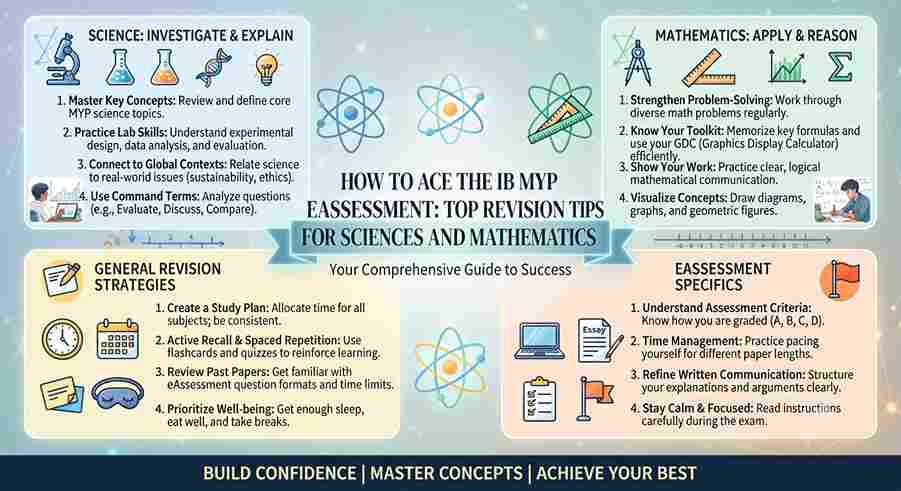
How to Ace the IB MYP eAssessment: Top Revision Tips for Sciences and Mathematics
Last Updated: October 2026 | By EdFlik Education Team
For students enrolled in international schools across the United Arab Emirates and globally, reaching the culmination of the International Baccalaureate Middle Years Programme (MYP Year 5 / Grade 10) brings a major academic milestone: the MYP eAssessments.
Unlike traditional paper-based exams that rely purely on rote memorization, the IB MYP onscreen examinations for Sciences and Mathematics are dynamic, computer-based assessments designed to evaluate critical thinking, data analysis, digital tool proficiency, and real-world problem-solving.
Because the eAssessment format blends multiple-choice queries, interactive drag-and-drop models, short-answer responses, and extended essay tasks, many students experience test-day anxiety not because they lack subject knowledge, but because they are unfamiliar with the unique onscreen exam interface and inquiry-driven rubric requirements.
In this comprehensive, masterclass guide, our expert MYP educators break down the official eAssessment structures for Sciences and Mathematics, reveal proven revision strategies, and share high-impact tips to secure top grades (Grades 6 and 7).
Part 1: Decoding the MYP eAssessment Structure
To revise effectively, you must understand how the International Baccalaureate assesses Sciences and Mathematics on screen.
1. Mathematics eAssessment Overview
The MYP Mathematics eAssessment (available in Standard and Extended tracks) is a 2-hour onscreen examination that evaluates four distinct assessment criteria:
- Criterion A (Knowing and Understanding): Selecting appropriate mathematics, recalling facts, and solving multi-step problems.
- Criterion B (Investigating Patterns): Spotting numerical or geometric patterns, conjecturing rules, and testing hypotheses.
- Criterion C (Communicating): Using correct mathematical notation, terminology, and diagrams.
- Criterion D (Applying Mathematics in Real-Life Contexts): Translating real-world scenarios into mathematical models and evaluating the reasonableness of solutions.
2. Sciences eAssessment Overview
The Sciences eAssessment (covering Biology, Chemistry, Physics, and Interdisciplinary Sciences) is also a 2-hour onscreen examination structured around scientific inquiry:
- Criterion A (Knowing and Understanding): Scientific knowledge, explaining concepts, and applying scientific reasoning.
- Criterion B (Inquiring and Designing): Formulating research questions, identifying variables, designing safe experiments, and evaluating methodologies.
- Criterion C (Processing and Evaluating): Analyzing quantitative and qualitative data, identifying trends, and drawing justified conclusions.
- Criterion D (Reflecting on the Impacts of Science): Evaluating the moral, ethical, social, economic, and environmental implications of scientific and technological developments.
Part 2: Top Revision Strategies for MYP Mathematics
MYP Mathematics eAssessments reward conceptual understanding and digital literacy over mechanical calculation.
1. Master the Onscreen Mathematical Tools
During the exam, you will use built-in digital tools, including scientific calculators, graphing software, and geometry drawing tools.
- Actionable Practice: Do not wait until exam day to touch the digital interface. Practice past papers using online graphing calculators and equation editors so you can plot functions, find intersections, and format fractions quickly without losing precious time.
2. Practice Constructing Rigorous Mathematical Arguments (Criterion C)
Many students lose marks because they write down a correct final number without showing intermediate logical steps.
- The Framework: Always write out your working clearly. Define your variables explicitly (e.g., "Let $x$ represent the number of hours..."), use proper mathematical symbols ($\therefore, \equiv, \le$), and conclude with a clear statement answering the prompt's real-world question.
3. Focus Heavily on Extended-Response Inquiry Tasks
Section B of the Math eAssessment usually features complex, multi-part real-world scenarios (Criterion D). Practice breaking down lengthy word problems into smaller mathematical models, identifying underlying quadratic, exponential, or trigonometric functions.
Part 3: Top Revision Strategies for MYP Sciences
MYP Sciences eAssessments test your ability to think like a scientist rather than a textbook reader.
1. Drill Experimental Design and Variable Control (Criterion B)
Examiners frequently ask you to design an experiment or critique an existing method. You must master these core scientific terms:
- Independent Variable: What you deliberately change.
- Dependent Variable: What you measure.
- Controlled Variables: What must be kept strictly constant to ensure fair testing.
- Anomalous Data: Identifying outliers and explaining whether they should be discarded or investigated.
2. Master Data Analysis and Trend Description (Criterion C)
When presented with graphs, tables, or scatter plots, your analysis must be quantitative, not just qualitative.
- The Rule: Never write vague statements like "As temperature goes up, enzyme activity goes up." Instead, use specific data points from the graph: "As temperature increases from $10^\circ\text{C}$ to $40^\circ\text{C}$, rate of reaction increases exponentially from $2\text{ g/s}$ to a peak of $12\text{ g/s}$ before sharply denaturing."
3. Connect Science to Global Contexts (Criterion D)
Criterion D questions require you to evaluate the societal or environmental impact of a scientific discovery (e.g., genetic engineering, nuclear energy, or renewable battery tech). Always structure your response using multiple perspectives: discuss the scientific benefits, the economic costs, the environmental risks, and ethical considerations.
Part 4: Top 4 Exam Traps That Cost Students Top Marks
- Ignoring Interface Tutorials: Failing to review the official IB sample eAssessment platform beforehand. Knowing how to drag, drop, input formulas, and navigate between tabs saves vital minutes during the exam.
- Vague Scientific Terminology: Using informal words like "fair test" instead of precise IB vocabulary such as "validity, reliability, random error, and systematic error."
- Rushing Through Command Words: Misinterpreting what the prompt is asking for. If an exam question says justify, you must provide valid reasons backed by evidence; if it says state, a brief single-word answer is sufficient.
- Poor Time Management: Spending 45 minutes on a single tricky Criterion B math investigation and leaving yourself short of time for the real-life application section.
Preparing for MYP eAssessments across international schools in Dubai, Abu Dhabi, or worldwide? EdFlik connects students globally with expert, 1-to-1 online MYP tutors specializing in Mathematics and Sciences, helping you master onscreen exam techniques, conquer inquiry rubrics, and achieve top grades of 6 and 7.Book a Free Demo Class Today!
Frequently Asked Questions (FAQs)
Q1: How are MYP eAssessments graded?
Ans: MYP eAssessments are graded on a scale from 1 to 7. Each of the four assessment criteria (A, B, C, D) is marked out of 8, and the combined total is converted into a final grade boundary where a grade 7 represents exceptional achievement.
Q2: Are MYP eAssessments compulsory for all IB schools?
Ans: While moderation by the IB is optional for some schools, most authorized IB World Schools require students to complete eAssessments in Year 5 to earn the official IB MYP Certificate.
Q3: How should my child practice for the computer-based format?
Ans: The best preparation is accessing official IB specimen papers through the school portal or online repositories, ensuring students practice typing mathematical expressions, reading graphs on a computer monitor, and managing digital scratch paper.
Q4: How does EdFlik support MYP students?
Ans: EdFlik connects international school students worldwide with vetted, expert 1-to-1 online tutors specializing in MYP Mathematics, Sciences, Individuals & Societies, and Language Acquisition. Our personalized coaching focuses on inquiry skill-building, past-paper walkthroughs, and eAssessment confidence.