How to Choose an Online Tutor in UAE 2026 — Complete Parent Guide

Choosing an online tutor in UAE is not difficult — it is the second decision that matters more. The first decision is choosing a tutor. The second is choosing the right tutor for your child's specific curriculum, grade level, and learning need. With over 600 private schools across UAE using 12+ different curricula, "finding a Maths tutor in Dubai" describes an enormous range of possible outcomes. This guide gives UAE parents the specific framework — questions to ask, red flags to watch for, and quality indicators to expect — that makes the second decision reliable.
The Non-Negotiable First Question: Which Board Specifically?
Before any other consideration, confirm that the tutor is a genuine specialist in your child's specific curriculum and examination board. The question: "Which board do you teach — and which papers specifically?" A correct answer sounds like: "Cambridge IGCSE 0580 Extended — Papers 2 and 4 — I use Cambridge official past papers from the last five years with mark-scheme correction in every session." A concerning answer sounds like: "I teach all curricula — Maths is Maths." In UAE's multi-curriculum environment, subject knowledge without board-specific expertise is insufficient for exam-year tutoring.
The Five Questions to Ask Before Booking Any Tutor
|
Question |
What a Good
Answer Looks Like |
What a
Concerning Answer Looks Like |
|
Which board
specifically do you teach? |
Immediately
names the specific board: Cambridge 0580, IB AA HL, CBSE Class 12, American
AP Calculus BC — with no hesitation |
Claims to
teach all curricula; or names a generic subject without specifying the board;
or asks which board you mean after a pause |
|
Can you show
me a session plan for my child's topic? |
Describes
specific past paper question types, mark-scheme requirements, and the
particular technique that distinguishes full marks from partial marks |
Describes
teaching the textbook chapter; describes general concepts; cannot specify how
the exam assesses this topic differently from how a textbook presents it |
|
What will I
receive after each session? |
Written
session summary to parent: what was covered, what gaps were found, what
practice was set for the week — sent within 24 hours |
Verbal update
only; or no standard feedback process; or "parents can ask me directly
if they want to know" |
|
How do you
decide what to teach each session? |
Based on past
paper analysis: looks at recent past papers, identifies which question types
generated errors, targets those in the following session |
Based on the
textbook chapter sequence; or based on what the school is currently covering;
or "it depends on what the student wants to do" |
|
What realistic
improvement can I expect in 8-12 weeks? |
Describes a
trajectory: "For a student at grade C now, 8 sessions of twice-weekly
tutoring typically produces B-level performance on past papers by week 10 —
verifiable through timed practice papers" |
Promises
dramatic results without qualification; or is vague about what improvement
looks like; or says "it depends on the student" without further
specificity |
Red Flags — When to Walk Away
• Claims expertise in every curriculum simultaneously. No single tutor is equally expert in IGCSE Cambridge, IB Chemistry HL, CBSE Class 12, and AP Chemistry. A tutor with genuine deep expertise in one or two boards is more valuable than a generalist who claims competence in all.
• No free trial. Reputable tutoring platforms offer a free first session. An insistence on payment before the first session removes your ability to assess the tutor before committing.
• Session feedback is verbal only. Written summaries after every session are a professional baseline — they create accountability, allow parents to monitor what is being taught, and ensure the tutor is preparing for each session rather than improvising.
• Cannot name the specific past paper series. An IGCSE specialist should be able to say "I use Cambridge 0580 QPs from 2020-2025" without hesitation. A tutor who cannot name the papers does not use them systematically.
Quality Indicators — What Good Tutoring Looks Like After 6-8 Weeks
After 6-8 weeks of twice-weekly sessions, a UAE parent should see at least two of the following:
• Past paper scores on the tutored topics improving — measurably and specifically, not anecdotally
• The student can answer question types they previously could not — demonstrable in a timed practice paper, not just in conversation with the tutor
• School test or assessment results in the tutored subject improving — the most objective external validation
• The student is more confident and less anxious about the subject — confidence and grade improvement correlate closely
If none of these indicators are visible after 8 sessions, the conversation to have is with the tutor: has the diagnostic been accurate? Is between-session practice happening? Should the curriculum focus, topic focus, or approach change? A good tutor welcomes this conversation and adjusts. A tutor who deflects or blames the student is a signal to reassess the match.
|
EdFlik's
matching process puts every new student through a diagnostic in the free
trial session, provides written feedback after every session, and replaces a
tutor match at no cost if the fit is not right. Every tutor is pre-verified
for board-specific curriculum knowledge before joining the platform. From AED
45 per session. Free diagnostic. Book at www.edflik.com or WhatsApp +91 88788
96600. |
Frequently Asked Questions
Q: What are the most important questions to ask an online tutor in UAE?
(1) Which board specifically — name the exact paper; (2) Show me a session plan for my child's topic; (3) What will parents receive after each session; (4) How do you decide what to teach each session; (5) What realistic improvement can I expect in 8-12 weeks.
Q: What are the red flags when choosing an online tutor in UAE?
Claims to teach all curricula equally well; cannot name specific past paper series; requires payment before any free trial; session feedback is verbal only; cannot describe a realistic improvement trajectory.
Q: How many tutoring sessions per week does a UAE student need?
1 per week for ongoing maintenance; 2-3 per week for intensive exam preparation; daily sessions only in the final 4 weeks before critical exams. Between-session practice is more important than session frequency.
Q: How do I know if the tutor is right for my child after the first session?
Did the tutor identify specific named gaps (not general weaknesses)? Can they describe a clear next 3-4 session plan? Did the student engage positively and feel comfortable asking questions? All three should be yes.
Q: Is it better to use a tutoring platform or find an independent tutor in UAE?
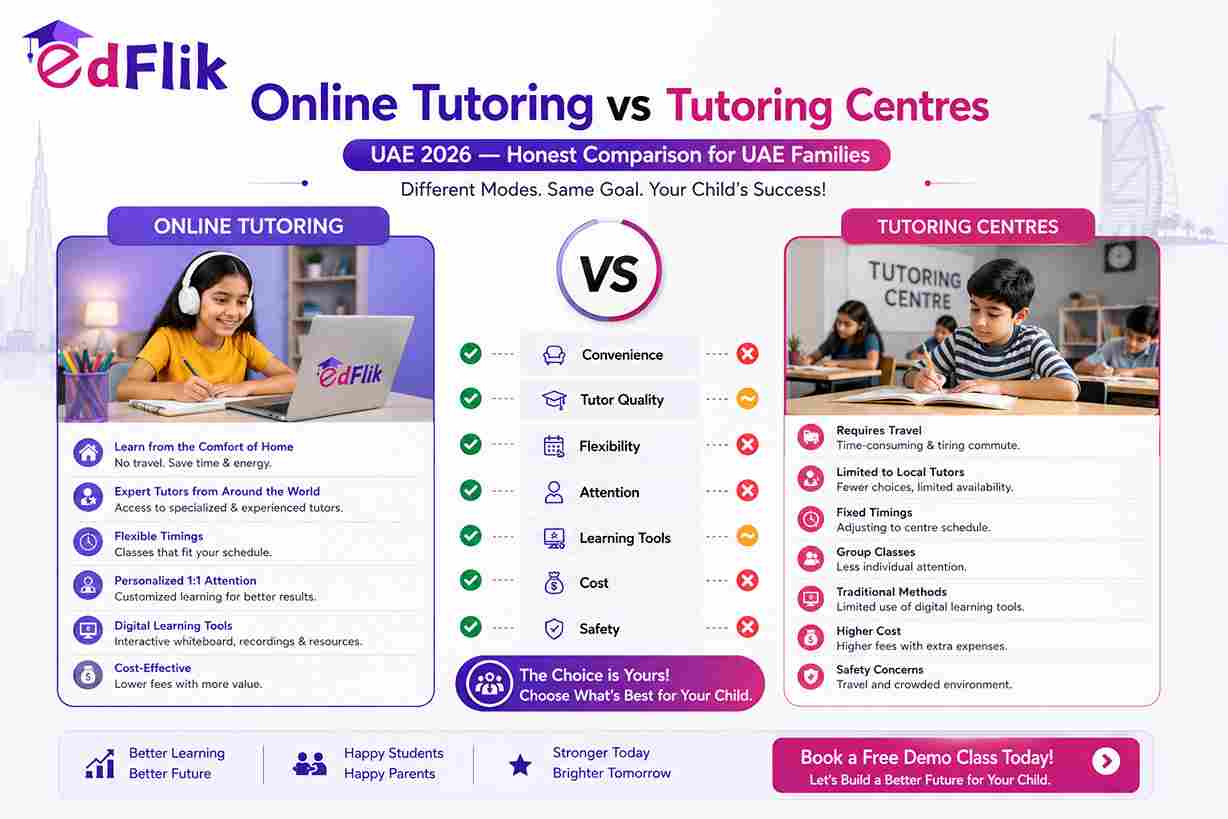
Platforms provide quality vetting, tutor replacement guarantees, and structured feedback with less parent diligence required. Independent tutors may offer cost savings but require more thorough curriculum credential verification. Both can produce excellent results with the right match.