How to Choose Between International Schools and Online Tutoring: A Parent's ROI Breakdown
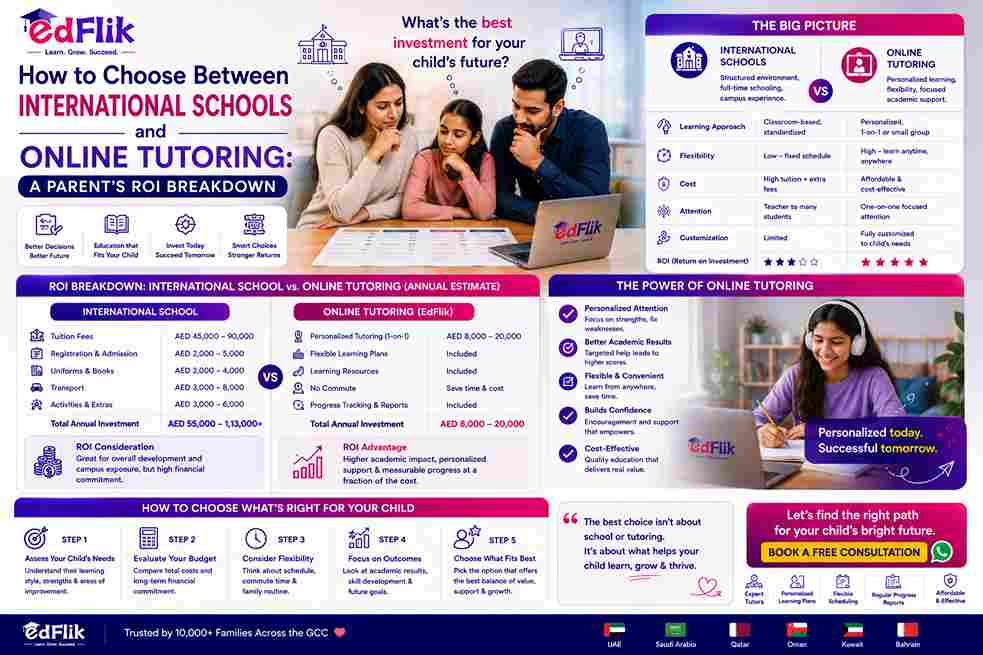
The decision between investing in a premium international school (AED 50,000–150,000+ per year) versus choosing a more affordable local school and supplementing with online tutoring (AED 10,000–25,000 per year) is one of the most consequential financial and educational decisions GCC parents face. This choice carries emotional weight—guilt about 'not choosing the best', anxiety about 'sacrificing your child's future', and uncertainty about whether supplemental tutoring is truly equivalent to an elite school environment. The reality is more nuanced: school choice matters, but tutoring quality, family engagement, and student agency matter equally or more.
This comprehensive guide breaks down the true costs, compares learning outcomes across options, and provides a decision framework based on research, data, and GCC-specific contexts. The goal isn't to tell you which choice is 'right'—it's to help you make an intentional decision aligned with your values, financial situation, and your child's specific needs.
Understanding True Costs: Beyond Tuition Stickers
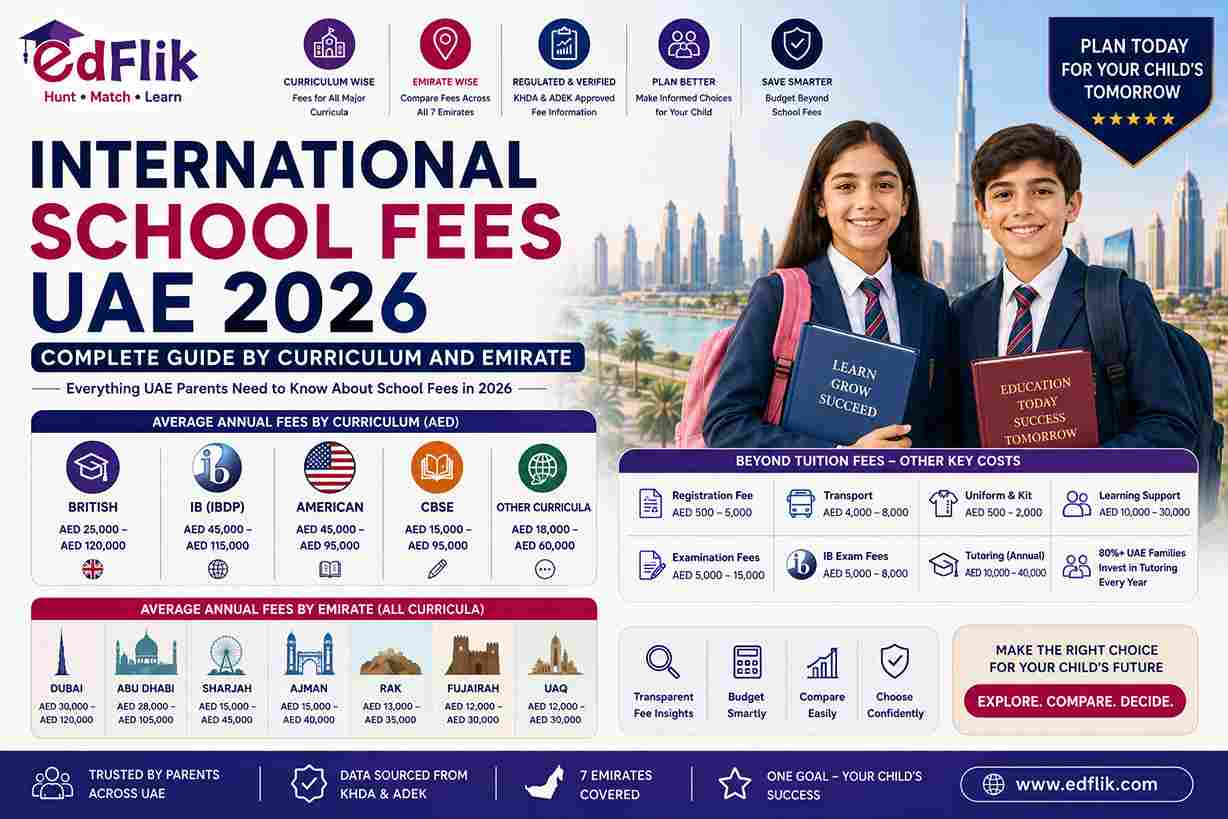
International school costs extend far beyond tuition. Most premium schools charge AED 60,000–120,000 annually in tuition, but add AED 10,000–20,000 in uniforms, books, field trips, exams, and mandatory co-curriculars. Over 13 years (KG–Grade 12), total cost reaches AED 1–2 million per child. For families with multiple children, this becomes prohibitive.
Online tutoring costs, by contrast, typically range AED 200–400/hour. A student needing 4 hours/week of tutoring (moderate support) costs AED 3,200–6,400/month (AED 40,000–75,000/year). Combined with a local school (AED 15,000–30,000/year tuition), the total is AED 55,000–105,000 annually—roughly 40–60% cheaper than premium international schools.
However, direct costs aren't the full story. Premium schools provide campus infrastructure (labs, libraries, sports facilities, arts centers), co-curricular opportunities, and peer networks that families must otherwise access separately. Quality online tutoring provides personalized academic support; it doesn't replace extracurriculars. When calculating true cost, factor in what's included and what you're adding/removing.
Learning Outcomes: What the Research Actually Shows
The pivotal question: Do premium international schools produce better academic outcomes than affordable schools + quality tutoring? Research is surprisingly clear: *school prestige matters less than previously believed*. University admissions, career earnings, and long-term success correlate more strongly with student engagement, learning quality, and skill development than school brand.
A comprehensive meta-analysis of school choice research finds: (a) Student effort and engagement predict outcomes more than school choice; (b) Peer effects are real but smaller than family engagement; (c) Teaching quality matters more than school resource levels; (d) Tutoring quality significantly boosts outcomes for students receiving it. This suggests that a motivated student in a good local school + quality tutoring can achieve outcomes equivalent to (or exceeding) a less-engaged student in a premium school.
Case Study 1: Local School + EdFlik Tutoring Model
Student profile: Grade 10, IGCSE curriculum, local school (AED 18,000/year tuition), target IB Grade 11–12. Challenge: Local school teaching is solid but paced for average learners; student is advanced in Math, average in English, struggling in Sciences.
EdFlik approach: 3 sessions/week (Math advanced content, English writing skills, Sciences conceptual foundations). Cost: AED 4,800/month = AED 57,600/year combined with school. Outcomes after 18 months: Grade 10 final exams show A* in Math, A in English, B+ in Sciences. Improved trajectory for IB. Total 2-year cost: AED 51,000 in tutoring + AED 36,000 in school = AED 87,000. Equivalent international school cost over same period: AED 180,000–240,000.
Case Study 2: International School Alone Model
Student profile: Same starting point, but enrolled in premium international school (AED 100,000/year tuition). Classroom sizes: 20–25 students. Teacher availability: limited 1-on-1 support. Outcomes: Student struggles in Sciences due to large class sizes and limited individual attention. School recommends hiring a tutor to support Sciences (AED 2,000/month). Total cost: AED 124,000/year (AED 100,000 tuition + AED 24,000 tutoring).
This case is instructive: The premium school didn't eliminate the need for supplemental tutoring; it simply shifted the model to 'premium school + expensive private tutoring' (often AED 150–300/hour through independent tutors). The student gets school prestige but not necessarily personalized support for their specific struggle areas.
Hybrid Models: Combining School Choices Strategically
Some GCC families use hybrid approaches: A less expensive international school (AED 40,000–60,000/year) + focused tutoring in weak subjects (AED 2,000–3,000/month). This model captures school benefits (campus, peers, college counseling, co-curriculars) while controlling total cost and adding targeted academic support.
Another hybrid: Local school in strong academics + international school for grades 11–12 only (capturing the IB/AP curriculum advantage at the critical years). This sequence minimizes cost while prioritizing curriculum choice at the highest-stakes grades.
Decision Framework: Choosing Based on Your Child & Values
Rather than prescribing a choice, here's a framework to clarify what matters most:
Dimension 1: Your child's independence level. Highly independent learners can thrive in local schools + tutoring models because they self-advocate and manage structured tutoring well. Less independent learners benefit from school structures and teacher relationships that 1-on-1 tutoring doesn't provide.
Dimension 2: Your financial flexibility. If premium school tuition doesn't strain your budget, the peace-of-mind may justify the cost. If you're stretching financially, a local school + tutoring model allows resources for other family priorities (international travel, other children's education, retirement savings).
Dimension 3: Your value for peer networks. International schools offer concentrated peer networks; local schools offer more diverse peers. Which aligns with your values? EdFlik's online-first model means your child accesses tutors globally, not limited to local talent.
Dimension 4: Curriculum priority. If curriculum choice is critical (IB vs IGCSE), that weighs toward specific schools. If curriculum flexibility is okay, that broadens school options.
Long-Term ROI: University Admissions & Career Success
University admissions research shows that elite universities (UK Russell Group, US Ivy League, UAE institutions) care deeply about curriculum choice (IB valued highly), exam grades, and demonstrated skills—but NOT about school brand per se. A student with strong IB grades from a local school is competitive with a premium school student with similar grades.
Career earnings correlate more with university choice than secondary school choice. An EdFlik-tutored student who aces exams, gains admission to a top university, and develops strong soft skills (communication, problem-solving) will have comparable career trajectory to an international school graduate—often with better financial flexibility during formative years.
The Guilt Factor: Reframing Education Investment
Many GCC parents feel guilty about not choosing premium schools, as though they're 'sacrificing' their child's future. Reframe: Intentional choice of a good local school + quality tutoring is not sacrifice; it's strategic allocation of resources for your family's needs. Your child's success depends far more on your engagement, the tutoring quality, and their own effort than on school tuition.
Frequently Asked Questions
Q1: Will a local school + tutoring lead to the same university outcomes as a premium international school?
Research suggests yes, for well-supported students. University admissions value curriculum (IB > IGCSE > national boards), exam grades, and skills—not school brand. A student with A*/A IB grades + strong tutoring support + demonstrated skills can be competitive at top universities, regardless of school origin.
Q2: What if I choose the wrong option and regret it?
Most families can pivot: switch schools mid-year if needed (with tutoring support for transition), or increase tutoring intensity if school isn't meeting needs. The decisions aren't irreversible. Give each choice 6–12 months before evaluating.
Q3: Can tutoring truly replace school infrastructure (labs, libraries, sports)?
No. Tutoring replaces personalized academic support; it doesn't replace campus infrastructure or organized co-curriculars. Factor this into your decision. If labs/sports/arts access is critical, that weighs toward school choice.
Q4: What's the minimum tutoring intensity to support a child in a local school?
EdFlik typically recommends 2–3 sessions/week for meaningful support. Less than 1–2 hours/week provides minimal impact. More than 4–5 hours/week risks over-tutoring. The sweet spot depends on your child's needs and school quality.
Make Your Decision with Clarity
Sessions from AED 45, free trial at edflik.com. EdFlik tutors help families make school choices strategically, supporting your child regardless of which school you choose.