How to Design a Top-Scoring IB MYP Science Investigation: Variables, Hypotheses, and Methodology
Last Updated: September 2026 | By EdFlik Education Team
For students progressing through the International Baccalaureate (IB) Middle Years Programme (MYP) Sciences across international schools, practical investigations are a core pillar of internal assessment. Evaluated strictly under Criterion B: Inquiring and Designing, a well-crafted lab design separates students who simply follow recipes from those who think like true scientists.
Achieving a top band score (7–8) requires more than just writing down a casual list of steps or a basic guess. It demands absolute precision in defining research questions, structuring scientifically backed hypotheses, rigorously controlling variables, and formulating safe, replicable methodologies.
In this comprehensive, masterclass guide, our expert MYP science educators break down the anatomy of a top-scoring investigation plan, reveal common pitfalls, and provide a systematic framework to secure maximum marks.
Part 1: Crafting a Focused Research Question and Hypothesis
Every exceptional scientific investigation begins with absolute clarity. Under Criterion B, your introductory section sets the tone for your entire methodology.
1. The Research Question
Your research question must explicitly state the relationship between your independent and dependent variables, alongside the specific system or organism being investigated.
- Weak Question: "How does temperature affect enzyme activity?" (Too vague; lacks specific parameters and variables).
- Top-Scoring Question: "How does increasing the temperature from $20^\circ\text{C}$ to $60^\circ\text{C}$ affect the initial rate of oxygen gas production ($cm^3\text{s}^{-1}$) during the catalytic breakdown of hydrogen peroxide by yeast catalase?"
2. The Scientific Hypothesis ("If... Then... Because...")
To score top marks, your hypothesis cannot just be a blind guess. It must contain a clear prediction coupled with deep scientific reasoning.
- The Blueprint: "If [independent variable changes in a specific way], then [dependent variable responds in a predicted manner], because [detailed underlying scientific theory, molecular interaction, or physical principle]."
- Example: "If the temperature of the catalase solution is increased from $20^\circ\text{C}$ to $60^\circ\text{C}$, then the initial rate of oxygen production will increase up to an optimum point at approximately $40^\circ\text{C}$, and then drop sharply to zero, because thermal kinetic energy initially increases successful enzyme-substrate collisions until excessive heat denatures the tertiary structure of the protein active site."
Part 2: Mastering Variables (The Key to Full Marks)
Vague variable control statements are one of the most common reasons students drop marks in Criterion B. Writing statements like "I will keep the room and equipment the same" will not earn top marks. You must be rigorously specific.
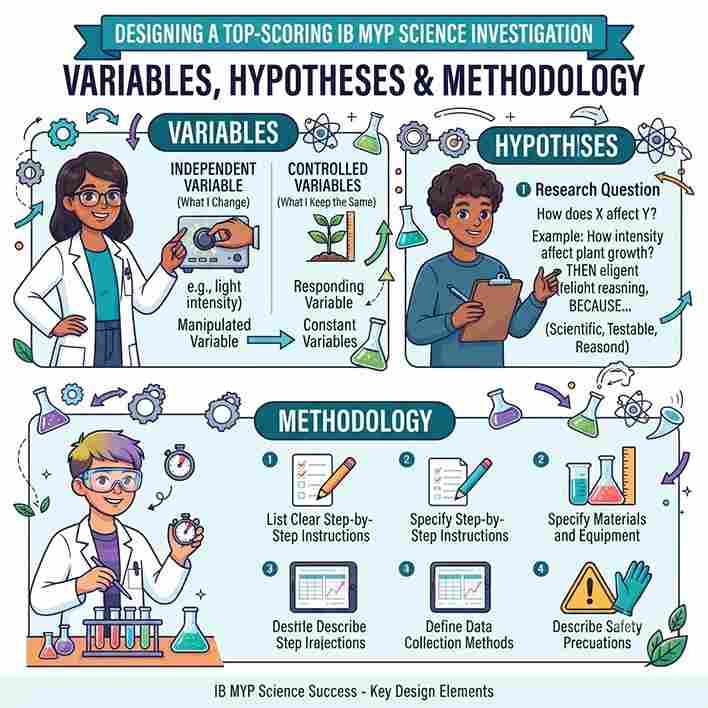
1. Independent Variable (IV)
- Definition: The variable you deliberately change or manipulate.
- Top-Mark Standard: You must specify at least 5 distinct, well-spaced quantitative values (e.g.,$20^\circ\text{C}, 30^\circ\text{C}, 40^\circ\text{C}, 50^\circ\text{C}, \text{and } 60^\circ\text{C}$) to allow for meaningful trend analysis and line-of-best-fit plotting.
2. Dependent Variable (DV)
- Definition: What you measure.
- Top-Mark Standard: Clearly state the exact units, the measurement apparatus, and how precision will be maintained (e.g., "Volume of oxygen gas collected in $\text{cm}^3$ using a calibrated gas syringe with precision $\pm 0.5\text{ cm}^3$").
3. Controlled Variables
You must explicitly identify at least 3 to 4 confounding variables, explain why they would ruin your results if left unchecked, and detail the exact method you used to keep them constant:
- Example Variable: Concentration of hydrogen peroxide solution.
- Why it matters: Changes in substrate concentration alter collision frequency independently of temperature.
- Control Method: Use $10\text{ cm}^3$ of $5\%$ hydrogen peroxide measured with a graduated pipette for every single trial.
Part 3: Designing a Safe, Replicable Methodology
Top-tier methodologies read like precise instructional manuals that any independent researcher could follow to achieve identical results.
1. Equipment Precision and Materials
Never list generic tools like a "scale" or "thermometer". Always specify equipment tolerances and sizing:
- Instead of: Beaker, scale, thermometer.
- Write: $100\text{ cm}^3$ Pyrex glass beaker, digital electronic balance ($\pm 0.01\text{ g}$), and a digital immersion probe thermometer ($\pm 0.1^\circ\text{C}$).
2. Methodical Replication and Reliability
A single trial is never enough in MYP science. To generate sufficient and reliable data for processing, your methodology must explicitly state that each independent variable condition is repeated at least three times to calculate a reliable mean and identify anomalies.
3. Comprehensive Risk Assessment
Safety, ethics, and environmental impact must be thoroughly evaluated before starting practical work. Create a risk assessment table outlining:
- Hazard: Corrosive chemicals, high heat sources, or fragile glassware.
- Risk: Chemical burns, skin irritation, or thermal scalds.
- Prevention / Safety Mitigation: Wearing splash-proof safety goggles, lab coats, heat-resistant gloves, and handling biological samples in accordance with school safety protocols.
Mastering MYP Science criteria, experiment designs, or preparing for eAssessments? EdFlik connects international school students globally with expert, 1-to-1 online science tutors, helping you build flawless lab investigations and secure top grades.Book a Free Demo Class Today!
Frequently Asked Questions (FAQs)
Q1: What is the difference between MYP Science Criterion B and Criterion C?
Ans: Criterion B (Inquiring and Designing) assesses your ability to plan, formulate hypotheses, identify variables, and structure a safe experimental methodology. Criterion C (Processing and Evaluating) measures how accurately you record raw data, construct graphs, interpret trends, and evaluate experimental limitations.
Q2: How many increments of the independent variable should I choose?
Ans: To score in the highest rubric band, your investigation should include at least five distinct, evenly spaced quantitative values for your independent variable, with each test repeated across at least three trials.
Q3: Is it mandatory to include a safety assessment in Criterion B?
Ans: Yes. Designing a safe method that accounts for relevant chemical, biological, or physical hazards is a core strand required to access top-band achievement levels in MYP Sciences.
Q4: How does EdFlik support MYP Science students?
Ans: EdFlik connects international school students worldwide with vetted, experienced 1-to-1 online tutors specializing in MYP and IGCSE sciences. Our personalized coaching focuses on experimental design, data processing, and exam preparation.