How to Evaluate Trading Blocs and Protectionism: Edexcel IAL Economics Unit 4 Essay Structure
Last Updated: October 2026 | By EdFlik Education Team
For international high school students studying Pearson Edexcel International Advanced Level (IAL) Economics Unit 4 (Developments in the Global Economy), essay writing is the ultimate test of your macroeconomic proficiency. Among the most frequently examined and challenging micro-macro overlap themes are trading blocs and protectionism.
Every exam season, students lose valuable marks not because they don't know economic definitions, but because their essays lack structural depth, fail to balance trade creation against trade diversion, or treat evaluation as a brief afterthought rather than an ongoing analytical dialogue. Edexcel Unit 4 essays require rigorous application of economic theory, precise diagrammatic analysis, real-world international trade examples, and deeply balanced evaluations to achieve a Level 4 or Level 5 grade.
In this comprehensive, exam-focused masterclass guide, our expert Edexcel IAL economics educators break down the Unit 4 assessment objectives, outline a foolproof paragraph-by-paragraph essay structure, and expose common traps to help you secure an $A^*$ grade.
Part 1: Deconstructing the Edexcel Unit 4 Essay Rubric
Edexcel Unit 4 papers feature extended-response questions (typically 20-mark or 25-mark essays) assessed using a levels-based mark scheme built around four core Assessment Objectives (AOs):
- AO1 (Knowledge & Understanding - ~20%): Defining key terms accurately (e.g., customs union, tariff, trade diversion) and demonstrating deep comprehension of international trade theory.
- AO2 (Application - ~20%): Weaving real-world economic data, country case studies (e.g., US-China tariff disputes, EU single market dynamics, ASEAN integration), and specific economic contexts into your argument.
- AO3 (Analysis - ~30%): Explaining economic mechanisms step-by-step using logical chains of reasoning (e.g., How does a tariff impact domestic consumer surplus, government revenue, and producer surplus?).
- AO4 (Evaluation - ~30%): Weighing competing arguments, discussing short-run versus long-run impacts, analyzing the significance of elasticity, and delivering a justified, evidence-based final judgment.
Part 2: Core Economic Concepts — Trading Blocs and Protectionism
Before structuring your essay, you must master the fundamental economic models tested in this theme:
1. Trading Blocs (Integration and Regionalism)
A trading bloc is an association of countries based in a specific region that agree to liberalize trade among themselves. They exist in varying degrees of economic integration:
- Free Trade Area (FTA): Removal of tariffs and quotas between members, but each member maintains independent trade policies with non-members (e.g., USMCA).
- Customs Union: An FTA plus a Common External Tariff (CET) applied to non-members (e.g., the EU Customs Union).
- Common Market: A customs union plus the free movement of factors of production (labor and capital) across member states (e.g., the EU Single Market).
- Economic Union: A common market plus unified economic policies, such as a single currency and centralized monetary policy (e.g., the Eurozone).
The Crucial Evaluative Debate: Trade Creation vs. Trade Diversion.
- Trade Creation: Occurs when high-cost domestic production is replaced by lower-cost imports from a fellow bloc member due to tariff elimination, increasing global welfare.
- Trade Diversion: Occurs when lower-cost imports from a more efficient non-member country are replaced by higher-cost imports from a bloc member because of the Common External Tariff, reducing global welfare.
2. Protectionism (Trade Restrictions)
Protectionism involves government policies that restrict international trade to protect domestic industries from foreign competition. Key instruments include:
- Tariffs: Taxes placed on imported goods, raising their domestic price and protecting local producers.
- Quotas: Physical limits on the volume or value of imported goods allowed into a country.
- Subsidies: Financial grants given to domestic producers to lower their costs of production, making them more competitive against imports.
The Crucial Evaluative Debate: Arguments for protectionism (infant industry protection, preventing dumping, protecting strategic industries, correcting balance of payments deficits) versus arguments against protectionism (loss of allocative efficiency, higher prices for consumers, risk of retaliatory trade wars).
Part 3: The Step-by-Step Edexcel Unit 4 Essay Structure
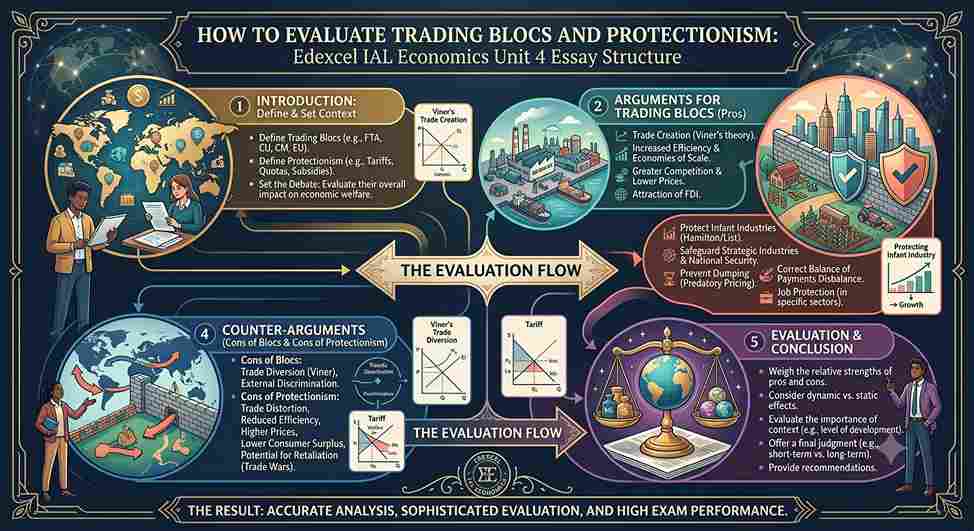
To consistently hit Level 4 and Level 5 criteria on a 25-mark essay, structure your response around this robust five-part framework:
Paragraph 1: Introduction (Definitions & Roadmap)
- Define key terms immediately (e.g., define customs union or tariff).
- Establish real-world context by mentioning a relevant global trade agreement or recent protectionist policy.
- Conclude with a clear, nuanced thesis statement outlining your main line of argument.
Paragraph 2: First Analytical Argument (Theory + Diagram + Application)
- Focus on the primary mechanism requested by the prompt (e.g., how joining a trading bloc increases intra-regional trade, or how a tariff creates deadweight loss).
- Draw and Explain a Diagram: For protectionism, draw a standard import tariff diagram showing world price, world price plus tariff, changes in consumer and producer surplus, and government revenue. For trading blocs, explain trade creation and trade diversion.
- Apply the theory to a real-world economy.
Paragraph 3: Counter-Analysis (The Flip Side)
- Introduce competing economic forces. If your second paragraph praised trading blocs for trade creation, dedicate this paragraph to analyzing trade diversion and the risk of turning into a "Fortress Europe" protectionist bloc.
- Use rigorous chains of reasoning to show how welfare gains can be partially or fully offset.
Paragraphs 4 & 5: Deep Evaluation (The Core of AO4)
Do not save evaluation for the last two sentences. Dedicate two full paragraphs to critical evaluation:
- The Elasticity Argument: Discuss how price elasticity of demand (PED) and supply (PES) dictate the actual impact of tariffs or trade agreements. (Inelastic demand means tariffs hit consumers hard with minimal reduction in imports).
- Short-Run vs. Long-Run Impacts: Evaluate whether protectionism provides temporary breathing room for an infant industry to achieve economies of scale, or whether it creates permanent dependency and X-inefficiency.
- Retaliation and Global Trade Wars: Analyze the macroeconomic risk of tit-for-tat tariff retaliations (referencing historical precedents like the Smoot-Hawley Tariff Act or modern US-China trade tensions) leading to global recessionary pressures.
Paragraph 6: Conclusion (Justified Final Judgment)
- Synthesize your preceding arguments without repeating them verbatim.
- Deliver a definitive, conditional judgment (e.g., "Ultimately, while trading blocs generate net welfare gains through trade creation, their net economic benefit depends heavily on whether their external trade barriers remain low enough to prevent severe trade diversion...").
Part 4: Top 4 Traps That Cost Edexcel Unit 4 Marks
- Descriptive Writing Without Economic Models: Writing an essay that reads like a political news article filled with opinions, lacking formal economic diagrams, cost-benefit analysis, and analytical frameworks.
- Neglecting Trade Diversion: Discussing trading blocs solely as forces of good while completely omitting trade diversion and welfare loss calculations. Top-tier essays always present both sides.
- Drawing Inaccurate Diagrams: Mislabeling axes (e.g., putting Quantity on the vertical axis and Price on the horizontal axis) or failing to shade deadweight loss triangles on tariff graphs.
- Weak or Missing Evaluation: Ending the essay abruptly after analysis without providing a balanced, weighted judgment that addresses the prompt's core question ("To what extent...?").
Preparing for Edexcel IAL Economics Unit 4 exams and aiming for an $A^$ grade? EdFlik connects international school students globally with expert, 1-to-1 online IAL economics tutors, helping you master essay structures, draw flawless economic models, and conquer past-paper past exam rubrics.*Book a Free Demo Class Today!
Frequently Asked Questions (FAQs)
Q1: How long should an Edexcel Unit 4 25-mark essay be?
Ans: While quality always trumps quantity, top-scoring students typically write between 3 to 4 pages (roughly 600 to 800 words) in exam conditions, ensuring every paragraph contains tight, analytical economic reasoning and application.
Q2: Are economic diagrams mandatory in Unit 4 essays?
Ans: While not explicitly forced by every single question, drawing, labeling, and accurately explaining relevant economic diagrams (such as tariff welfare loss, AD/AS shifts, or exchange rate models) is essential for accessing Level 4 and Level 5 marks.
Q3: What is the difference between a free trade area and a customs union?
Ans: In a Free Trade Area, member states eliminate tariffs between each other but keep their own separate tariff rates against non-members. In a Customs Union, members not only trade freely with each other but also adopt a Common External Tariff (CET) against all non-members.
Q4: How does EdFlik support Edexcel IAL Economics students?
Ans: EdFlik connects international school students worldwide with vetted, expert 1-to-1 online tutors specializing in Pearson Edexcel IAL Economics (Units 1–4). Our personalized coaching focuses on structuring 25-mark essays, mastering macroeconomic theory, and practicing under timed exam conditions.