How to Get into Medicine from UAE 2026 — A-Level, IB, UCAT and UK University Application Guide
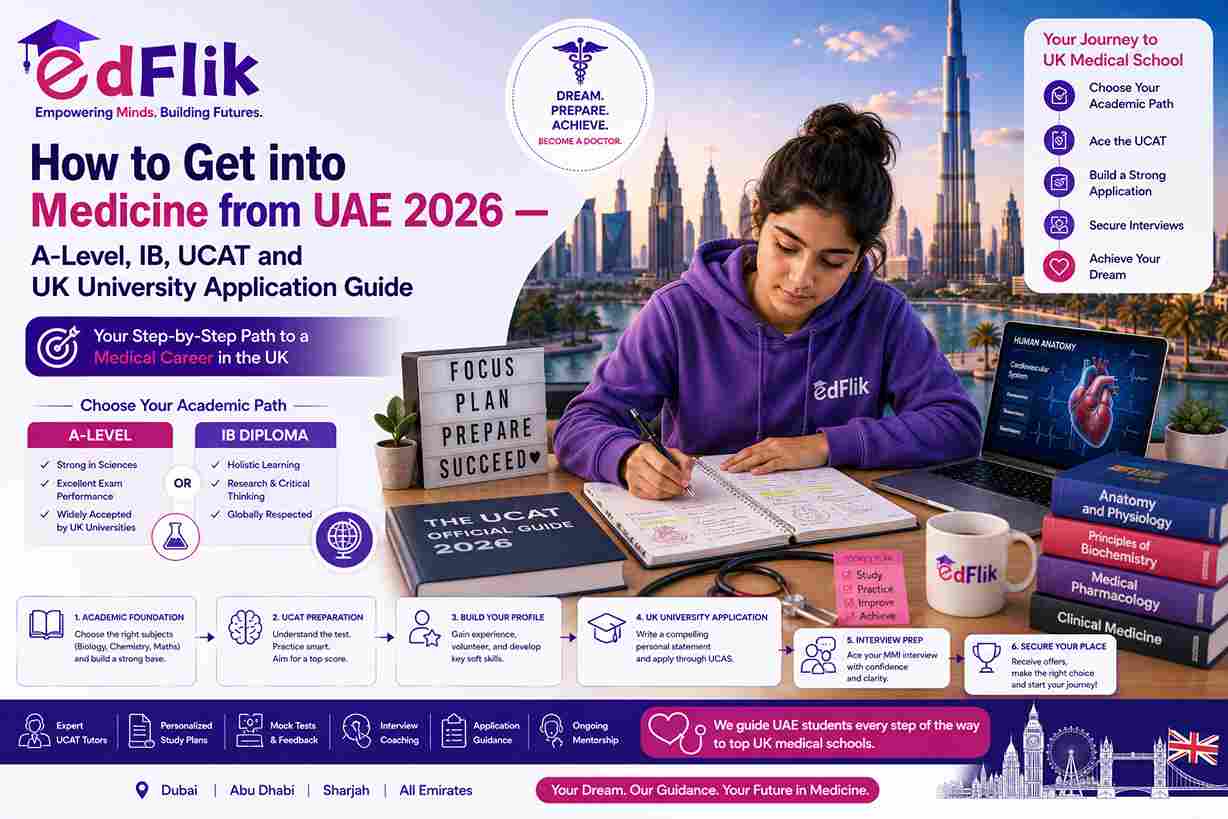
Medicine is the most applied-for university course from UAE international schools — and the most demanding application pathway. The combination of specific A-Level or IB Diploma subject requirements, the UCAT admissions test, healthcare work experience, a compelling UCAS personal statement, and potential Medical School Interview preparation means that Medicine applications require the longest lead time and the most coordinated academic support of any UAE school-to-university pathway. This guide covers every component of the Medicine application from UAE.
UK Medicine Application — The Complete Timeline for UAE Students
|
When |
Action |
Notes for UAE
Students |
|
Year 10-11
(IGCSE) |
Secure strong
grades in Sciences — Chemistry and Biology particularly |
IGCSE
Chemistry A* and Biology A* are expected by top UK medical schools; lower
grades here create a difficult trajectory |
|
Year 12 / IB
Year 1 |
Choose
Chemistry and Biology as two of three A-Levels (or Chemistry HL and Biology
HL for IB); begin healthcare work experience |
Work
experience: arrange UAE hospital/clinic shadowing in summer after Year 12 —
most UAE hospital placements require advance arrangement 2-3 months ahead |
|
Year 12 summer |
Begin UCAT
preparation; arrange work experience |
UCAT
registration opens July 1; book early as Dubai/Abu Dhabi test dates fill
quickly; at least 6-8 weeks dedicated UCAT preparation |
|
Early Year 13
/ IB Year 2 |
Complete UCAT
test (July-September); refine university list based on UCAT score; write UCAS
personal statement first draft |
Personal
statement: 4,000 characters; must demonstrate insight from work experience,
academic motivation, and awareness of what Medicine involves |
|
October 15 |
UCAS
application deadline for all UK Medicine applications (hard deadline — no
extensions) |
This is the
same deadline as Oxbridge; all Medicine applications to any UK university
must be submitted by October 15 |
|
November-January |
Medical school
interviews — in-person or MMI format |
Many UAE
students travel to the UK for interviews; some schools now offer virtual
interview options; MMI preparation typically 4-6 weeks |
|
March-May |
Receive
medical school offers (conditional or unconditional) |
Most offers
are conditional on A-Level or IB results; conditional offers typically A*AA
(A-Level) or 38-40 points (IB) |
|
August |
A-Level
results / IB results; confirm place |
IB results in
July; A-Level results in August; accept confirmed place if conditions met;
enter Adjustment or Clearing if conditions not met |
The UCAS Personal Statement for Medicine — What UAE Students Must Include
The UCAS Medicine personal statement (4,000 characters, one statement for all five university choices) must address four elements. UK medical schools are experienced at spotting generic personal statements — the most effective ones are specific:
• Why Medicine specifically (not just helping people): A reflection on what the work experience revealed about what practicing medicine involves — the intellectual challenge of diagnosis, the communication skill required, the team dynamics of healthcare. "I want to help people" is not sufficient at any medical school.
• What the work experience showed: Named setting, what you observed, what it revealed about medicine, what you were surprised by. One well-described week of UAE hospital shadowing is more compelling than a list of five brief experiences.
• Academic engagement: Evidence that you have engaged with medical or scientific topics beyond the school syllabus — reading (British Medical Journal, Lancet articles), courses (Coursera healthcare courses), relevant EPQ research.
• Extracurricular achievement and personal qualities: Leadership, resilience, teamwork, communication — demonstrated through specific activities. These show the qualities a good doctor requires.
Multiple Mini Interview (MMI) — What UAE Medicine Applicants Face
Many UK medical schools use the MMI (Multiple Mini Interview) format — a series of 6-10 short stations (5-8 minutes each) assessing different competencies rather than one traditional interview. UAE students who have not encountered MMI before find the format initially disorienting. MMI stations typically include: ethical scenario discussion (end of life care, resource allocation, clinical confidentiality); role play (breaking bad news to a simulated patient); data interpretation; current NHS issue discussion; personal statement probe; empathy demonstration. MMI preparation requires specific practice with mock stations — not general interview skills.
|
EdFlik
supports UAE Medicine applicants across the full pathway — IGCSE Science
grades (Years 10-11), A-Level Chemistry and Biology (Years 12-13), UCAT
preparation (July-September Year 13), UCAS personal statement review, and MMI
preparation. From AED 70 per session. Free consultation. Book at
www.edflik.com or WhatsApp +91 88788 96600. |
Frequently Asked Questions
Q: What qualifications do UAE students need to study Medicine in the UK?
A-Level: Chemistry (essential), Biology (required by most), third A-Level A grade — typical offer A*AA or AAA. IB: Chemistry HL (essential), Biology HL (required by most) — typical offer 38-40 points with HL 7,6,6. UCAT required by 30+ UK medical schools. Work experience in a healthcare setting required for personal statement.
Q: Which UAE schools have the best record of getting students into UK Medicine?
Dubai College (strongest placement including Oxbridge Medicine), Repton Dubai, Brighton College Dubai, GEMS Wellington International School (IB route), NLCS Dubai (IB route), Cranleigh Abu Dhabi. Ask each school for specific Medicine placement data (number of applicants vs offers, which medical schools).
Q: Is it easier to get into Medicine via A-Level or IB from UAE?
Neither is definitively easier — medical schools treat both equally. A-Level offers are specific and predictable (A*AA). IB Diploma is valued for breadth but demanding (38-40 points with HL 7,6,6). The most important factor is academic strength within the chosen route, not the route itself.
Q: What work experience do UAE students need for UK Medicine applications?
In-person observation in a healthcare setting — UAE hospitals, clinics, care homes, pharmacies. Arrange 2-3 months in advance. Cleveland Clinic Abu Dhabi, American Hospital Dubai, Mediclinic well-known to UK admissions teams. Personal statement must reflect specifically on what was observed, not just that it was done. Virtual experience acceptable as supplement only.
Q: Can UAE students get into Medicine in the UAE instead of the UK?
MBRU Dubai, UAEU Al Ain, Gulf Medical University Ajman, and RAKCOMS are UAE options. UAEU prioritises UAE nationals. International places limited. UAE medical degrees are accredited but UK GMC registration may require additional steps for UAE-trained graduates. Most UAE families targeting top Medicine prefer UK schools for international registration flexibility.