How to Master Trapezoidal Rule and Sigma Notation in Edexcel IAL Pure Math 2
Last Updated: October 2026 | By EdFlik Education Team
For international high school students completing the Edexcel International Advanced Level (IAL) Mathematics qualification, Pure Mathematics 2 (P2) is a crucial module that bridges foundational algebra with advanced calculus and series. Among the topics that frequently appear on P2 exam papers—and regularly cause students to lose easy marks—are numerical integration via the Trapezoidal Rule (Trapezium Rule) and series summation using Sigma Notation ($\sum$).
While these two topics may initially appear unrelated, they share a common mathematical demand: absolute precision in sequence generation, meticulous boundary value evaluation, and structured algebraic execution under timed exam conditions.
In this comprehensive, exam-focused masterclass guide, our expert Edexcel IAL math tutors break down the core formulas, expose the most common exam traps set by Pearson Edexcel examiners, and provide step-by-step frameworks to help you score full marks on P2.
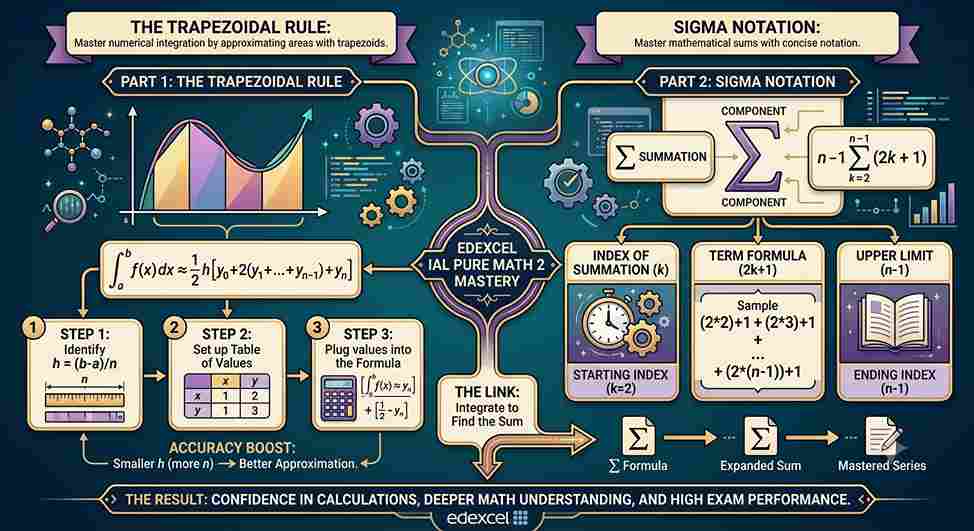
Part 1: Mastering the Trapezoidal Rule in Edexcel IAL P2
The Trapezoidal Rule is a numerical method used to estimate the area under a curve $y = f(x)$ between two boundaries, $x = a$ and $x = b$, when exact integration is either difficult or impossible.
The Edexcel P2 Trapezoidal Rule Formula
As provided in the official Pearson Edexcel IAL Formula Booklet:
$$\int_{a}^{b} y \, dx \approx \frac{1}{2}h \left[ (y_0 + y_n) + 2(y_1 + y_2 + \dots + y_{n-1}) \right]$$
Where:
- $h$ (Strip Width / Interval Step): Calculated as $h = \frac{b - a}{n}$
- $n$: The number of strips (trapeziums).
- $y_0, y_n$: The first and last ordinates (end values).
- $y_1, y_2, \dots, y_{n-1}$: The intermediate ordinates (middle values).
Step-by-Step Execution Framework for Trapezoidal Rule Questions
To guarantee full marks on a 5-to-6 mark Trapezoidal Rule question, follow this exact four-step workflow:
Step 1: Calculate $h$ and List All $x$-Values
Identify the lower limit $a$, upper limit $b$, and the requested number of strips $n$ or ordinates ($n + 1$).
- Critical Rule: Number of Ordinates = Number of Strips + 1. If the question asks for 4 strips, you will have 5 $x$-values ($x_0, x_1, x_2, x_3, x_4$).
Step 2: Construct an Ordinate Table
Draw a neat table listing every $x_i$ value alongside its corresponding $y_i$ value evaluated using your function $y = f(x)$.
- Calculator Tip: Store intermediate $y$-values in your scientific or graphic calculator to at least 4 or 5 decimal places (or exact surd/fraction form). Rounding too early in the table is the number one cause of lost accuracy marks on Edexcel P2 mark schemes!
Step 3: Apply the Formula Structure
Group your ordinates clearly into End Values and Middle Values:
$$\text{Area} \approx \frac{1}{2}h \times \left[ (\text{First} + \text{Last}) + 2 \times (\text{Sum of All Middle Values}) \right]$$
Step 4: Determine Overestimate vs. Underestimate
Edexcel P2 exams frequently end with a 1-mark qualitative question asking: "State, with a reason, whether your answer in part (a) is an overestimate or an underestimate of the true area."
- Concave Up Curve ($\cup$-shape): The secant lines of the trapeziums lie above the curve, resulting in an overestimate.
- Concave Down Curve ($\cap$-shape): The secant lines lie below the curve, resulting in an underestimate.
Part 2: Demystifying Sigma Notation ($\sum$) in P2 Series
Sigma notation ($\sum$) is simply a compact shorthand notation for adding together terms in a sequence. In Edexcel IAL P2, sigma notation questions test your ability to recognize and evaluate both Arithmetic Progressions (AP) and Geometric Progressions (GP).
Decoding the Sigma Syntax:
$$\sum_{r=k}^{n} f(r) = f(k) + f(k+1) + f(k+2) + \dots + f(n)$$
- Bottom Limit ($r = k$): The starting term index.
- Top Limit ($n$): The ending term index.
- Number of Terms ($N$): Calculated as $N = \text{Top Limit} - \text{Bottom Limit} + 1$.
- The Trap: Students often think $\sum_{r=1}^{10}$ has 10 terms and $\sum_{r=3}^{10}$ has $10 - 3 = 7$ terms. In reality, $\sum_{r=3}^{10}$ has $10 - 3 + 1 = 8$ terms! Always add 1.
How to Identify Series Types from Sigma Expressions
When given a sigma expression like $\sum_{r=1}^{20} (3r + 5)$ or $\sum_{r=1}^{12} 4 \times 2^r$, do not attempt to write out all terms manually. Identify the underlying series model:
1. Arithmetic Progression (Linear Inside Sigma)
If $f(r)$ is a linear expression in terms of $r$ (e.g., $f(r) = 3r + 5$), the series is Arithmetic.
- First term $a = f(\text{bottom limit})$.
- Common difference $d =$ coefficient of $r$.
- Use the AP Sum Formula: $S_N = \frac{N}{2} [2a + (N - 1)d]$ or $S_N = \frac{N}{2} (a + L)$, where $L$ is the last term $f(\text{top limit})$.
2. Geometric Progression (Exponential Inside Sigma)
If $f(r)$ has $r$ in the exponent (e.g., $f(r) = 4 \times 3^r$), the series is Geometric.
- First term $a = f(\text{bottom limit})$.
- Common ratio $r =$ the exponential base.
- Use the GP Sum Formula: $S_N = \frac{a(1 - r^N)}{1 - r}$ or $S_N = \frac{a(r^N - 1)}{r - 1}$.
Part 3: Top 4 Traps That Cost Students Marks in Edexcel P2
- Confusing Strips and Ordinates: Using $n = 5$ in the step size formula $h = \frac{b - a}{n}$ when the question gives 5 ordinates instead of 5 strips. Remember: $n$ is always the number of strips ($n = \text{ordinates} - 1$).
- Premature Rounding Errors: Rounding $y$-values to 2 decimal places inside the Trapezoidal Rule table. Edexcel mark schemes explicitly penalize answers that differ due to intermediate rounding. Keep at least 4 decimal places throughout your working.
- Incorrect Term Count in Sigma Notation: Calculating $N = \text{top} - \text{bottom}$ without adding 1 when the sum starts at $r > 1$ (e.g., $\sum_{r=5}^{25}$).
- Radians vs. Degrees Mode: Evaluating trigonometric functions in the Trapezoidal Rule (e.g., $y = \sin x$ or $y = \cos^2 x$) while your calculator is set to Degrees instead of Radians. Unless explicitly stated in degrees ($^\circ$), all calculus and numerical integration in Edexcel P2 must be performed in Radians.
Preparing for Edexcel IAL Pure Math 2 exams and aiming for an A grade? EdFlik connects international school students globally with expert, 1-to-1 online IAL math tutors, helping you master calculus, series, trigonometry, and past-paper exam strategies.* Book a Free Demo Class Today!
Frequently Asked Questions (FAQs)
Q1: How can I increase the accuracy of a Trapezoidal Rule estimate?
Ans: To make the Trapezoidal Rule estimate closer to the exact area under the curve, you must increase the number of strips ($n$) (which decreases the strip width $h$). As $n \to \infty$, the trapezoidal estimate approaches the exact definite integral.
Q2: Can I use the definite integral button on my calculator to check my Trapezoidal Rule answer?
Ans: Yes! You can and should use your scientific calculator’s numerical integration key ($\int_{a}^{b}$) to check the exact value of the area. However, you must show full manual working using the Trapezoidal Rule formula to earn full marks on the exam paper.
Q3: What should I do if a Sigma summation problem starts at $r = 0$?
Ans: If the lower limit is $r = 0$, evaluate the first term at $r = 0$. The total number of terms $N$ will be $\text{Top Limit} - 0 + 1 = \text{Top Limit} + 1$.
Q4: How does EdFlik support Edexcel IAL Mathematics students?
Ans: EdFlik connects international school students worldwide with vetted, expert 1-to-1 online tutors specializing in Pearson Edexcel IAL Pure Math (P1–P4), Mechanics (M1–M3), and Statistics (S1–S3). Our personalized sessions focus on clarifying complex algebraic concepts, practicing past-paper questions, and mastering exam technique.