How to Prepare Budgeting Statements and Variance Analysis for Edexcel IAL Accounting
Last Updated: October 2026 | By EdFlik Education Team
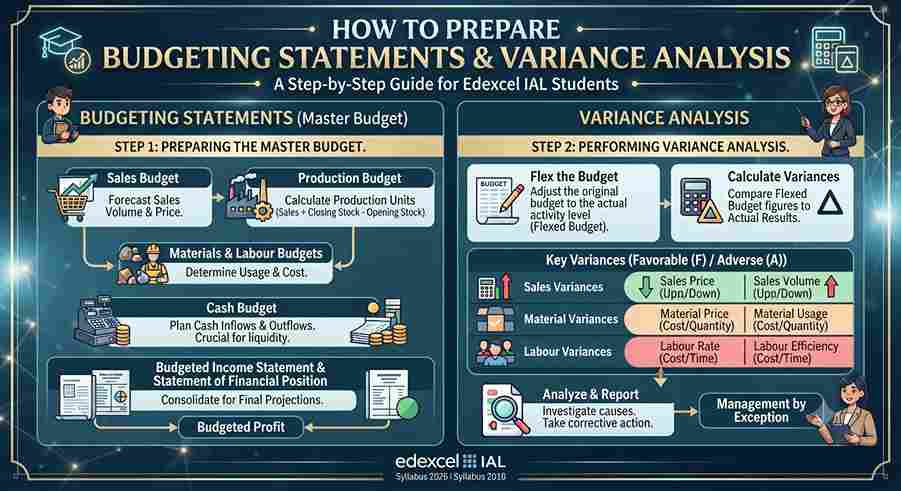
For students studying Pearson Edexcel International Advanced Level (IAL) Accounting, quantitative decision-making, planning, and control form the backbone of the higher-level curriculum. Whether you are analyzing cash flows in Unit 3 or mastering standard costing and budgetary control in Unit 4, examiners consistently test your ability to construct cash budgets, calculate complex material and labour variances, and evaluate operational performance.
Many students struggle with accounting budgeting and variances not because the arithmetic is overly complex, but because they mix up standard formulas, confuse favorable and adverse variances, or fail to follow systematic layout structures in exam answers.
In this comprehensive, exam-focused masterclass guide, our expert accounting educators break down the preparation of budgeting statements, demystify variance analysis formulas, and provide structured problem-solving frameworks to help you secure a top grade $A$ or $A^*$.
Part 1: The Foundation of Budgetary Control
Before constructing statements, you must understand what a budget is and why businesses use budgetary control systems.
- Budget: A quantitative financial plan for a future period of time, outlining expected revenues, costs, cash inflows, and cash outflows.
- Budgetary Control: The continuous comparison of actual financial results against budgeted targets to monitor performance, identify deviations, and implement corrective managerial action.
Part 2: Preparing Cash Budgets Step-by-Step
A cash budget tracks the timing of cash receipts and cash payments to ensure a business maintains adequate liquidity. The golden rule of cash budgeting is that non-cash items (such as depreciation and provisions for bad debts) are strictly excluded, and cash is recorded only when it actually changes hands.
Step-by-Step Construction Framework:
- Establish Time Periods: Set out columns for consecutive months or quarters (e.g., January, February, March).
- Calculate Cash Inflows (Receipts):
- Cash sales.
- Trade receivables (debtors) collections based on credit terms (e.g., 60% in the month of sale, 40% in the following month).
- Capital injections or loan proceeds.
- Calculate Cash Outflows (Payments):
- Cash purchases.
- Trade payables (creditors) payments based on credit terms granted by suppliers.
- Operating expenses (rent, wages, electricity, insurance) paid in the month incurred.
- Capital expenditures (machinery purchases, dividends).
- Determine Net Cash Flow and Bank Balances:
- $\text{Net Cash Flow} = \text{Total Receipts} - \text{Total Payments}$
- $\text{Closing Bank Balance} = \text{Opening Bank Balance} + \text{Net Cash Flow}$
- The closing balance of one month automatically becomes the opening balance of the next month.
Part 3: Introduction to Variance Analysis
Once a budget period concludes, actual results are compared with budgeted targets. Any difference is known as a variance.
- Favorable Variance (F): Occurs when actual performance is better than budgeted (e.g., actual revenue is higher than budgeted, or actual costs are lower than budgeted).
- Adverse Variance (A): Occurs when actual performance is worse than budgeted (e.g., actual costs exceed budget, or actual revenue falls short).
Part 4: Standard Costing and Variance Formulas
Edexcel IAL Accounting places heavy emphasis on calculating specific operational variances for materials and labour. Memorize these standard formulas:
1. Direct Material Variances
- Direct Material Total Cost Variance:$$\text{Standard Cost of Actual Output} - \text{Actual Cost Incurred}$$
- Direct Material Price Variance: Measures the financial impact of paying a higher or lower price per unit of material than budgeted.$$\text{Material Price Variance} = (\text{Standard Price} - \text{Actual Price}) \times \text{Actual Quantity Purchased (or Used)}$$
- Direct Material Usage Variance: Measures the financial impact of using more or fewer material units than expected for the actual output produced.$$\text{Material Usage Variance} = (\text{Standard Quantity for Actual Output} - \text{Actual Quantity Used}) \times \text{Standard Price}$$(Note: Price Variance + Usage Variance = Total Material Cost Variance).
2. Direct Labour Variances
- Direct Labour Total Cost Variance:$$\text{Standard Labour Cost for Actual Output} - \text{Actual Labour Cost Incurred}$$
- Direct Labour Rate Variance: Measures the impact of paying a higher or lower hourly wage rate than budgeted.$$\text{Labour Rate Variance} = (\text{Standard Rate per Hour} - \text{Actual Rate per Hour}) \times \text{Actual Hours Worked}$$
- Direct Labour Efficiency Variance: Measures the impact of workers taking more or fewer hours to produce output than standard time allowed.$$\text{Labour Efficiency Variance} = (\text{Standard Hours for Actual Output} - \text{Actual Hours Worked}) \times \text{Standard Rate per Hour}$$
Part 5: Top 4 Exam Traps That Cost Edexcel IAL Accounting Marks
- Including Non-Cash Items in Cash Budgets: Including depreciation of non-current assets or provisions for doubtful debts in a cash budget. Remember: cash budgets only record actual cash movements!
- Mixing Up Favorable and Adverse Labels: Failing to clearly label final variances with an (F) or (A). A correct numerical answer without the proper directional label loses half the available marks.
- Confusing Purchased Quantity vs. Used Quantity in Material Variances: Using material purchased quantity when the formula or question specifically requires material used quantity for price and usage reconciliations. Read question data carefully.
- Inverting Standard Minus Actual in Formulas: Subtracting actual from standard incorrectly, which leads to sign errors and inverted Favorable/Adverse conclusions. Always remember: for costs, Standard is what it should cost; if Actual is higher, it is Adverse.
Preparing for Pearson Edexcel IAL Accounting examinations? EdFlik connects international school students globally with expert, 1-to-1 online accounting tutors, helping you master budgeting statements, variance calculations, and past-paper mark schemes to secure top grade $A^$ results.*Book a Free Demo Class Today!
Frequently Asked Questions (FAQs)
Q1: What is the difference between a flexible budget and a fixed budget?
Ans: A fixed budget is prepared for a single, pre-determined volume of activity and is never adjusted for actual production levels. A flexible budget is adjusted to reflect the actual level of output achieved, making it a much fairer benchmark for evaluating cost variances.
Q2: How do trade credit terms affect cash budget timing?
Ans: Trade credit terms dictate when cash actually changes hands. If a customer is granted 30-day credit, sales made in January will only appear as a cash inflow in February's cash budget column.
Q3: Why must direct material price and usage variances always reconcile with the total material cost variance?
Ans: Because total variance is broken down into its two root causes: price fluctuation and quantity efficiency. Their sum must equal the net variance between total standard cost and total actual cost.
Q4: How does EdFlik support Edexcel IAL Accounting students?
Ans: EdFlik connects international school students worldwide with vetted, expert 1-to-1 online accounting tutors specializing in Pearson Edexcel International A-Level specifications. Our personalized sessions focus on solving complex financial statements, breaking down variance formulas, and exam technique.