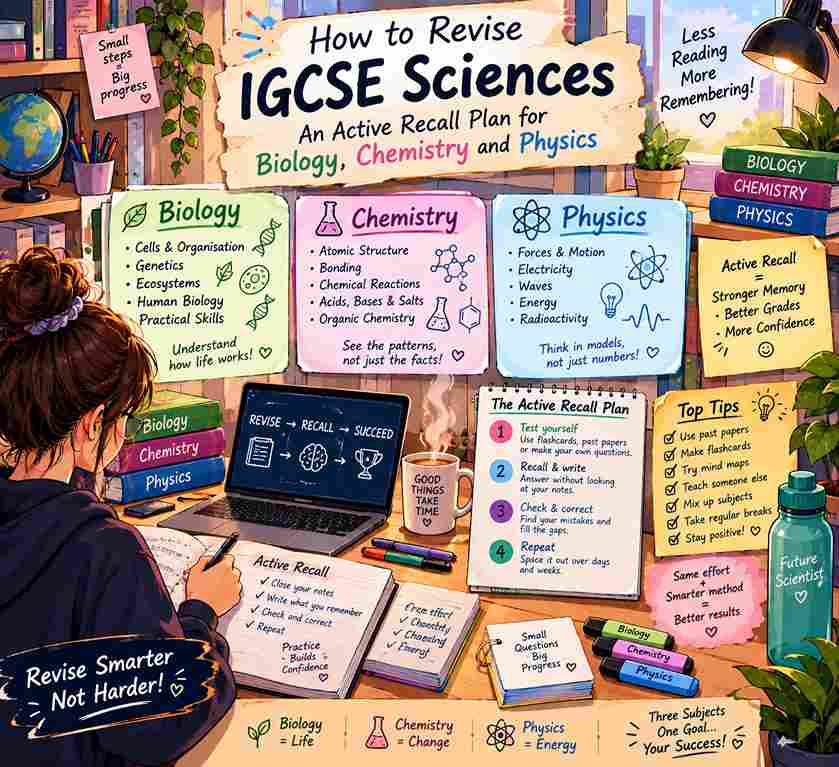
How to Revise IGCSE Sciences: An Active Recall Plan for Biology, Chemistry and Physics
Last updated: November 2026 | By EdFlik Education Team
Most students revise by rereading notes and highlighting. It feels productive, but research in cognitive psychology consistently finds that retrieving information from memory, and spacing practice over time, leads to better long-term retention than rereading. This guide turns that into a practical plan for IGCSE sciences.
Principle 1: retrieve, do not reread
- Close the book and write everything you remember about a topic, then check and correct.
- Use flash cards: a question on the front, a short answer on the back.
- Turn headings in your notes into questions ("Why does a catalyst increase the rate?") and answer them aloud.
- Explain a topic to someone else without notes.
Principle 2: space it out
Review a topic soon after learning it, then again after a few days, then after a week or two. Short, repeated sessions beat one long session.
Review |
When |
First |
Same day |
Second |
After 2–3 days |
Third |
After about a week |
Fourth |
After 2–3 weeks, then before the mock |
Principle 3: practise the exam, not just the content
- Answer exam-style questions by topic first, then full papers.
- Mark with the mark scheme and note exactly which marking point you missed.
- Redo wrong questions a week later.
- Practise calculations until the steps are automatic: moles, equations, half-life.
Build a topic checklist
Take your board's specification and list every topic for each science. Rate each one red, amber or green. Revise red topics first. Re-rate after each session so you can see progress.
Science |
High-value areas to check |
Biology |
Enzymes, transport, respiration and photosynthesis, genetics, ecology, six-mark answers |
Chemistry |
Moles, electrolysis, rates, organic chemistry, salts and tests |
Physics |
Equations and units, circuits, waves, radioactivity, energy |
A weekly plan
Day |
Task (about 45–60 minutes) |
Mon |
Biology: 20 minutes of flash cards, then 15 questions on one topic |
Tue |
Chemistry: one calculation set and mark it |
Wed |
Physics: equations and one circuit or waves set |
Thu |
Weakest topic: relearn, then test yourself |
Fri |
Mixed retrieval quiz across all three sciences |
Sat |
One timed paper or half paper, then mark it |
Sun |
Rest, or 20 minutes redoing last week's errors |
Common mistakes
- Colour-coding notes for hours without testing yourself.
- Starting past papers before covering the content, then feeling discouraged.
- Only revising favourite topics.
- Skipping sleep before an exam. Memory consolidation depends on it.
How a tutor can help
A tutor is most useful for diagnosing why marks are lost, explaining difficult topics, and giving feedback on written answers. EdFlik matches students with teachers who know their board and subject, and the IGCSE practice platform covers Cambridge and Edexcel for all years.
Frequently asked questions
Q: What is active recall?
Testing yourself by retrieving information from memory, for example with flash cards or practice questions, instead of rereading.
Q: How long should I revise each day?
Consistent sessions of 45–60 minutes with breaks usually work better than long, irregular sessions. Adjust to your timetable.
Q: When should I start past papers?
Once you have covered most of the content, begin with topic questions, then move to timed papers.
Q: Is it better to revise one subject at a time or mix?
Mixing topics in a session (interleaving) helps retention. Many students combine a focus topic with a short mixed quiz.
Try a free trial class with EdFlik. Live 1:1 IGCSE tutoring for Cambridge and Edexcel students in the UAE, matched to your child's board, subject and year group. Book at edflik.com or message us on WhatsApp. |
Related reading
- IGCSE Maths 8-Week Mock Revision Plan
- IGCSE Science Papers: Cambridge vs Edexcel
- IGCSE Practice Questions Online
Sources
- Cognitive psychology research on retrieval practice and spaced learning (for example, studies by Roediger and Karpicke)
- Cambridge International and Pearson Edexcel specifications for topic lists