
How to Solve Stress, Strain, and Young's Modulus Calculations in Cambridge AS Physics
Last Updated: October 2026 | By EdFlik Education Team
For high school students completing Cambridge International AS & A Level Physics (9702), Deformation of Solids (Topic 7) is one of the core mechanical domains tested across Paper 1 (Multiple Choice) and Paper 2 (AS Level Structured Questions). Among the key concepts in this topic, calculating Tensile Stress, Tensile Strain, and the Young Modulus represents a fundamental mathematical skill that routinely accounts for 6 to 10 marks per exam series.
Whether calculating the extension of a loaded steel cable, determining the strain energy stored in a stretched wire, or interpreting a stress-strain graph up to the ultimate tensile strength, CIE examiners design calculation tasks specifically to test unit conversions, area derivations, and numerical precision.
In this comprehensive, exam-focused masterclass guide, our expert Cambridge A-Level physics educators break down the core equations, step-by-step problem-solving frameworks, common conversion traps, and graphical interpretation techniques to help you secure an $A^*$ grade.
Part 1: Core Definitions and Equations
Before solving calculation tasks, you must master the precise physical definitions and algebraic relationships mandated by the Cambridge 9702 syllabus.
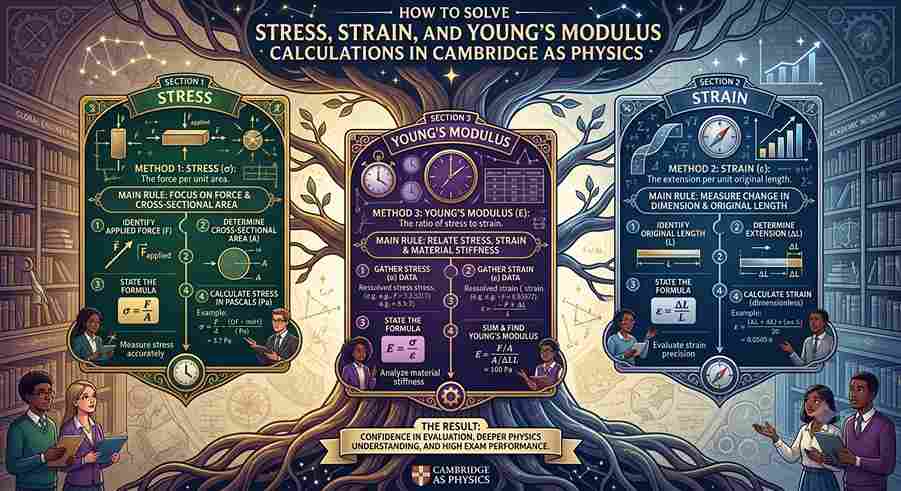
                   MECHANICAL DEFORMATION OF SOLIDS
                                   |
      +----------------------------+----------------------------+
      |                            |                            |
TENSILE STRESS ($\sigma$)     TENSILE STRAIN ($\epsilon$)    YOUNG MODULUS ($E$)
• Force per unit cross-       • Fractional extension        • Ratio of Stress to
  sectional area               ($\Delta L / L$)               Strain ($\sigma / \epsilon$)
• Units: $\text{Pa}$ or $\text{N m}^{-2}$ • Dimensionless (No units) • Units: $\text{Pa}$ or $\text{N m}^{-2}$
1. Tensile Stress ($\sigma$)
Tensile Stress is defined as the force applied per unit cross-sectional area of a material. It measures the intensity of internal restoring forces resisting deformation.
$$\text{Stress } (\sigma) = \frac{\text{Force } (F)}{\text{Cross-Sectional Area } (A)}$$
- Force ($F$): Measured in Newtons ($\text{N}$). If a mass $m$ is hung vertically from a wire, $F = mg$ (where $g = 9.81 \text{ m s}^{-2}$).
- Cross-Sectional Area ($A$): Measured in square meters ($\text{m}^2$). For a circular wire of diameter $d$ or radius $r$:$$A = \pi r^2 = \pi \left(\frac{d}{2}\right)^2 = \frac{\pi d^2}{4}$$
- SI Units for Stress: Pascals ($\text{Pa}$) or Newtons per square meter ($\text{N m}^{-2}$). ($1 \text{ Pa} = 1 \text{ N m}^{-2}$).
2. Tensile Strain ($\epsilon$)
Tensile Strain is defined as the extension per unit original length of a material. It measures the proportional deformation produced by stress.
$$\text{Strain } (\epsilon) = \frac{\text{Extension } (e \text{ or } \Delta L)}{\text{Original Length } (L)}$$
- Extension ($e$): Change in length ($\Delta L = L_{\text{final}} - L_{\text{original}}$), measured in meters ($\text{m}$).
- Original Length ($L$): Unstretched length, measured in meters ($\text{m}$).
- SI Units for Strain: Dimensionless! Strain has no units because it is a ratio of two lengths ($\text{m} / \text{m}$). It can also be expressed as a percentage ($\epsilon \times 100\%$).
3. The Young Modulus ($E$)
The Young Modulus ($E$) is a fundamental material property that measures the stiffness of a solid within its Hooke's Law (elastic) limit. It is defined as the ratio of tensile stress to tensile strain.
$$E = \frac{\text{Tensile Stress } (\sigma)}{\text{Tensile Strain } (\epsilon)} = \frac{\frac{F}{A}}{\frac{e}{L}} = \frac{F \cdot L}{A \cdot e}$$
- SI Units for Young Modulus: Pascals ($\text{Pa}$) or Newtons per square meter ($\text{N m}^{-2}$). Typical metals have Young Modulus values in the Gigapascals range ($1 \text{ GPa} = 10^9 \text{ Pa}$).
Part 2: Step-by-Step Problem-Solving Framework for Cambridge Papers
When solving multi-part stress, strain, and Young Modulus calculation tasks on CIE Paper 2, execute this 4-step workflow:
                  THE 4-STEP CALCULATION WORKFLOW
                                 |
  Step 1: Standardize Units  ---> Convert mm to m, mm² to m², and GPa to Pa
  Step 2: Derive Area (A)    ---> Calculate A = πd²/4 from wire diameter
  Step 3: Apply Young Ratio  ---> Substitute values into E = (F · L) / (A · e)
  Step 4: Verify Precision   ---> Match 2 or 3 significant figures (g = 9.81 m s⁻²)
Worked Exam Example:
A steel wire of original length $2.50 \text{ m}$ and diameter $0.80 \text{ mm}$ is suspended vertically. A mass of $12.0 \text{ kg}$ is attached to its lower end. The Young Modulus of steel is $2.0 \times 10^{11} \text{ Pa}$. Calculate:
- The stress in the wire.
- The extension of the wire.
Step 1: Convert All Values to Standard SI Units
- Original Length ($L$) = $2.50 \text{ m}$
- Diameter ($d$) = $0.80 \text{ mm} = 0.80 \times 10^{-3} \text{ m}$
- Tension Force ($F = mg$) = $12.0 \text{ kg} \times 9.81 \text{ m s}^{-2} = 117.72 \text{ N}$
- Young Modulus ($E$) = $2.0 \times 10^{11} \text{ Pa}$
Step 2: Calculate Cross-Sectional Area ($A$)
$$A = \frac{\pi d^2}{4} = \frac{\pi (0.80 \times 10^{-3})^2}{4} = 5.0265 \times 10^{-7} \text{ m}^2$$
Step 3: Calculate Stress ($\sigma$)
$$\sigma = \frac{F}{A} = \frac{117.72 \text{ N}}{5.0265 \times 10^{-7} \text{ m}^2} = 2.342 \times 10^8 \text{ Pa} = 2.34 \times 10^8 \text{ Pa} \quad \text{(3 s.f.)}$$
Step 4: Calculate Extension ($e$)
Rearrange $E = \frac{\sigma}{\epsilon} = \frac{\sigma}{e / L} \implies e = \frac{\sigma \cdot L}{E}$:
$$e = \frac{(2.342 \times 10^8 \text{ Pa}) \times 2.50 \text{ m}}{2.0 \times 10^{11} \text{ Pa}} = 2.93 \times 10^{-3} \text{ m} = 2.93 \text{ mm}$$
Part 3: Stress-Strain Graphs and Strain Energy
Cambridge papers frequently test graphical analysis of deformation.
       Stress (σ)
           ^                                         Ultimate Tensile Strength
           |                                       . - - * (Fracture)
           |                                    . '
           |                                 . '
           |        Limit of Proportionality (P)
           |               * - - - Elastic Limit (E)
           |             . '
           |           . '
           |         . '   <--- Gradient = Young Modulus (E)
           |       . '
           |     . '
           +----*---------------------------------------------> Strain (ε)
               0
Key Graphical Features:
- Gradient of Stress-Strain Graph: The gradient of the initial linear region equals the Young Modulus ($E$).
- Limit of Proportionality ($P$): The point beyond which stress is no longer directly proportional to strain (Hooke's Law breaks down).
- Elastic Limit ($E$): The point beyond which the material undergoes permanent plastic deformation and will not return to its original length when unloaded.
- Area Under Force-Extension Graph: The area under a Force vs. Extension ($F$-$e$) graph equals the Work Done / Strain Energy ($W$):$$W = \frac{1}{2} F e = \frac{1}{2} k e^2$$
- Area Under Stress-Strain Graph: Represents the Strain Energy per unit volume ($\text{J m}^{-3}$).
Part 4: Top 4 Traps That Cost Students Marks in Cambridge AS Physics
- Unit Conversion Errors for Area ($\text{mm}^2$ to $\text{m}^2$): Incorrectly converting area by multiplying by $10^{-3}$ instead of $10^{-6}$! (Remember: $1 \text{ mm} = 10^{-3} \text{ m} \implies 1 \text{ mm}^2 = (10^{-3})^2 \text{ m}^2 = 10^{-6} \text{ m}^2$).
- Confusing Radius and Diameter in Area Formulas: Plugging diameter directly into $A = \pi r^2$ without dividing by 2. Always use $A = \frac{\pi d^2}{4}$ to prevent radius/diameter confusion!
- Assuming Young Modulus Changes with Wire Length or Diameter: Claiming that doubling the length or thickness of a wire changes its Young Modulus. The Young Modulus is an intrinsic material property (steel has the same $E$ whether it's a thin needle or a thick bridge cable).
- Using $g = 9.8$ or $g = 10$ Instead of $9.81\text{ m s}^{-2}$: In Cambridge International AS & A Level Physics (9702), the value of acceleration due to gravity is explicitly $g = 9.81 \text{ m s}^{-2}$. Using $9.8$ or $10$ will result in small numerical discrepancies penalized by mark schemes.
Preparing for Cambridge AS Physics exams and aiming for an $A^$ grade? EdFlik connects international school students globally with expert, 1-to-1 online A-Level physics tutors, helping you master deformation of solids, waves, electricity, kinematics, and structured Paper 1 through Paper 4 exam techniques.*Book a Free Demo Class Today!
Frequently Asked Questions (FAQs)
Q1: What is the difference between elastic deformation and plastic deformation?
Ans: Elastic deformation occurs when a material returns to its original shape and dimensions when the deforming force is removed. Plastic deformation occurs when the applied force exceeds the elastic limit, causing permanent, irreversible extension.
Q2: What is the unit of strain energy density?
Ans: Strain energy density (the area under a stress-strain graph) is measured in Joules per cubic meter ($\text{J m}^{-3}$) or Pascals ($\text{Pa}$).
Q3: How do you calculate the Young Modulus from a Force-Extension graph?
Ans: From $E = \frac{F \cdot L}{A \cdot e}$, the gradient of a Force-Extension graph is $\frac{F}{e}$. Therefore, multiply the gradient ($\frac{F}{e}$) by the original length $L$ and divide by the cross-sectional area $A$: $E = \text{Gradient} \times \frac{L}{A}$.
Q4: How does EdFlik support Cambridge AS & A Level Physics students?
Ans: EdFlik connects international school students worldwide with vetted, expert 1-to-1 online tutors specializing in Cambridge International AS & A Level Physics (9702). Our personalized coaching focuses on clarifying complex physical concepts, working through past-paper calculation problems, and mastering exam technique under timed conditions.