How to Tackle Extended Investigative Proof Questions in IB Math AA HL Paper 3
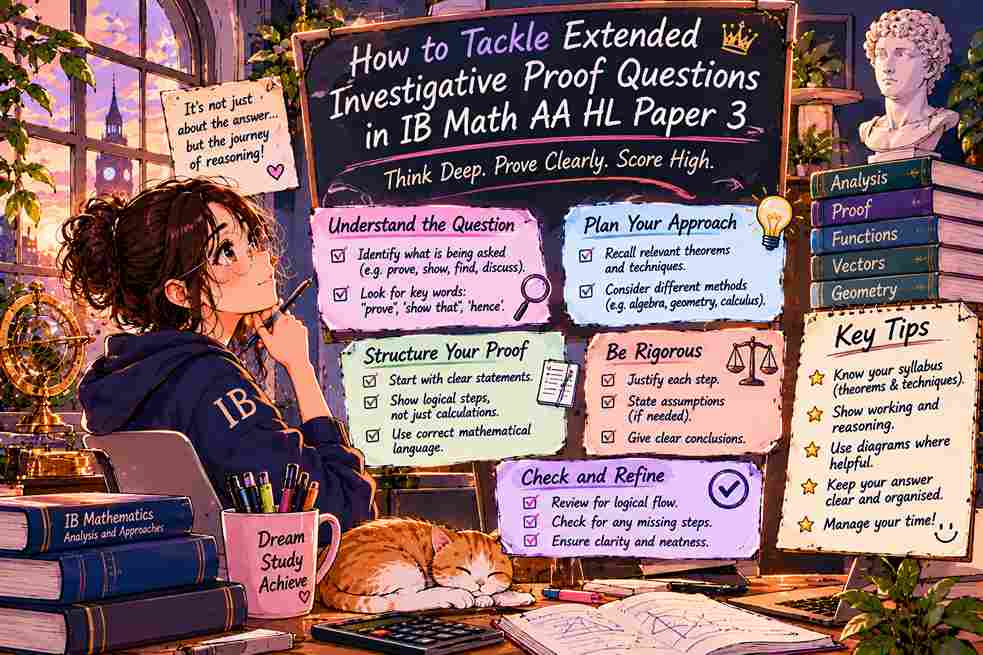
By EdFlik Team | November 19, 2026
For Diploma Programme students across Dubai, Abu Dhabi, Sharjah, and the Northern Emirates enrolled in IB Mathematics: Analysis and Approaches (AA) Higher Level, Paper 3 is widely regarded as the ultimate intellectual hurdle of the 16–18 curriculum.
Unlike Paper 1 (non-calculator) and Paper 2 (calculator), which consist of traditional Section A short-response and Section B extended-response items, IB Math AA HL Paper 3 features just two extended, compulsory investigative problem-solving questions to be completed within 1 hour and 15 minutes (75 minutes) for a total of 55 marks ($20\%$ of the final HL grade).
Each Paper 3 question is designed as a scaffolded mathematical journey. It starts with concrete numerical cases ($n = 1, 2, 3$), nudges candidates to spot algebraic or geometric patterns, guides them toward formulating a general conjecture, and culminates in a rigorous deductive proof—most commonly using Mathematical Induction, Proof by Contradiction, Contrapositive Proof, or Algebraic/Trigonometric Generalization.
Securing a Grade 7 in IB Math AA HL—a vital requirement for applicants targeting competitive Engineering, Computer Science, Physics, and Economics programs globally—requires mastering the architecture of Paper 3.
This masterclass guide breaks down the anatomy of IB Math AA HL Paper 3, explains how to decode scaffolding clues, outlines rigorous proof execution templates, walks through an exam-style investigative problem, exposes common mark-scheme traps, and includes 100% copy-paste JSON-LD schema markup.
Key Takeaways
- Paper 3 Is Scaffolded—Read Forward Before Writing: Every sub-part (
(a),(b),(c),(d)) is intentionally engineered to hand you the exact algebraic tool or identity required for the final proof. Never treat a Paper 3 sub-question in isolation. - Concrete Cases Reveal the General Structure: When stuck on part
(a)or(b), avoid simplifying fractions or expanding numbers too early (e.g., keep $1 + 2 + 3$ or $\frac{1}{2 \times 3}$ visible rather than writing $6$ or $\frac{1}{6}$) so the pattern jumps off the page. - "Hence" Means Mandatory Use of Previous Results: When an IB prompt uses the command word "Hence", you earn zero method marks if you prove the result via an alternative route without explicitly invoking the preceding sub-part.
- Rigorous Proof Phrasing Wins Communication Marks: In Mathematical Induction and Contradiction proofs, missing the formal base-case verification, inductive assumption phrasing ("Assume true for $n = k$"), or concluding statement routinely costs the final R1 (Reasoning) mark.
Part 1: Deconstructing the Anatomy of IB Math AA HL Paper 3
Understanding how IB examiners construct a 27- or 28-mark Paper 3 investigative question removes the intimidation factor immediately:
              ANATOMY OF AN IB MATH AA HL PAPER 3 QUESTION (27–28 MARKS)
                                         |
  +--------------------------------------+--------------------------------------+
  |                                      |                                      |
STAGE 1: EXPLORATION (Parts a–b)      STAGE 2: CONJECTURE (Part c)           STAGE 3: DEDUCTIVE PROOF (Parts d–e)
• Concrete numerical cases            • "Write down a general expression"    • "Prove your conjecture for all n ∈ ℤ+"
  (e.g., n = 1, 2, 3 or k = 2, 3).      or "Suggest a conjecture in terms     • Formal Mathematical Induction,
• Testing special cases using GDC.      of n."                                 Proof by Contradiction, or Direct
• Builds intuition & reveals structure.• Worth 2–4 marks (A1/A2).               Algebraic/Calculus Deduction.
Time Management Rule for 75 Minutes:
With 55 marks across 75 minutes, you have roughly 1.35 minutes per mark:
- First 5 Minutes: Read both Question 1 and Question 2 completely from start to finish. Identify which question aligns better with your strongest syllabus strand (e.g., Calculus/Differential Equations vs. Complex Numbers/Vectors/Sequences).
- 35 Minutes on Question 1 and 35 Minutes on Question 2: Set a strict mental checkpoint at the 37-minute mark so you never leave Question 2 half-attempted.
Part 2: Decoding IB Command Words in Paper 3
IB mark schemes enforce rigid distinctions between command terms. Misinterpreting a single verb changes how much working you must show:
| IB Command Word | Exact Mark-Scheme Requirement | Tactical Execution Tip |
| "Write down" | Obtain the answer directly from previous work or pattern recognition with little/no working. | Usually follows 2–3 concrete cases; inspect unsimplified terms for the pattern. |
| "Show that" | Obtain the required result (given in the question) using explicit algebraic steps. | Never work backward from the given answer; show every intermediate step clearly. |
| "Hence" | Use the preceding result directly to establish the next step. | Quote the equation from (a) or (b) explicitly in your first line of working. |
| "Hence, or otherwise" | Use the preceding result (usually the fastest route) OR any valid mathematical method. | Always check if the "Hence" path takes 3 lines before trying a 15-line brute-force method. |
| "Prove that" | Construct a formal, airtight deductive argument valid for all values in the domain. | Requires formal structure (e.g., Base Case $\to$ Inductive Hypothesis $\to$ Inductive Step $\to$ Conclusion). |
Part 3: Mastering the Big Three Proof Techniques in Paper 3
1. Proof by Mathematical Induction
Mathematical Induction is the single most common concluding proof technique in IB Math AA HL Paper 3—appearing across sequences/series, divisibility, matrix powers, De Moivre's Theorem, and $n$-th derivatives.
As illustrated in the process flowchart above, an airtight IB induction proof requires four non-negotiable stages:
- Base Case: Verify the statement $P(n)$ holds for the initial integer $n = n_0$ (usually $n = 1$, though occasionally $n = 0$ or $n = 2$—always check the domain stated in the prompt!). Show $\text{LHS} = \text{RHS}$ explicitly.
- Inductive Hypothesis: State clearly: "Assume $P(k)$ is true for some integer $k \ge n_0$", and write out the exact mathematical equation or divisibility statement for $n = k$.
- Inductive Step: Consider $n = k + 1$. Manipulate the $k + 1$ expression algebraically until you isolate the $P(k)$ expression, substitute your Inductive Hypothesis, and simplify to match the target form for $n = k + 1$.
Conclusion Statement (Mandatory for Final R1 Mark): Write the complete logical closing:
"Since $P(n_0)$ is true, and $P(k)$ being true implies $P(k+1)$ is true, by the principle of mathematical induction $P(n)$ is true for all integers $n \ge n_0$."
2. Proof by Contradiction
Used when proving irrationality (e.g., $\sqrt{3}$ or $\log_2 5$ is irrational), non-existence of integer solutions, or geometric/inequality bounds:
- Negate the Statement: Assume the exact opposite of what you want to prove is true (e.g., "Suppose, for the sake of contradiction, that $\log_2 3$ is rational...").
- Translate to Algebra: Express the assumption mathematically (e.g., $\log_2 3 = \frac{p}{q}$ where $p, q \in \mathbb{Z}^+$ have no common factors).
- Deduce a Logical Impossibility: Derive a direct contradiction (such as $2^p = 3^q$, where the LHS is always even and the RHS is always odd for $p, q \ge 1$).
- Conclude: State clearly that the assumption leads to a contradiction, therefore the original statement must be true.
3. Proof by Contrapositive
To prove an implication of the form "If $A$, then $B$" ($A \implies B$), prove its logically equivalent contrapositive: "If not $B$, then not $A$" ($\neg B \implies \neg A$). This is particularly effective when proving parity properties (e.g., "If $n^2$ is even, then $n$ is even").
Part 4: Full Exam-Style Investigative Worked Example
Problem: Consider the function $f(x) = x e^{2x}$.
(a) Find $f'(x)$ and $f''(x)$, leaving your answers in factored form. [4 marks]
(b) Hence, write down a conjecture for the $n$-th derivative $f^{(n)}(x)$, where $n \in \mathbb{Z}^+$. [2 marks]
(c) Prove your conjecture from part (b) using mathematical induction. [7 marks]
Step-by-Step Model Solution:
Part (a): Concrete Exploration ($n = 1, 2$)
Using the product rule $\frac{d}{dx}[u \cdot v] = u'v + uv'$ with $u = x$ and $v = e^{2x}$:
$$f'(x) = (1)e^{2x} + x(2e^{2x}) = e^{2x}(2x + 1)$$
Differentiating $f'(x) = (2x + 1)e^{2x}$ again using the product rule:
$$f''(x) = (2)e^{2x} + (2x + 1)(2e^{2x}) = e^{2x}(2 + 4x + 2) = e^{2x}(4x + 4)$$
(Strategic Tip: Notice the powers of $2$! Write $f'(x) = 2^0 e^{2x}(2x + 1)$ and $f''(x) = 2^1 e^{2x}(2x + 2)$ to spot the general pattern immediately!)
Part (b): Formulating the General Conjecture
Comparing $n = 1$ and $n = 2$:
- For $n = 1$: $f^{(1)}(x) = 2^{1-1} e^{2x}(2x + 1)$
- For $n = 2$: $f^{(2)}(x) = 2^{2-1} e^{2x}(2x + 2)$
Therefore, for any positive integer $n \in \mathbb{Z}^+$:
$$f^{(n)}(x) = 2^{n-1} e^{2x}(2x + n)$$
Part (c): Formal Proof by Mathematical Induction
1. Base Case ($n = 1$): From our conjecture when $n = 1$:
$$\text{RHS} = 2^{1-1} e^{2x}(2x + 1) = 2^0 e^{2x}(2x + 1) = e^{2x}(2x + 1)$$
From part (a), $\text{LHS} = f'(x) = e^{2x}(2x + 1)$. Since $\text{LHS} = \text{RHS}$, the statement $P(1)$ holds true.
2. Inductive Hypothesis: Assume $P(k)$ is true for some integer $k \ge 1$, so that:
$$f^{(k)}(x) = 2^{k-1} e^{2x}(2x + k)$$
3. Inductive Step ($n = k + 1$): We need to prove that $f^{(k+1)}(x) = 2^k e^{2x}(2x + k + 1)$. By definition, $f^{(k+1)}(x) = \frac{d}{dx}\left[f^{(k)}(x)\right]$. Substituting the inductive hypothesis:
$$f^{(k+1)}(x) = \frac{d}{dx}\left[2^{k-1} e^{2x}(2x + k)\right]$$
Factor out the constant $2^{k-1}$ and apply the product rule:
$$f^{(k+1)}(x) = 2^{k-1} \left[ 2e^{2x}(2x + k) + e^{2x}(2) \right]$$
Factor out $2e^{2x}$ from inside the bracket:
$$f^{(k+1)}(x) = 2^{k-1} \cdot 2e^{2x} \left[ (2x + k) + 1 \right]$$$$f^{(k+1)}(x) = 2^k e^{2x}(2x + k + 1)$$
This matches the target expression for $n = k + 1$.
4. Conclusion: Since $P(1)$ is true, and assuming $P(k)$ is true implies $P(k+1)$ is true, by the principle of mathematical induction $f^{(n)}(x) = 2^{n-1} e^{2x}(2x + n)$ is true for all integers $n \ge 1$.
Part 5: Top 4 Exam Traps That Cost AA HL Students Marks
- Simplifying Numbers Too Early in Parts (a) & (b): If part
(a)yields $\frac{1}{2} + \frac{1}{6} + \frac{1}{12}$, writing $\frac{3}{4}$ hides the telescoping pattern $\frac{1}{1 \times 2} + \frac{1}{2 \times 3} + \frac{1}{3 \times 4}$. Always keep structural patterns visible. - Writing "Assume true for all $k$" in Induction: Saying "Assume true for all $k$" assumes what you are trying to prove—a fatal logical fallacy penalized by IB examiners. Always write "Assume true for some integer $k \ge n_0$".
- Working Backward in "Show That" Prompts: Starting with the given target equation and manipulating both sides until you reach $0 = 0$ earns zero marks. Always start from the LHS (or given condition) and derive the RHS step by step.
- Neglecting the GDC for Rapid Conjecture Verification: Paper 3 allows full Graphical Display Calculator (GDC) access. Use your GDC's table, sequence, or numerical derivative/integral tools to verify that your algebraic conjecture matches numerical values for $n = 3$ and $n = 4$ in under 20 seconds.
For expert 1-on-1 online tutoring support to master IB Math AA HL Paper 3 investigative proofs, Internal Assessments (IA), and Grade 7 exam strategies across the UAE, book a class on EdFlik.
Frequently Asked Questions (FAQs)
Q1: How is IB Math AA HL Paper 3 graded, and what are the grade boundaries?
Ans: Paper 3 is marked out of 55 marks across two extended investigative questions (typically 27 and 28 marks each) and accounts for 20% of the overall HL grade. Historically, achieving 38–42 out of 55 places a candidate comfortably inside the Grade 7 boundary.
Q2: Can I use my Graphical Display Calculator (GDC) on IB Math AA HL Paper 3?
Ans: Yes. A GDC (such as the TI-Nspire CX II or Casio fx-CG50) is permitted and required for Paper 3. While final proofs must be strictly algebraic/deductive, your GDC is essential for generating numerical values in part (a), sketching unfamiliar functions, and verifying conjectures.
Q3: What topics appear most frequently in IB Math AA HL Paper 3?
Ans: Paper 3 problems frequently synthesize Calculus (differential equations, Maclaurin series, $n$-th derivatives, improper integrals), Sequences & Series (telescoping sums, recurrence relations), Complex Numbers (De Moivre's Theorem, roots of unity), and Algebraic Proof (mathematical induction, proof by contradiction).