How to Write 7-Mark Case Study Answers in Cambridge IGCSE Geography
Last Updated: October 2026 | By EdFlik Education Team
For high school students preparing for the Cambridge International GCSE (IGCSE) Geography (0460) examinations, Paper 2 and Paper 4 are packed with geographical skills, but it is Paper 1 (Geographical Themes) where your grade is ultimately decided. Among the various question types on Paper 1, the dreaded 7-mark case study question acts as the definitive grade differentiator between an $A^*$ and a lower grade boundary.
Every exam season, thousands of candidates lose marks on 7-mark questions not because they lack geographical knowledge, but because their answers lack specific regional detail, accurate statistics, and structured analytical depth. Writing a generic paragraph about earthquakes or river management will never score above Level 2 (3-4 marks). To hit Level 3 (6-7 marks), you need a rigorous, structured writing framework backed by precise case study facts.
In this comprehensive, exam-focused masterclass guide, our expert Cambridge IGCSE geography educators break down the CIE mark scheme, introduce our foolproof 4-Part PEEL/SEEP Framework, and provide a complete model answer breakdown to help you secure full marks.
Part 1: Deconstructing the Cambridge IGCSE 7-Mark Mark Scheme
Before writing a single word, you must understand how Cambridge examiners allocate marks for extended response case studies. CIE uses a levels-based mark scheme centered around two core assessment criteria:
                      7-MARK CASE STUDY MARK ALLOCATION
                                     |
        +----------------------------+----------------------------+
        |                                                         |
LEVEL 1 (1-2 Marks): Generic Statements                        LEVEL 2 (3-4 Marks): Developed Points
• Broad, generalized statements                              • Explanations with basic development
• Lacks specific location knowledge                          • Contains minimal case study statistics
• Could apply to almost any country                          • Meets basic developmental criteria
        |
        +----------------------------+
                                     |
                      LEVEL 3 (5-7 Marks): Detailed Case Study
                      • Rich, specific location details and named examples
                      • Precise, accurate statistics (dates, magnitudes, costs, populations)
                      • Highly developed, well-reasoned geographical explanations
The Key Takeaway:
To achieve Level 3 (5–7 marks), your answer must be anchored to a specific, named case study (e.g., the 2011 Christchurch earthquake in New Zealand rather than just "an earthquake in a developed country"), and it must feature precise quantitative data and statistics.
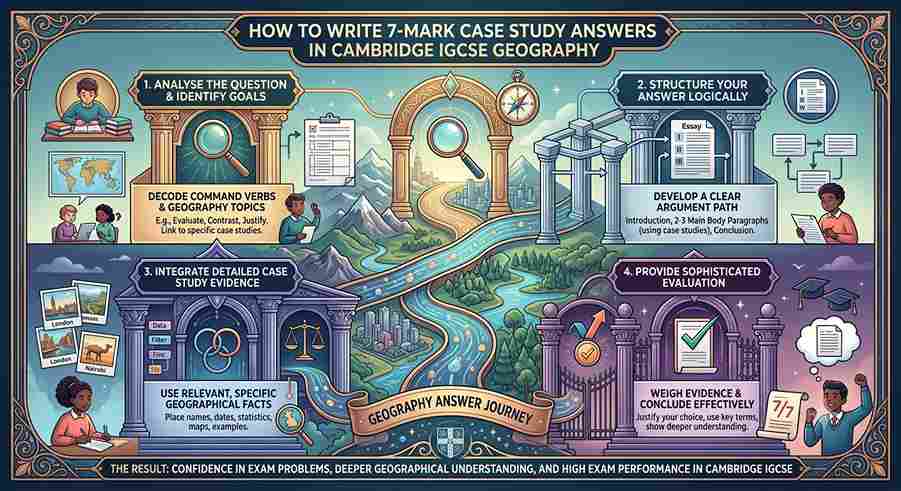
Part 2: The 4-Part SEEP/PEEL Framework for 7 Marks
To consistently hit Level 3 criteria in under 10 minutes of exam writing time, structure your 7-mark case study around the SEEP + PEEL Framework:
                  THE 4-PART SEEP/PEEL WRITING STRUCTURE
                                    |
        +---------------------------+---------------------------+
        |                           |                           |
  1. LOCATION & CONTEXT      2. QUANTITATIVE STATS       3. DEVELOPED REASONING      4. CAUSE & EFFECT
  Name specific places,      Integrate exact dates,      Explain the 'why' and       Connect physical or
  cities, or regions.        costs, and death tolls.     'how' using geography.      human impacts clearly.
1. Named Location & Context (The Anchor)
- State your specific case study immediately in the opening sentence.
- Example: "A volcanic eruption I have studied is the eruption of Mount Merapi in Java, Indonesia, in October and November 2010."
2. Quantitative Facts & Statistics (The Evidence)
- Incorporate at least three precise numerical facts (e.g., population displacement figures, Richter scale magnitudes, economic costs in billions of dollars, or date ranges).
- Example: "The eruption displaced over 350,000 people, resulted in 353 fatalities, and caused economic losses exceeding $600 million."
3. Developed Geographical Reasoning (The Explanation)
- Do not just list facts; explain the physical and human processes behind them. Use geographical terminology specific to the topic (e.g., pyroclastic flows, lahar mudflows, subduction zones, GDP per capita, population density).
4. Balanced Impacts or Management Strategies (The Conclusion)
- Ensure you answer both parts of the prompt. If the question asks for causes and impacts, divide your time equally between both elements.
Part 3: Model Answer Breakdown (Earthquake Case Study)
Let’s examine how this framework applies to a classic IGCSE Paper 1 question:
"Describe the impacts of an earthquake in a developed or developing country you have studied." (7 marks)
Model Response (Level 3 - 7/7 Marks):
"An earthquake I have studied is the Christchurch earthquake in New Zealand, which struck on 22 February 2011 at a magnitude of 6.3 on the Richter scale.
Regarding primary impacts, the shallow focus of the earthquake directly beneath Lyttelton caused widespread destruction of infrastructure. 185 people were killed, and historic landmarks such as the Christchurch Cathedral suffered catastrophic collapses. Unreinforced masonry buildings crumbled under violent ground shaking, trapping citizens in the central business district.
Secondary impacts were equally severe. The violent shaking triggered soil liquefaction in eastern suburbs like Bexley, forcing wet silt up through roads and rendering thousands of residential homes structurally uninhabitable. Over 10,000 houses had to be demolished. Furthermore, water and sewage mains ruptured, cutting off fresh water supplies to 80% of the city and creating severe public health concerns.
Economically, the disaster cost New Zealand an estimated $40 billion NZD in insurance claims and structural reconstruction, causing a temporary contraction in national GDP and devastating the local tourism industry as international flights were canceled."
Why This Scores 7/7:
- Named Case Study: Explicitly names Christchurch, New Zealand, and the exact date.
- Precise Statistics: Includes magnitudes, fatality numbers, damaged home counts, and economic costs.
- Geographical Terminology: Integrates advanced IGCSE terms like shallow focus, soil liquefaction, masonry collapse, and GDP contraction.
- Balanced Coverage: Covers primary impacts, secondary impacts, and economic consequences comprehensively.
Part 4: Top 4 Traps That Cost Students Marks in IGCSE Geography
- Using Vague Place Names: Writing "an earthquake in a rich country" instead of naming Christchurch, New Zealand, or "a LEDC flood" instead of Bangladesh (2004 or 2007 floods). Examiners cannot award Level 3 marks without a specific named location.
- Memorizing Facts Without Statistics: Writing long paragraphs describing what happened without including a single number, date, or financial figure. Numbers validate your case study knowledge.
- Answering the Wrong Question Focus: Forgetting to address both causes and impacts if the question demands both, or focusing entirely on management when the prompt asks for impacts. Always underline command words in the exam paper!
- Running Out of Time on Paper 1: Spending 20 minutes writing a 2-page essay for a 7-mark question, leaving insufficient time for subsequent questions. A 7-mark answer should take approximately 8 to 10 minutes to write.
Preparing for Cambridge IGCSE Geography exams and aiming for an $A^$ grade? EdFlik connects international school students globally with expert, 1-to-1 online IGCSE tutors, helping you master case study memorization, map-reading skills, paper-specific exam techniques, and past-paper mark scheme strategies.*Book a Free Demo Class Today!
Frequently Asked Questions (FAQs)
Q1: How many case studies do I need to memorize for Cambridge IGCSE Geography?
Ans: You should prepare at least two detailed, contrasting case studies (one in a developing/LIC/MIC country and one in a developed/HIC country) for every major Paper 1 topic: Earthquakes/Volcanoes, Rivers, Coasts, Population, Settlement, Economic Development, and Tourism/Energy.
Q2: Should I draw a sketch map or diagram in a 7-mark case study answer?
Ans: While sketch maps and labeled diagrams are not mandatory, adding a quick, annotated sketch (e.g., a cross-section of a destructive plate boundary or a coastal management groyne system) can earn credit and help illustrate complex geographical processes if time permits.
Q3: How long should a 7-mark geography answer be?
Ans: An ideal 7-mark answer is typically three to four well-structured paragraphs (roughly 150 to 250 words), focusing heavily on precise statistics, geographical terminology, and developed explanations.
Q4: How does EdFlik support Cambridge IGCSE Geography students?
Ans: EdFlik connects international school students worldwide with vetted, expert 1-to-1 online tutors specializing in Cambridge IGCSE Geography (0460). Our personalized coaching focuses on structuring 7-mark case study answers, mastering topographical map-reading skills, and practicing under timed exam conditions.